






Your air conditioner needs repair when it runs but blows warm air, moves weak airflow, short cycles, ices up, leaks, makes new noises or smells like burning. Burning, ice, a repeat breaker trip and active leaks mean shut it off first. James Heating answers AC calls around the clock. Dial (541) 461-2101 in Eugene or (503) 581-9982 in Salem.
What are the signs my air conditioner needs repair?
Nine signs say your air conditioner needs repair, and the table pairs each with its usual cause, urgency, first check and cost.
| Sign | Likely cause | Urgency | Check first | Typical repair cost |
|---|---|---|---|---|
| Running but warm air | Dirty condenser coil, failed capacitor, refrigerant leak, compressor | This week | Thermostat on Cool, filter, outdoor fan spinning | Capacitor $100 to $400; leak $200 to $1,500 |
| Weak airflow, uneven rooms | Clogged filter, failing blower motor, leaky ducts | This week | Filter, vents open | Blower motor $200 to $900; ducts $200 to $2,100 |
| Ice on lines or coil | Restricted airflow or low charge | Today | Thermostat Off, fan On to thaw | Depends on the cause found |
| Water at the indoor unit | Clogged condensate drain, cracked drain pan | Today | Switch cooling off | Drain cleaning $75 to $250 |
| Burning smell, repeat breaker trip | Failed capacitor, burnt contactor, seized motor, wiring | Now | Nothing. Power off | Contactor $100 to $450 |
| Grinding, screeching, banging | Fan motor, bearings, compressor | Shut off, call | Nothing. Power off | Fan motor $300 to $800; compressor $600 to $3,000 |
| Short cycling | Thermostat, low charge, oversized unit, dirty coil | This week | Filter, thermostat | Thermostat $150 to $500 |
| Bill climbing, weather unchanged | Dirty coils, low airflow, aging equipment | This month | Compare to last year’s same month | Depends on the cause found |
| Unit past 10 years, repairs piling up | Wear across parts | Plan ahead | Note repair history | See repair-or-replace section |
Cost ranges are national guides from Fixr and This Old House, not James prices. The national average for one AC repair is $375, typically $250 to $700 (Fixr). James Heating quotes a firm price after a technician inspects your system. The technician checks the sign against the part before touching it. Most failures announce themselves weeks ahead, so which part is each sign pointing at?
Where in my air conditioner does each warning sign come from?
Each warning sign traces to one of seven places: the outdoor fan, capacitor, condenser coil, compressor, indoor coil, drain or ducts.
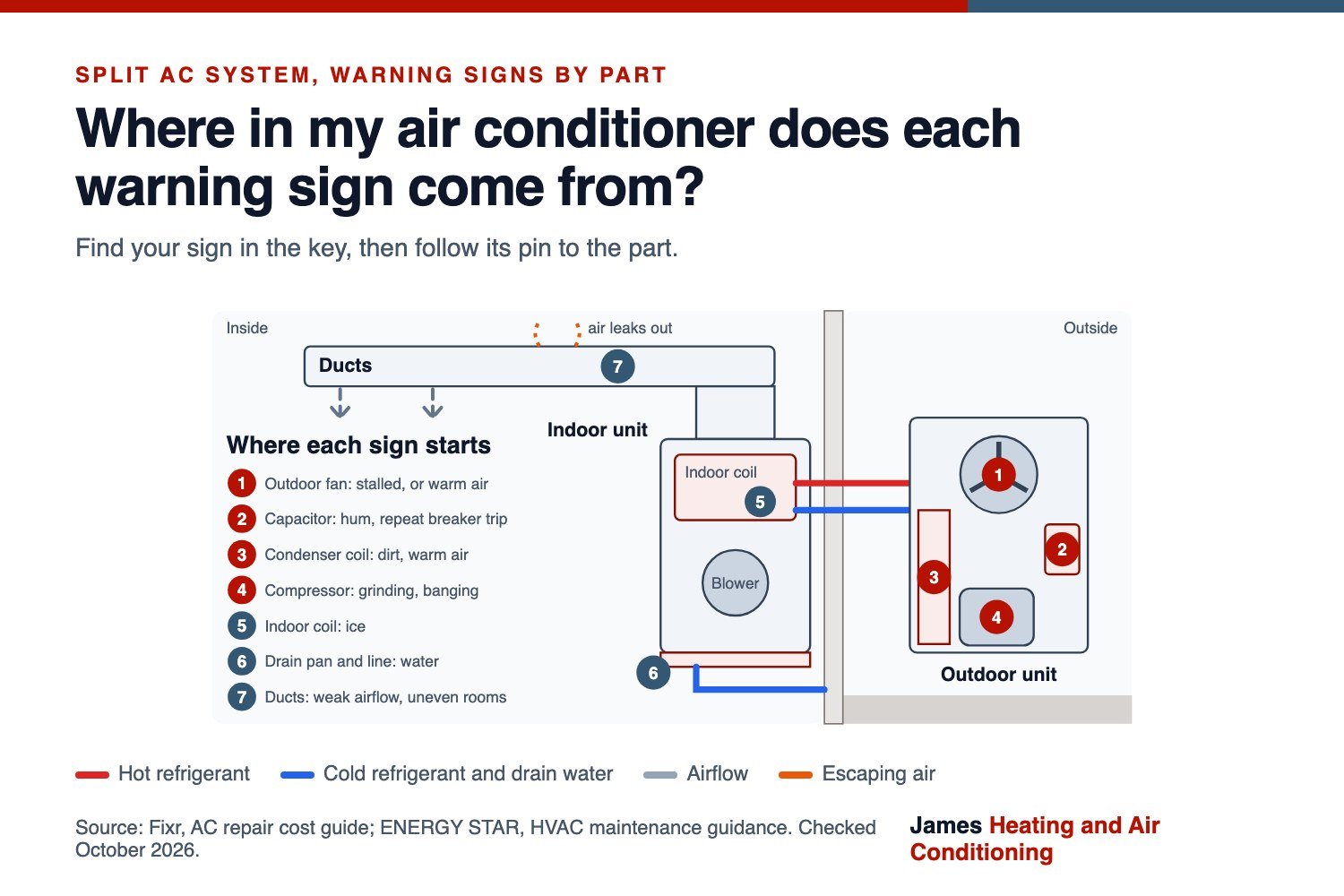
Four of the seven sit in the outdoor unit. That’s where heat leaves your house. The indoor coil, drain pan and ducts sit inside, where air gets cooled and delivered. We start every cooling call at the part the sign points to. Our technicians test that part first, then the parts around it. A failed capacitor can look like a dead compressor from the thermostat, so we test the cheap part before we quote the expensive one. Two of these signs need your hands off the equipment entirely, and our technicians inspect both only with the power off. So which ones?
Which AC warning signs mean I should shut it off right now?
Burning smells, a breaker that trips twice, grinding, screeching, banging, ice and active water all mean switch cooling off before you call.
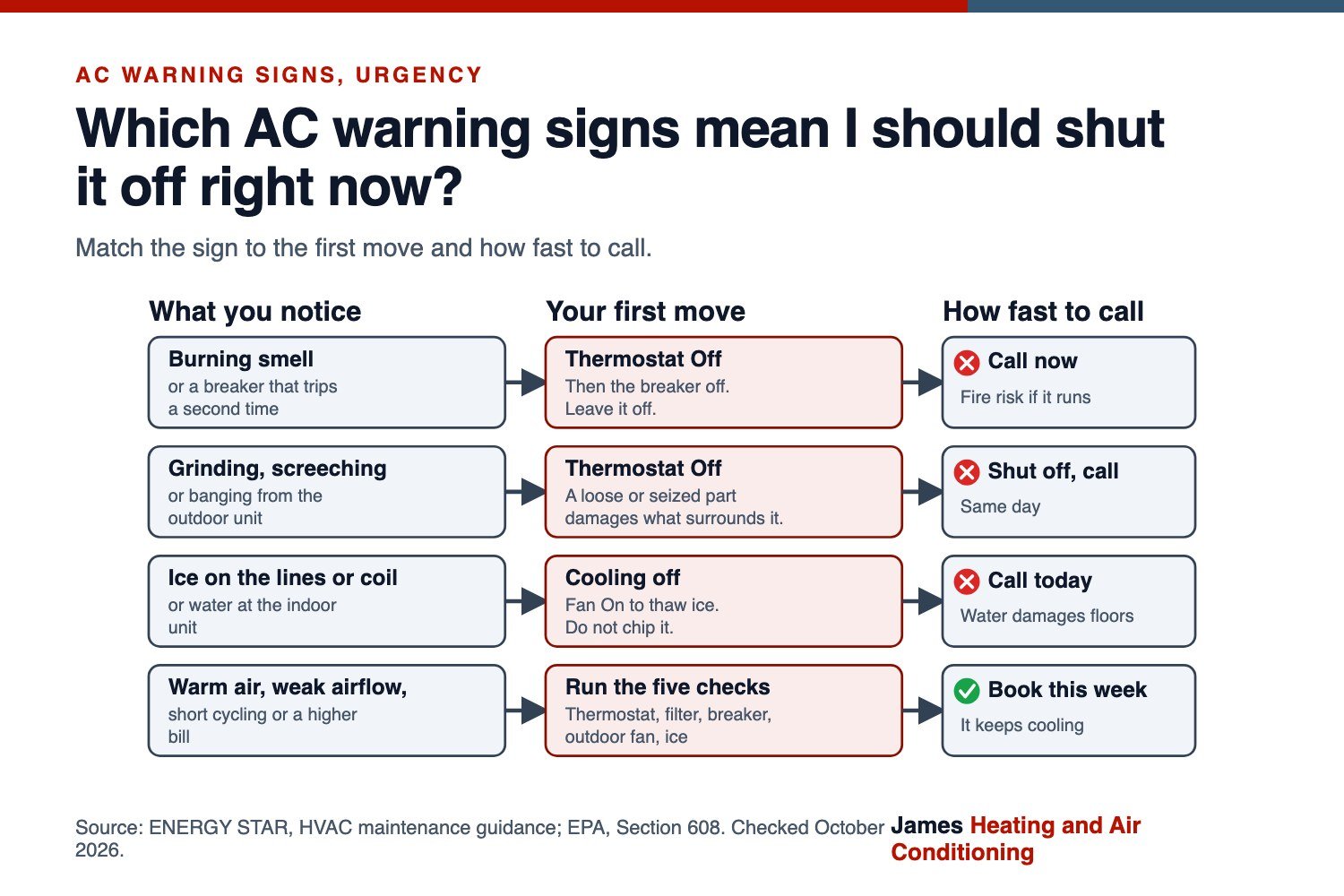
A burning smell is electrical until proven otherwise. Act fast. Set the thermostat to Off, then switch off the AC breaker and leave it off. Our technicians test the circuit before they restore power. A failed capacitor, burnt contactor or seized motor can cook wire insulation. Running the unit to see if the smell clears is how a repair becomes a fire. Our technicians inspect the breaker, disconnect and wiring before the unit runs again.
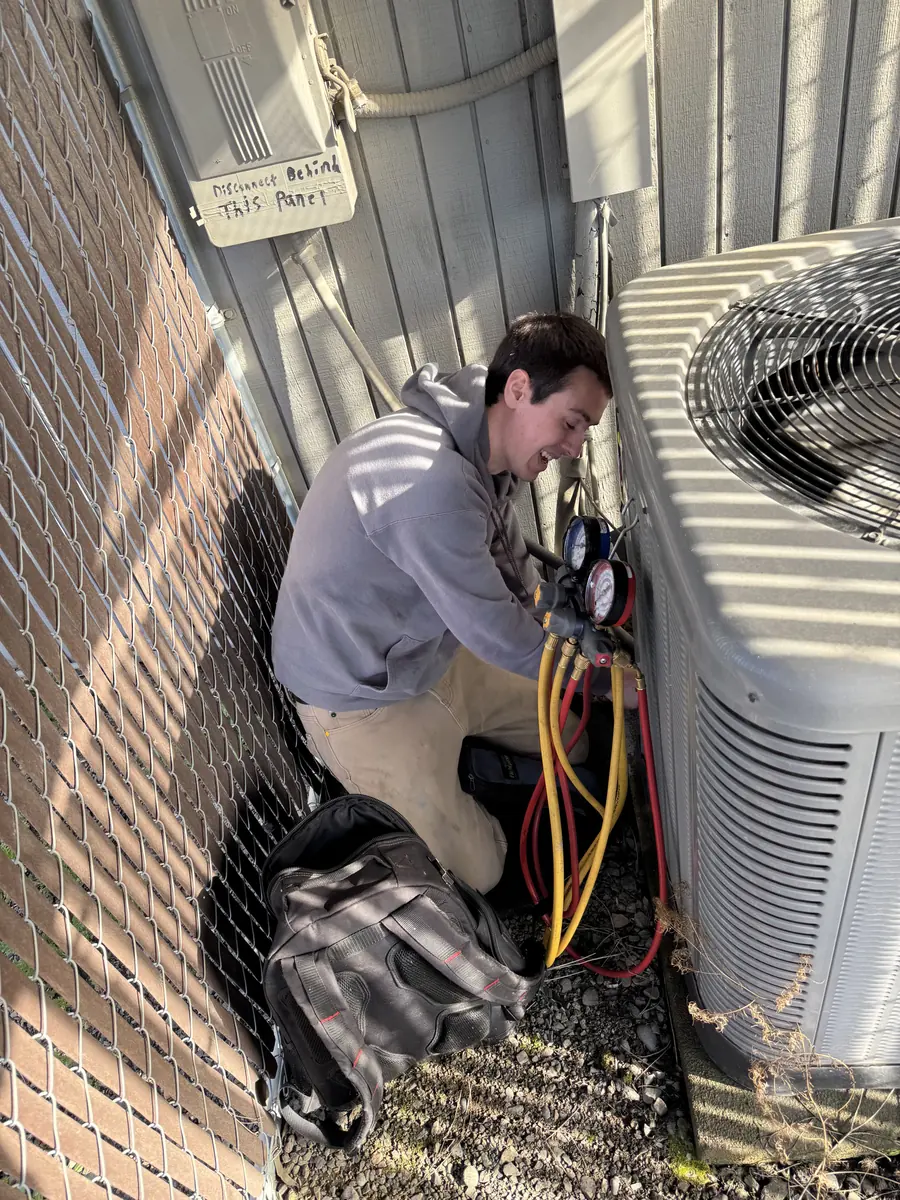
We reset a tripped breaker once. You can too. If it trips again, the fault is real, so don’t hold it on. Ice, or water near electrical equipment, gets the same response, with cooling off and then a call to us. We answer these calls day or night, because a loose or seized part damages everything around it. The signs that aren’t urgent still cost money, and the most common one is lukewarm air.
Why is my AC running but blowing warm air?
Your AC runs but blows warm air when the outdoor unit can’t shed heat, and the usual suspects are a packed coil, a weak capacitor or a refrigerant leak.
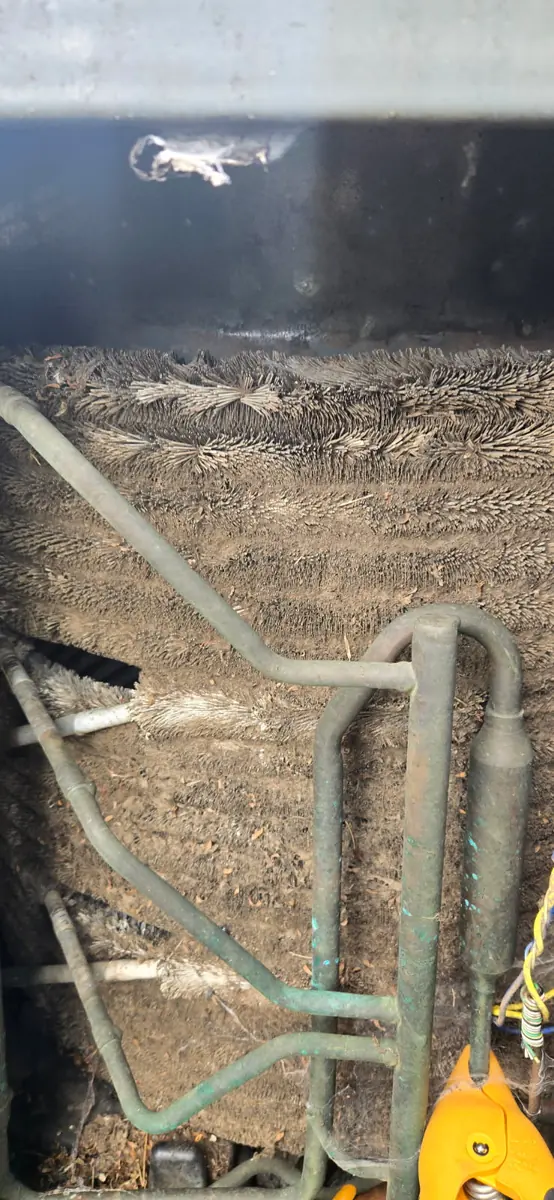
A packed condenser coil can’t release heat to the outside air, and we clean it before we blame the charge. We test the temperature split across the indoor coil to see how much cooling you’re really getting. A weak capacitor leaves the fan or compressor humming without starting, and a capacitor swap is one of the cheaper fixes on the table. Low refrigerant is the cause people name most, but refrigerant runs in a sealed loop and isn’t consumed, so low charge means a leak. The EPA requires Section 608 certification to handle refrigerant. Our technicians find the leak before they add any. We inspect the lines, coils and fittings for the leak. Topping off without a leak search is only a patch. The posts on why an AC blows warm air and low refrigerant symptoms go deeper. If the air is cool but thin, the problem moves indoors. We check the filter there first.
Why is the airflow weak or uneven in some rooms?
Weak or uneven airflow usually traces to a clogged filter, a failing blower motor or leaky ducts, and the filter is the cheapest place to start.
ENERGY STAR rates a monthly filter check as the baseline and says to change the filter at least every three months. If your filter is clean, we test the blower motor and then inspect the ducts. ENERGY STAR covers duct leakage in a dedicated flyer, and the figure above comes from it. In typical homes, about 20 to 30 percent of the air moving through the duct system is lost to leaks, so a room that never cools can be a duct problem rather than an equipment one. The posts on weak airflow from vents and uneven cooling in a house cover both. Airflow problems are quiet. Easy to miss. The noisy ones come next, and they are rarely subtle.
What do the noises from my AC mean?
A hum with no fan movement points at the capacitor, a click then silence points at the contactor, and grinding or banging points at the fan motor or compressor.
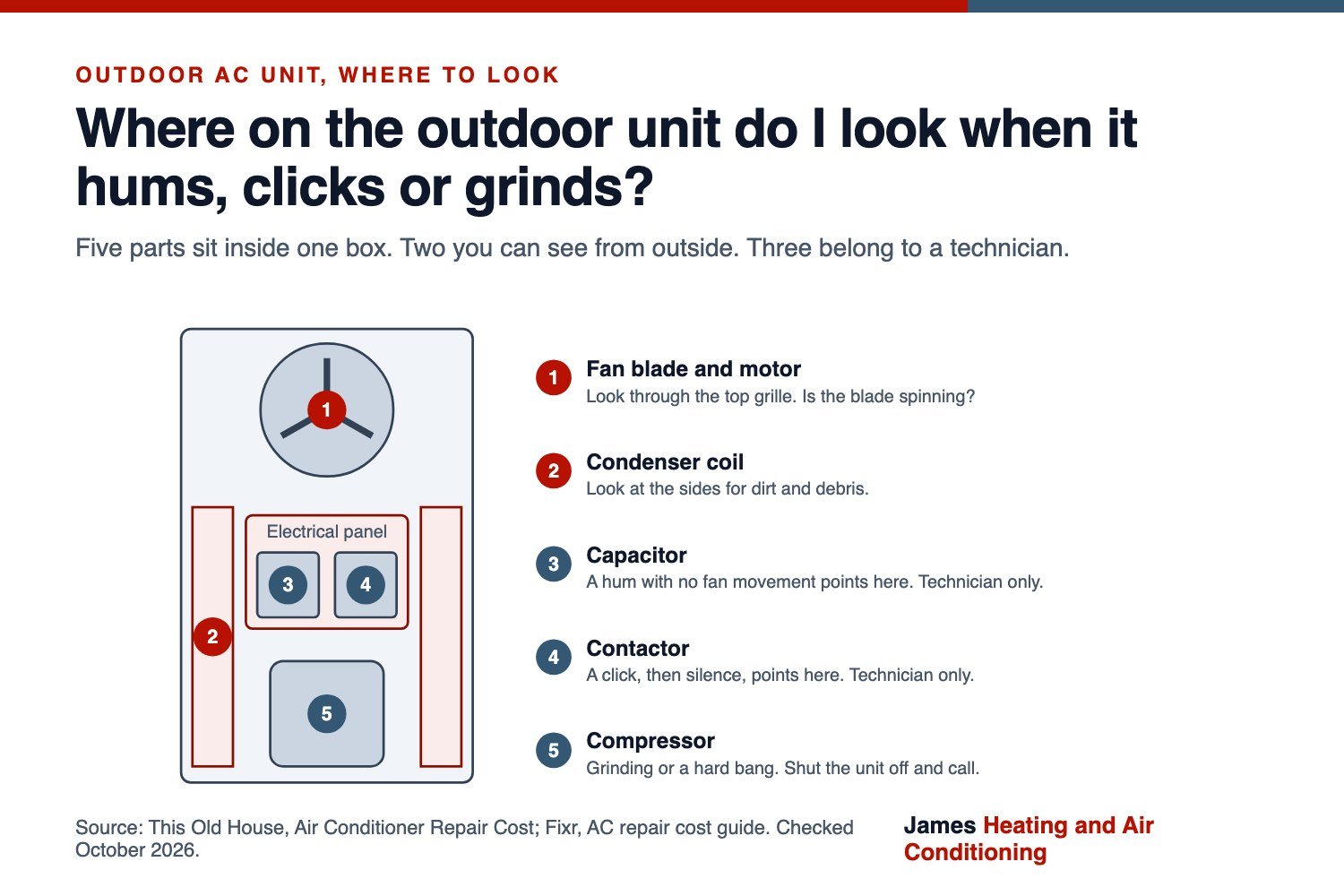
You can look through the top grille to see whether the fan blade spins, and at the sides of the unit for dirt on the coil. The capacitor and contactor sit behind the electrical panel, and our technicians open that panel only after the power is off. We test the capacitor and contactor there, and we check the fan motor beside them. Screeching or grinding means a fan motor or bearing, and it’s rarely minor. A hard bang may be the compressor. Shut the unit off for any of these, because a loose or seized part damages what surrounds it. The post on AC making loud noises maps each sound in detail. A unit that makes no noise at all can still be failing by starting and stopping.
Why does my AC keep turning on and off?
Your AC keeps turning on and off when something shuts it down early, such as a failing thermostat, low charge, a dirty coil or equipment too large for the house.
Short cycling punishes the compressor. Starting is the hardest thing it does, and a unit that starts every few minutes never gets a rest. An oversized unit shuts off before it pulls moisture out of the air, so the house feels clammy even in a dry Willamette Valley summer. We check the thermostat and filter first, then our technicians test the coil and charge. We inspect the equipment size against the house. A Manual J load calculation settles sizing. We run one before we recommend a replacement. Water and ice come next. A struggling system leaves both behind.
Why is there ice or water on my AC?
Ice on your AC means the coil got too cold, usually from restricted airflow or low charge, and water means a clogged condensate drain or a cracked pan.
Thaw ice with the thermostat Off and the fan On. Don’t chip it. For water, switch cooling off so the system stops making condensate, then call us. We clear the drain line and inspect the pan on every water call, and we test airflow and charge on every ice call. The posts on a frozen evaporator coil and an AC leaking water walk through each. Not every sign shows up on the equipment, so the next place to look is your utility account.
Is a higher electric bill a sign my AC needs repair?
A higher electric bill is a sign when the weather stayed the same, because a struggling system runs longer to deliver the same cooling.
EWEB serves Eugene and SUB serves Springfield, so pull the same month from last year on your EWEB, SUB, Pacific Power or Salem Electric account. We check the unit against the bill. Similar weather and a higher bill means a dirty coil, weak airflow or aging equipment is working harder for the same result. We clean the coil and inspect the filter first, because those cost the least to fix. When bills climb every summer, ask how old the unit is. The data plate shows the year.
How do I know whether to repair or replace my AC?
Repair your AC when one part failed, and replace it when the repair costs more than half of a new system.
The U.S. Department of Energy’s Building America guide sets that half-the-cost line for central AC. ENERGY STAR adds that equipment over 10 years old should be evaluated by a professional if it is not performing well. A $100 to $400 capacitor on an old unit is still reasonable. A $600 to $3,000 compressor on a unit that already needs repairs belongs beside a replacement quote. We quote both, so you can hold them against the half-the-cost line, and we run that math with you. We also size any replacement with a Manual J calculation. New equipment since 2025 uses A2L refrigerants (R-454B or R-32), and the federal 25C tax credit ended December 31, 2025. The post on how long an AC should last covers lifespan. Before you call for either one, there are five checks worth two minutes.
What can I check before I call for AC repair?
Check five things before you call: thermostat on Cool, filter clean, breaker on, outdoor fan spinning and no ice.
James Heating technicians run the same five checks first on every cooling call. Two minutes covers all five. If your unit still won’t cool, the cause sits inside the equipment, and we diagnose it from there. If it won’t start at all, the post on an AC that won’t turn on covers that case. So what happens when you do call?
What happens during an AC repair visit?
A repair visit starts with a technician testing the electrical parts, airflow and refrigerant pressures to find the actual failure before quoting. We test the capacitor, contactor and fan motor, and our technicians check airflow and charge.
Fixr puts the national service call fee at $75 to $200, often waived or applied to the repair, so ask us when you book. We explain the failure and the repair options before any work starts. The HVAC diagnostics and repair page lists what we test. We service Ruud and Rheem air conditioners. A yearly AC tune-up catches the dirty coil and weak capacitor before they become a breakdown, and ENERGY STAR covers yearly maintenance in its guidance.
Frequently asked questions
Is it normal for an AC to run all day?
On the hottest afternoons, yes. In mild weather it points to a dirty coil, low charge or leaky ducts. We check those in that order.
Is a burning smell from my AC dangerous?
Yes. A burning smell is electrical until proven otherwise, so switch the thermostat and breaker off and call us. We inspect the capacitor, contactor and wiring before the unit runs again.
Should I turn off my AC if it is leaking water?
Yes. Switch cooling off so it stops making condensate, then call us. We clear the drain and inspect the pan.
Does James Heating repair air conditioners on weekends?
Yes. We take calls 24 hours a day, every day.
What are the signs of trouble on a heat pump in winter?
Heavy ice on the outdoor unit that doesn’t clear after a defrost cycle, or a unit that runs without warming the house, means call us. We test the defrost cycle and the reversing valve.
Call James Heating and Air Conditioning when a sign shows up
Oregon requires a contractor license, and ours is CCB #47396. We have served Eugene and Salem since 1983, and we handle Springfield, Keizer and the surrounding counties from Eugene and Salem. If you’re in Eugene, Springfield or Lane County, dial (541) 461-2101. If you’re in Salem, Keizer or Marion County, dial (503) 581-9982. Book AC repair, or check whether it’s an AC emergency that can’t wait.