






Weak airflow from vents in a house comes from a clogged or too-dense filter, blocked returns, leaking or crushed ducts, an iced coil or a tired blower. One weak room points at its own duct run, and every weak room points at the filter, coil or blower. No air at all means check power first.
Want a technician now? We answer around the clock. Call (541) 461-2101 in Eugene, Springfield and Lane County, or (503) 581-9982 in Salem, Keizer and Marion County.
What causes weak airflow from vents?
Weak airflow from vents comes from a restriction at one of six stops on the air’s loop: the return grille, filter, blower, evaporator coil, supply duct or register.
Your blower pulls room air in through the return grille and filter, pushes it across the evaporator coil and sends it down the supply ducts to each register. A restriction at any stop weakens what reaches your room. We check those stops in order, from the grille to the register, because one blocked stop can hide the others. Our technicians diagnose the loop as a whole.
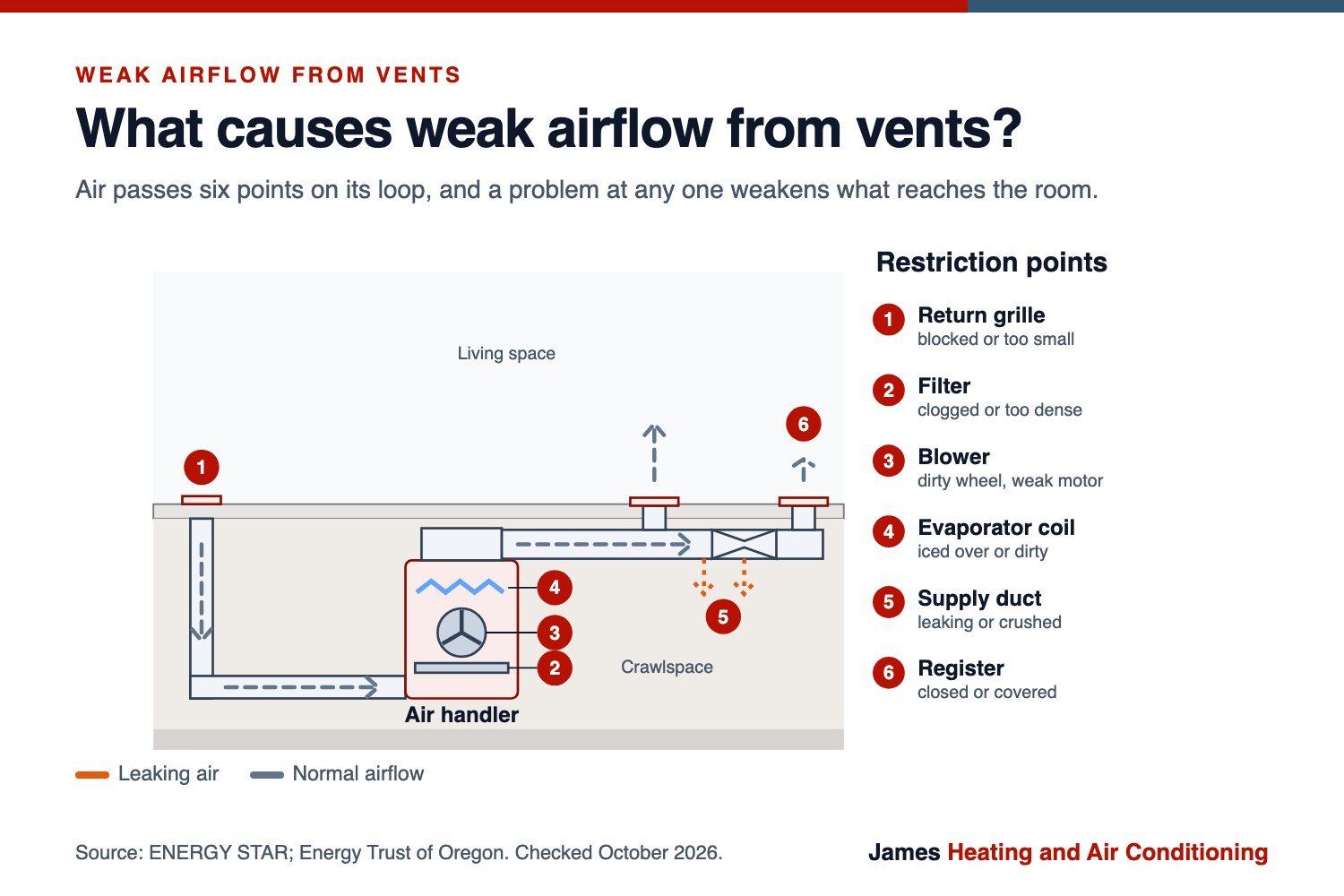
Where you feel the weakness tells you which stop to chase, so sort the symptom first.
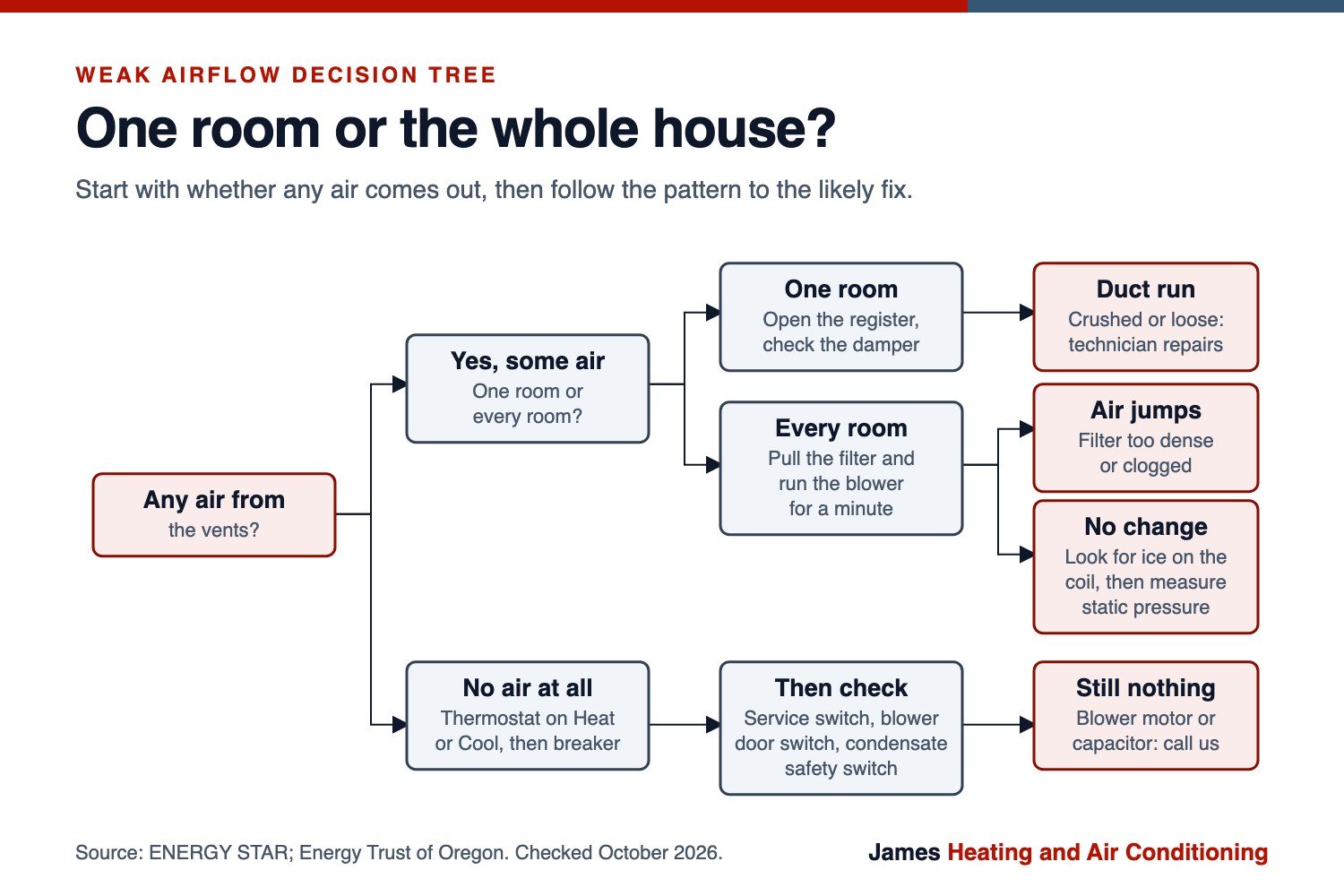
Is the weak airflow in one room or the whole house?
One weak room points at that room’s own duct run or register, and every weak room points at the filter, coil or blower. We ask which rooms are weak, and whether the drop came suddenly or slowly, at the start of every call. Our technicians check that pattern before they touch a part. We diagnose a one-room problem at the duct and an every-room problem at the blower.
| What you notice | Likely cause | DIY check | Who fixes it |
|---|---|---|---|
| One room weak, the rest fine | Crushed, loose or closed duct run to that room | Open the register and look for a damper | Technician, if the duct is in a crawlspace or attic |
| Every vent weak, getting worse slowly | Clogged filter, dirty coil or dirty blower wheel | Check the filter | Technician for coil and blower cleaning |
| Weaker right after a new filter | Filter too restrictive for the blower | Run the filter-out test below | Technician advises which filter fits |
| Weak and warm air, ice on the indoor coil or lines outside | Frozen coil | Switch off and thaw | Call if it returns |
| Whistling in walls, stuffy rooms, high bills | Duct leaks | Look at accessible duct joints | Technician seals the leaks |
| Sudden drop, humming blower | Failing blower motor or capacitor | Nothing; keep panels closed | Technician |
| No air at all | Power, safety switch or dead blower | Thermostat and breaker | Technician if they check out |
Take the row that fits your house, then run the five-minute check to confirm it.
What can I check in five minutes?
You can check five things in five minutes without tools: the air at one register, the filter, every register and return, the coil for ice and any duct you can see.
- Hold your hand over a register with the system running. Confirm there’s air, and note which rooms are weak.
- Pull the filter and run the blower for a minute or two. If airflow jumps, the filter or the filter type is the problem. Put a clean filter back right away, because running without one lets dirt coat the coil.
- Open every register and clear every return grille. Furniture and rugs count.
- Look for ice on the indoor coil or on the lines at the outdoor unit. If you see any, switch the system off and follow our thaw steps for a frozen evaporator coil.
- Check any duct you can see for a crushed, kinked or disconnected run.
Setting your thermostat fan to On keeps the blower running for the test. Auto versus On changes when the blower runs, not how hard it pushes, so it confirms the blower works and does not cause weak air. We run these same five checks at the start of a call, so what you find helps us when you phone. On arrival we check the filter and the coil again, and we test the airflow at the register.
Can a dirty or high-MERV filter cause weak airflow?
Yes, a clogged filter and a filter that’s too dense both starve the blower of air, and that weakens every vent in the house.
Energy Trust of Oregon’s 2015 technical tip on HVAC filters states the rule: the higher the MERV rating, the more airflow resistance, and the less air the fan moves. Unless the whole system is designed for it, the tip recommends filters with a pressure drop under 0.10 IWC, and it notes that many hardware store filters exceed 0.2 IWC.
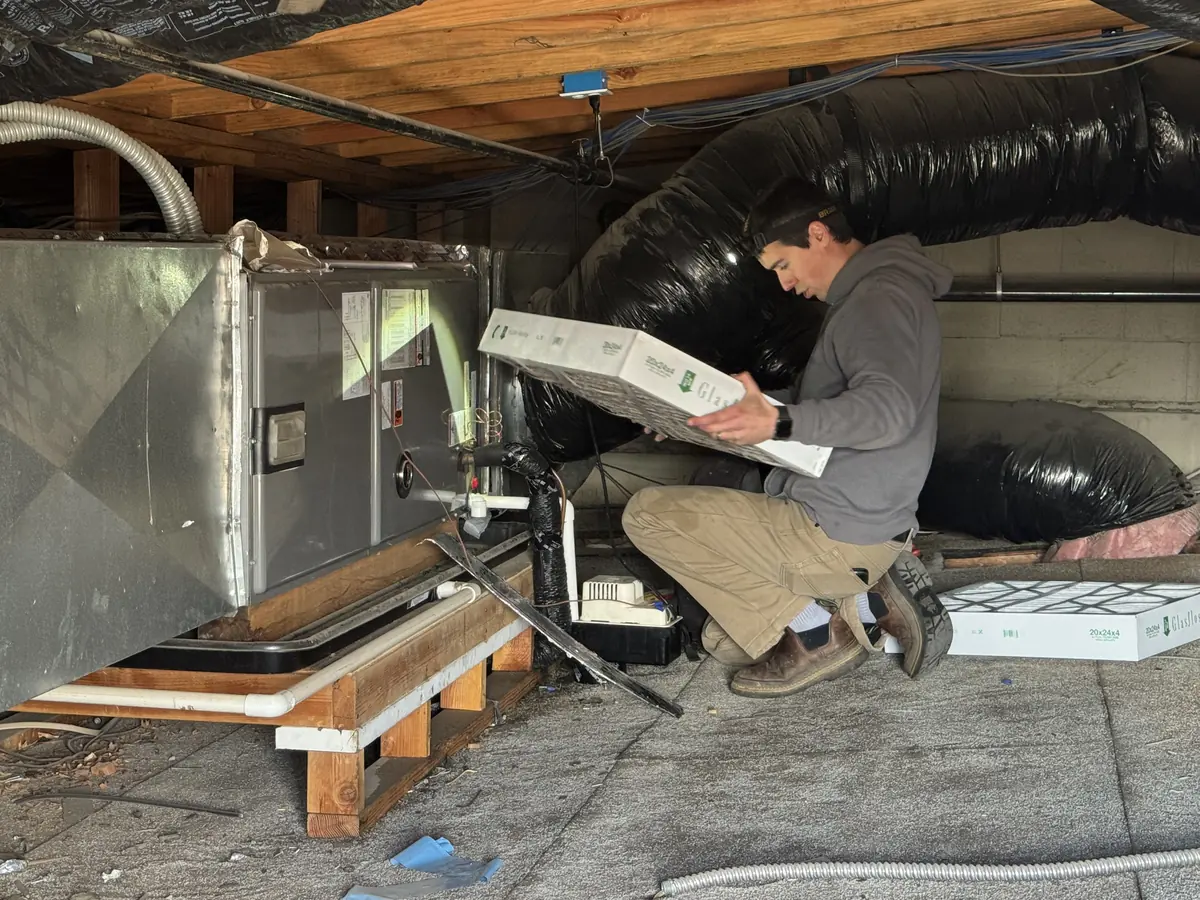
If airflow dropped right after you bought a thicker or higher-MERV filter, you’ve found the cause. We pull the filter, rerun the blower and tell you which filter your blower can pull through. Our technicians size the filter to the return and the blower, and a one-inch filter behind a small return grille can be a mismatch. We replace a mismatched filter with one the blower can pull, and we test the airflow again.
Change the filter on schedule. ENERGY STAR says to inspect, clean or change it once a month, and how often to change the filter shifts with pets, dust and smoke. After a wildfire smoke event, look sooner.
Does closing vents or blocking a return hurt airflow?
Yes, closing registers in unused rooms and blocking returns raises the pressure your blower pushes against and weakens airflow. Open them back up.
Closing a register doesn’t send that air to another room. The blower meets more resistance and your leaks leak harder. Leave registers open. We clean a register or grille that dust has choked.
Returns matter as much as supply vents, since a blower can’t push out air it can’t pull in. We check every return grille for a sofa against it or a size too small for the system, and we inspect each manual damper in a trunk line. A damper handle running parallel to the duct is open, and crosswise is closed. If every register and return is clear and one room is still weak, the duct itself comes next.
Why do leaky or crushed ducts leave one room weak?
Leaky or crushed ducts waste air before it reaches the register, so the farthest room gets only what the leaks leave. That room feels it first.
ENERGY STAR says about 20 to 30 percent of the air moving through a typical duct system is lost to leaks, holes and poorly connected ducts. Its warning signs include rooms that are hard to heat or cool, stuffy rooms, high utility bills, ducts in an attic, crawlspace or garage, and kinked flex duct.
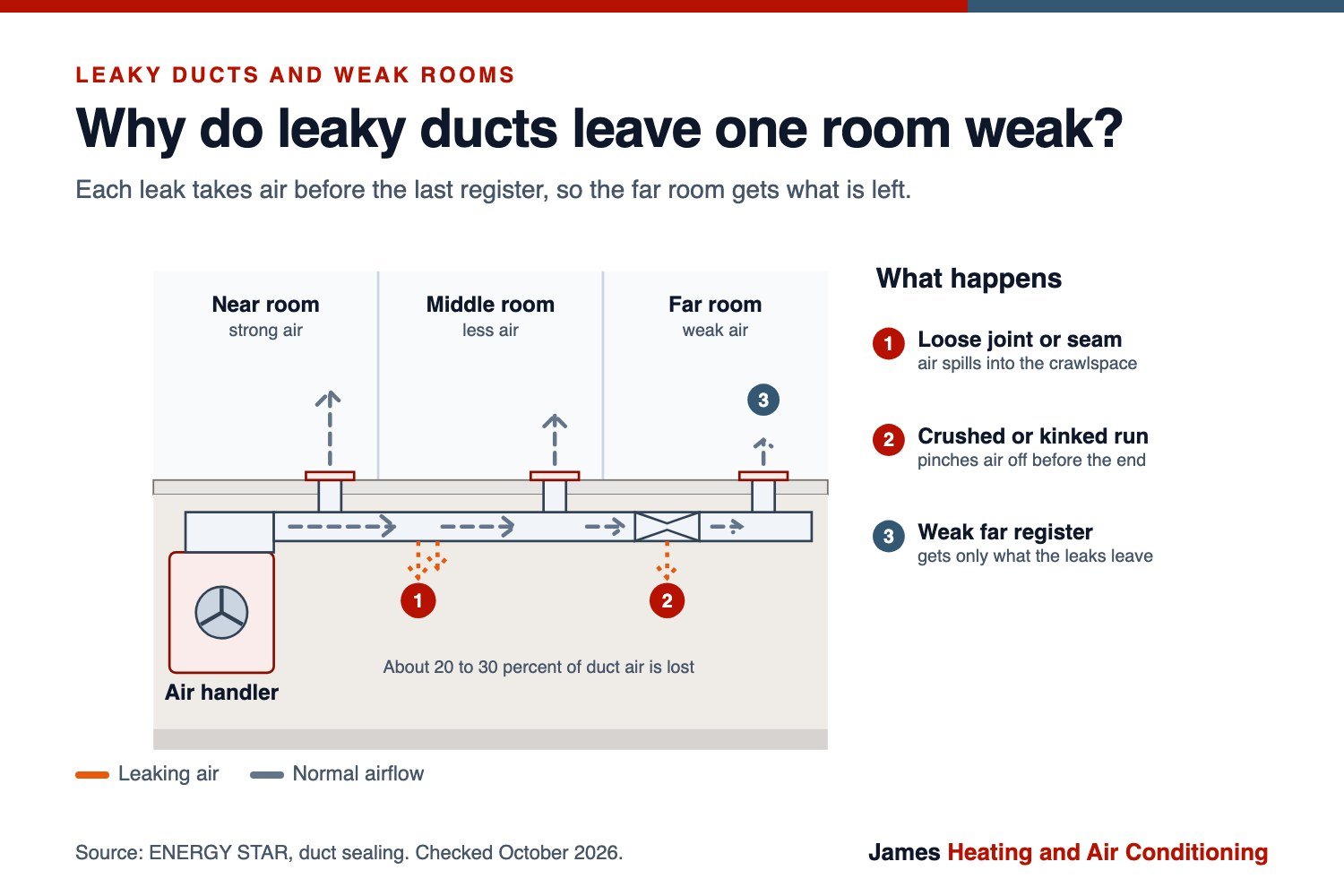
If your ducts run through a crawlspace or attic, a flashlight look along the run to the weak room can turn up a crushed section or a pulled-apart joint. Stay on the joists and mind the wiring. Skip the attic on a hot afternoon. We check the boots and plenum seams on every run, and we inspect flex for kinks.
When we trace a weak room, we follow the run from that register back toward the plenum. We repair what has pulled apart, and we seal joints with mastic or metal tape. We check the airflow at the register before and after the repair, and we replace flex that is crushed past straightening. The same symptom, one room that never matches the rest, is covered in uneven cooling in a house.
Does duct cleaning fix weak airflow?
No, duct cleaning removes dust and debris and leaves leaks where they were, so it rarely fixes weak airflow on its own.
A leak is a hole, and cleaning leaves it open. EPA lists substantial visible mold, vermin and excessive dust or debris as the reasons to clean ducts. Better airflow isn’t on that list, and EPA says little evidence exists that cleaning only the ducts improves efficiency. ENERGY STAR’s advice on sealing is blunt: never use duct tape, because it doesn’t last.
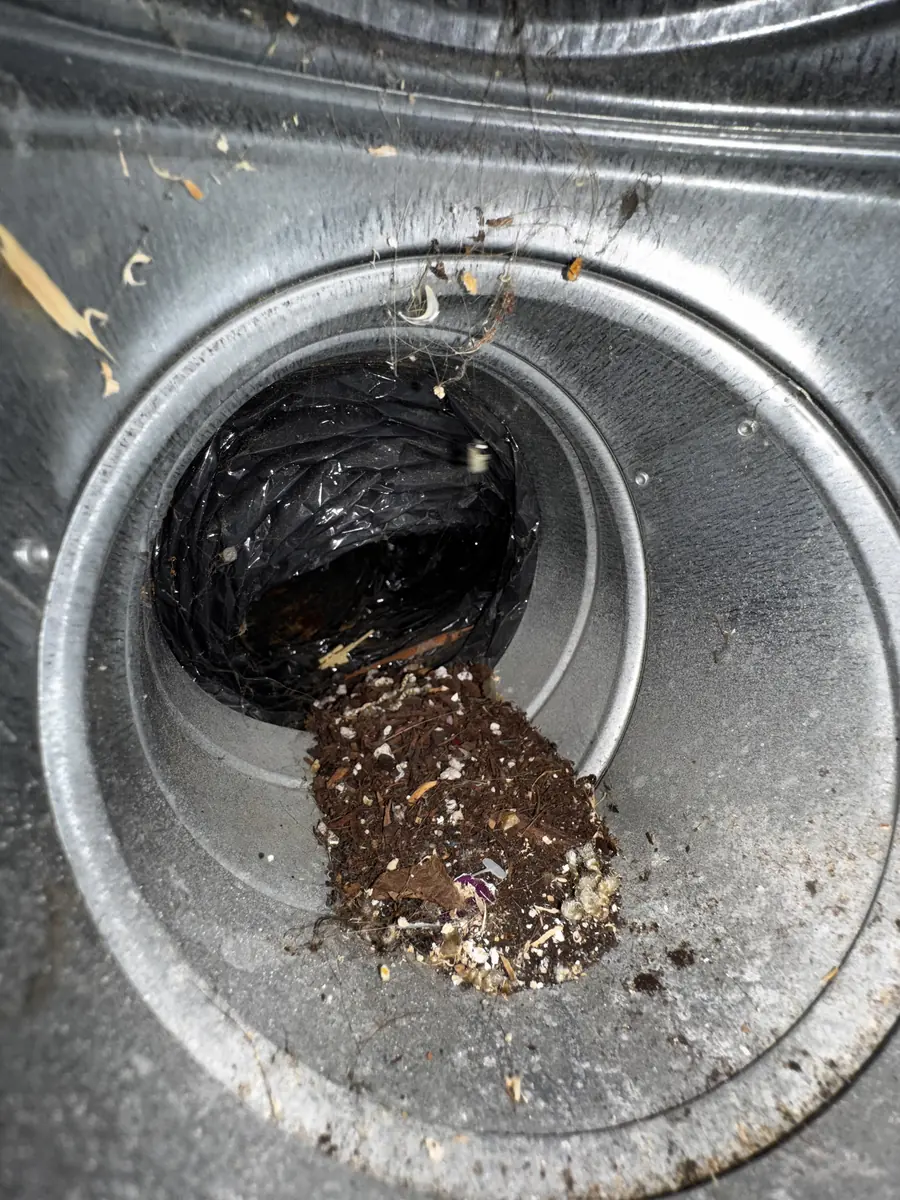
If a camera shows heavy debris or you’ve had pests, we clean the ducts, and duct cleaning is a legitimate call. Sealing closes holes with mastic or metal tape, and cleaning clears debris. We clean ducts only when debris or pests call for it, and we’ll say so when cleaning isn’t the fix.
Can a frozen coil, dirty blower wheel or failing motor cause low airflow?
Yes, ice on the evaporator coil, a dust-caked blower wheel or a failing blower motor each cut the air coming out of every vent.
Ice on the evaporator coil blocks air physically. You’ll see weak air, warm air and sometimes frost on the lines at the outdoor unit. Switch the system off and thaw it before anything else. We inspect the coil and the drain once it thaws, and why an AC blows warm air covers the case where the air stays warm.
A blower wheel caked with dust moves less air, much like a fan with dirty blades. We clean the wheel, and we test the motor. A humming, slow-starting or silent blower can point to a failed capacitor. SERVICE magazine says a humming motor that won’t turn over almost always points to a failed run or start capacitor, and it says to replace the capacitor before condemning the motor. We test the capacitor first, because capacitors hold a charge after the power is off. We replace a failed capacitor or a failed motor.
Our technicians also test static pressure across the blower, the same inches-of-water-column unit as filter pressure drop. High pressure means a restriction in the filter, coil or ducts, and we run the reading at each stop to find where it jumps. Ducts sized too small from the start can’t be rescued by a better filter. That’s a duct design (Manual D) problem, and we confirm it before we quote a fix.
Why is no air coming out of my vents at all?
No air at all usually means the blower has lost power or a safety switch has shut it off, so check the thermostat, breaker and switches in order.
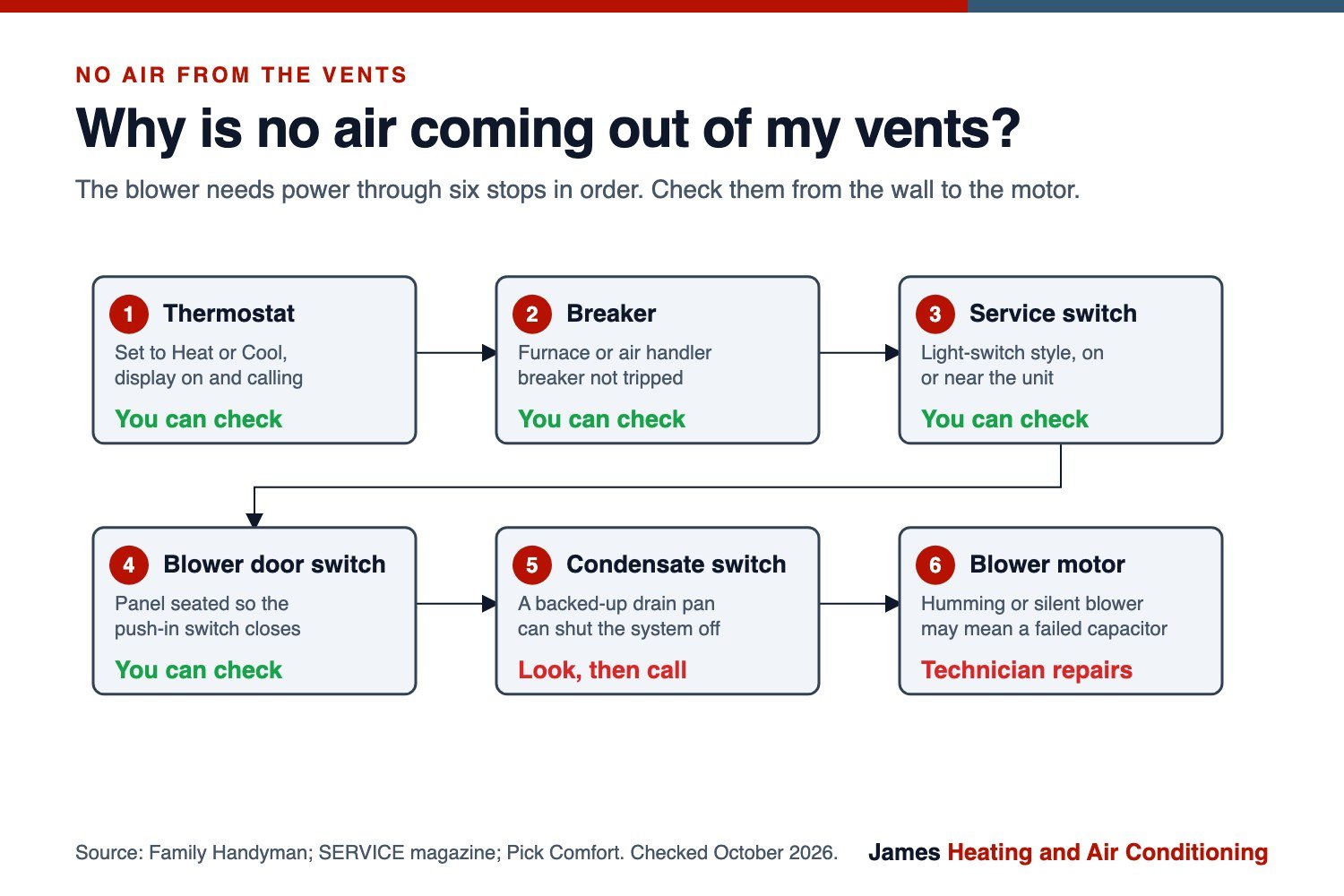
- Thermostat set to Heat or Cool, display on, calling for air.
- The furnace or air handler breaker.
- The service switch at or near the unit, which looks like a light switch. Family Handyman says to look for a standard wall switch on or near the furnace.
- The blower door or panel, seated fully. Family Handyman describes a push-in switch behind it that must be fully depressed for the furnace to run.
- A tripped condensate safety switch from a backed-up drain pan, which can shut an AC system off.
- A dead blower motor.
Your outdoor unit can run while your indoor blower sits silent, so listen at the air handler. If the blower is silent, shut the system off, because without airflow the coil can freeze quickly. Don’t open energized panels. If you smell gas or see scorching, leave the home and call. Our technicians check the thermostat’s call for air first. We repair a failed blower motor or capacitor, we test both once the switches check out, and we inspect the drain pan for the condensate switch.
Can weak airflow shut my furnace off in winter?
Yes, a furnace that can’t move enough air overheats, and its limit switch shuts the burner off to protect it.
Family Handyman says a clogged filter overheats the heat exchanger and the furnace shuts off to protect it. You get warm air that fades to cool in cycles while the blower keeps running. That’s the furnace protecting itself, and that safeguard should never be bypassed. Restricted airflow is the cause to chase, so we check the filter, the returns and the registers first, and we test the limit switch rather than jump it. We run the furnace through a full cycle after the filter change.
How much does it cost to fix weak airflow?
The cheap causes cost little, and national guides put duct repair at $200 to $1,000, a blower motor at $250 to $900 and a new evaporator coil at $627 to $2,700.
These ranges are national guide figures, not James prices, so your quote will differ. We inspect the ducts first, then we quote in writing, and access to the ducts moves the number.
| Fix | National guide range | Source |
|---|---|---|
| Duct repair | $200 to $1,000 (average $600) | Fixr |
| Blower motor replacement | $250 to $900 (average $515) | Bob Vila, citing HomeAdvisor and Angi |
| Evaporator coil replacement | $627 to $2,700 (average $1,350) | This Old House |
Call the number for your area
If the five-minute check didn’t find it, we trace it. James Heating and Air Conditioning serves Oregon homes from Eugene and Salem, has done so since 1983 under CCB #47396, and answers around the clock. We repair, seal and test ducts and blowers, and we service homes in Eugene, Springfield, Salem and Keizer. See our HVAC diagnostics and repair and ventilation and duct services.
- Eugene, Springfield and Lane County, call (541) 461-2101.
- Salem, Keizer, Marion and Polk counties, call (503) 581-9982.
Frequently asked questions
Can a tune-up fix weak airflow from my vents?
Sometimes. A preventative maintenance visit replaces a dirty filter and cleans a dirty coil or blower wheel, which are common causes. We handle both on the visit. It won’t repair a crushed duct or a leak behind a wall, and we’ll tell you which one you have.
Why is my AC blowing but not much air?
Check the temperature of that air first. We check the coil for ice on every call. Cold but weak points at the filter, blower or ducts, while weak and warm points at a frozen coil or a refrigerant problem, so switch the system off and look for ice before running it longer.
How do I increase airflow from my vents?
Remove the restriction instead of adding force. Open every register, clear returns, replace a clogged filter with one the blower can handle, and look for ice. If the air is still weak, the restriction is in the ducts or the blower, and we test static pressure to find it.
Does the thermostat fan setting change how hard air blows from the vents?
No, the Auto and On settings change when the blower runs, not how hard it pushes. Setting the fan to On keeps the blower running so you can test airflow, and it is not a cause of weak air. We check the fan setting first on every call.
How often should I change my filter?
Inspect it monthly and change it when it’s dirty, which usually lands between one and three months depending on pets, dust and smoke. Set a reminder using how often to change the filter.