






Your air conditioner is loud because a part is loose, dry, worn or failing, and the sound tells you which one. Grinding, a screech that won’t stop, loud banging, crackling or a burning smell means switch it off at the thermostat. Eugene and Lane County homes reach us at (541) 461-2101, and Salem-area homes reach our Salem office at (503) 581-9982.
We answer both lines 24 hours a day, 7 days a week, so a noise that scares you at midnight reaches a person, not a voicemail.
Why is my air conditioner so loud?
Your air conditioner is loud because a part is loose, dry, worn or failing, and each fault makes its own sound.
Find the sound closest to yours, note where it comes from, and read across to the shut-off call. We diagnose by sound first, then we confirm the part with a meter and a visual check. The repair figures are national ranges from Fixr and This Old House, not James prices. We quote a firm price only after a technician looks at your system.
| Sound | Where | Likely cause | Shut it off now? | Typical repair cost |
|---|---|---|---|---|
| Buzzing | Outdoor unit | Failing capacitor, worn contactor, loose wiring | Yes if it buzzes and won’t start | Capacitor $100 to $400; contactor $150 to $400 |
| Humming, nothing starts | Outdoor unit | Weak capacitor, or a seized fan or compressor | Yes | Capacitor $100 to $400; compressor $800 to $2,800 |
| Repeated clicking | Outdoor unit or thermostat | Contactor chattering, relay or thermostat fault | Yes if it never settles | $150 to $400 for small electrical faults |
| Rattling | Either | Loose panel, debris in the fan cage, loose screw | No, but check soon | Often a quick tightening job; quoted on the visit |
| Banging or clanking | Outdoor unit, or indoors at the blower | Loose or bent fan blade, blower wheel, motor mount, compressor internals | Yes | Fan motor $200 to $700; compressor $800 to $2,800 |
| Squealing | Outdoor fan or indoor blower | Dry or worn motor bearings | Stop if it turns to a screech | Fan motor $200 to $700; blower motor $450 to $2,000 |
| Screeching or grinding | Either | Seizing bearings, metal on metal, compressor wear | Yes, immediately | Blower motor $450 to $2,000; compressor $800 to $2,800 |
| Hissing | Outdoor unit or the indoor coil | Refrigerant leak, or a normal pressure release | Yes if it keeps going | Leak repair and recharge $200 to $1,600 (Fixr); $400 to $1,500 (This Old House) |
| Bubbling or gurgling | Indoor unit or the lines | Low refrigerant, or a partly blocked condensate drain | Not for the drain; yes if cooling is weak | Drain line $75 to $250 |
| Whistling or popping | Return grille or ducts | Clogged filter, tight return, flexing duct panels | No | Often a filter or return fix; quoted on the visit |
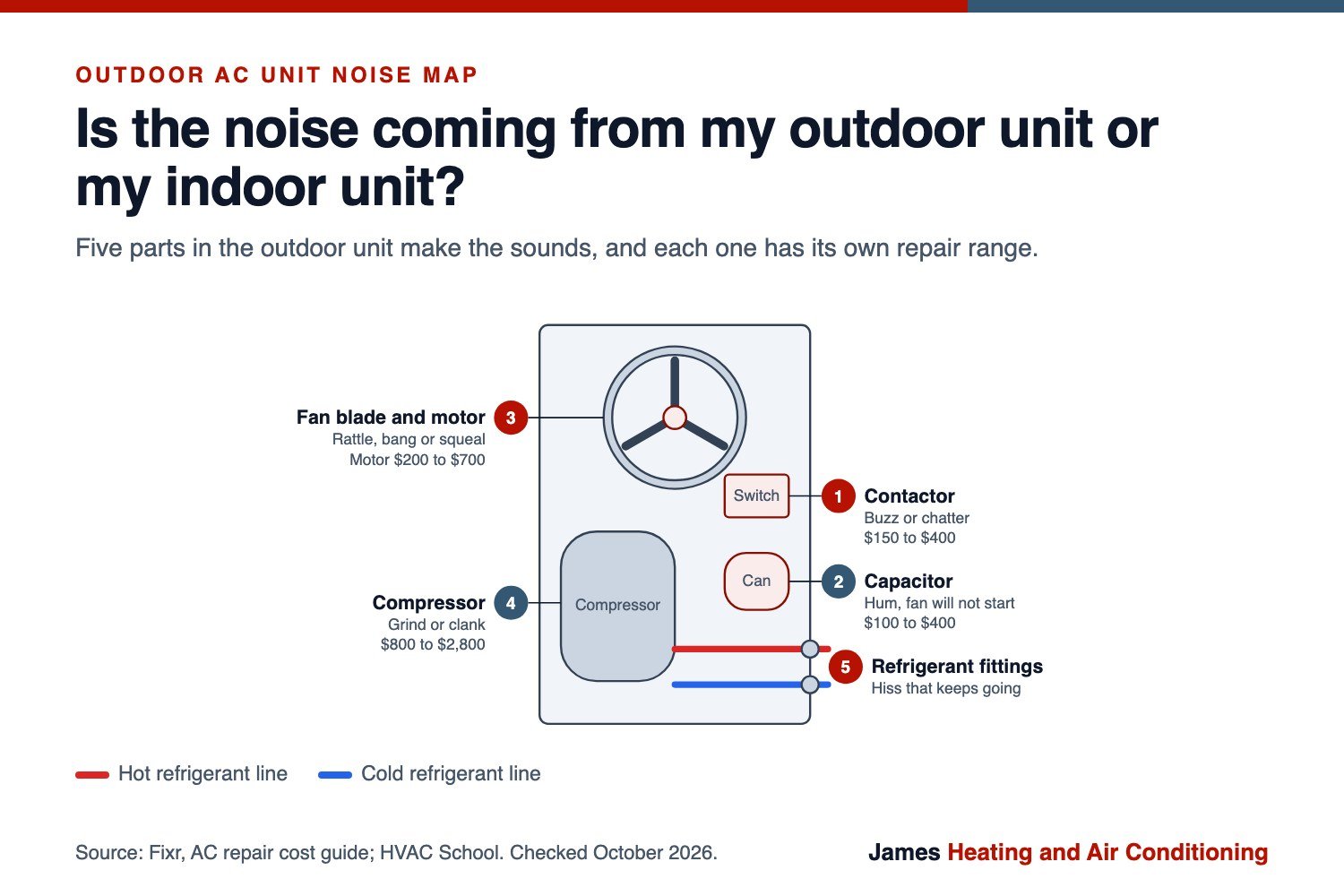
Is the noise coming from my outdoor unit or my indoor unit?
Stand next to the outdoor condenser, then next to the air handler indoors, and the louder end is where the fault sits.
The outdoor unit holds the fan, the capacitor, the contactor and the compressor, and the drawing pins each sound to its part. The capacitor kicks the fan motor and compressor into motion. The contactor is the switch that sends power to both. We inspect the contactor and the capacitor behind the panel.
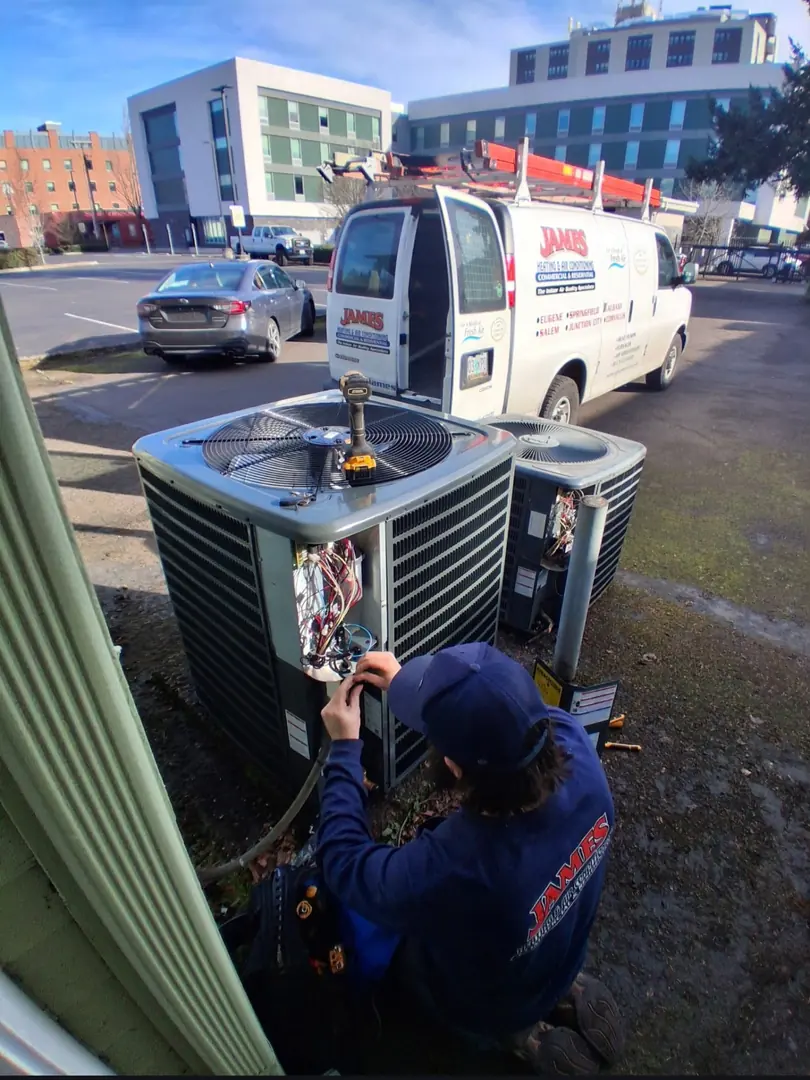
Indoors, the blower wheel and motor make most of the noise, and the ducts add pops and whistles. Our technicians check the outdoor unit first and the air handler second, and we run the same Fan only test on a service call. You can run it in a minute.
- Switch the thermostat to Fan only. If the noise stays, the blower or the ducts are making it.
- Switch back to Cool. If a new sound appears outside, the condenser is making it.
- Note whether it happens at startup, while running or at shutdown.
A startup-only noise usually means a part struggling to turn over. A running noise points to something loose or worn. A shutdown noise is often just pressure settling.
Why is my AC making a banging or rattling noise?
Banging means something heavy is hitting something solid, and rattling means something light has come loose.
A bent fan blade, a loose blower wheel or a slipped motor mount can all bang. Our technicians check each one with the power off. The bang to fear comes from the compressor, since replacement runs about $800 to $2,800 in Fixr’s national guide. Shut the system off and call. We check the compressor mounts and windings before we recommend a replacement.
A loose panel, a twig in the fan cage or a working-loose screw will rattle. With the thermostat off, clear leaves and sticks from the base of the outdoor unit. We inspect the fan blade, the shroud and the mounts when a rattle stays, and we send a technician to tighten the hardware.
Why is my AC buzzing, humming or clicking?
A buzz, hum or repeated click comes from the electrical side, usually a failing capacitor, a worn contactor or loose wiring.
A capacitor gives the fan motor or compressor the kick it needs to start. When the capacitor weakens, the motor hums and strains without turning over. HVAC School notes that a failed run capacitor often leaves a compressor unable to run, and that fans may turn slowly or backward.
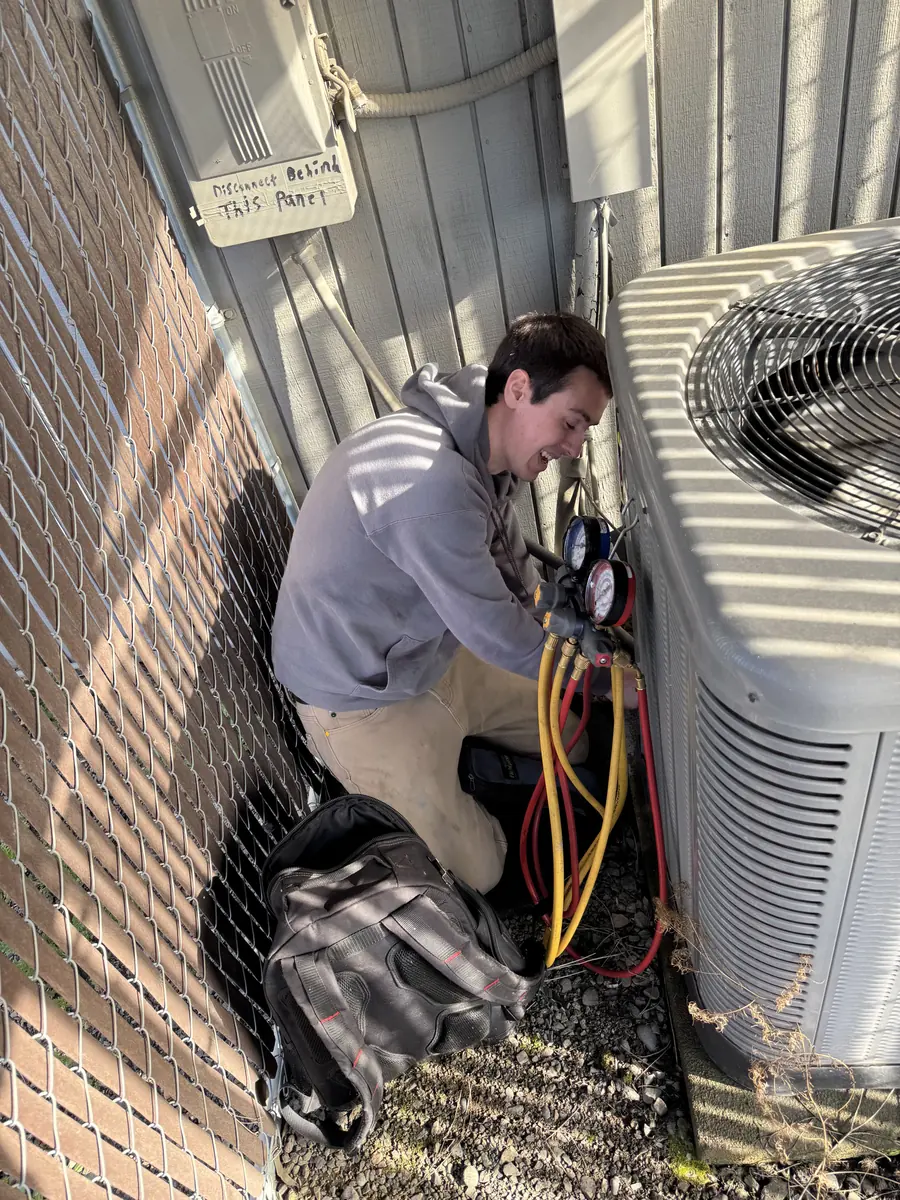
That makes a buzz the electrical sound to take seriously. The part itself is cheap, and we replace capacitors and contactors as repair jobs. Fixr puts capacitor replacement at $100 to $400, and a contactor or other small electrical fault at $150 to $400. A hum left running turns a small repair into a burned-out motor.
One click when the system starts or stops is normal. Clicking that repeats, or a contactor that chatters without pulling in, is not. We test the capacitor and the contactor before we replace either one, and we repair loose wiring at the terminals. We hold Oregon CCB #47396 for this electrical work.
Why does my AC squeal, screech or grind?
A squeal, screech or grind means a motor bearing is dry or wearing out, and a grind means metal is already rubbing metal.
Most modern residential fans and blowers are direct drive, with no belt to slip. A squeal at startup that fades usually means dry or worn motor bearings. A squeal that turns into a screech, or a grind, means the bearings are going.
Fixr puts a condenser fan motor at $200 to $700 and an indoor blower motor at $450 to $2,000. Waiting costs you more, because a seized motor can overheat. We service direct-drive fan and blower motors, and we check the bearings before we quote a new one. We replace a failed motor only after we test it. A squeal means call within the week. A grind or screech means the AC stays off until a technician looks at it.
What noises come from the inside air handler?
The air handler makes the blower squeal, the loose-panel rattle, the drain gurgle and the return-grille whistle you hear indoors.
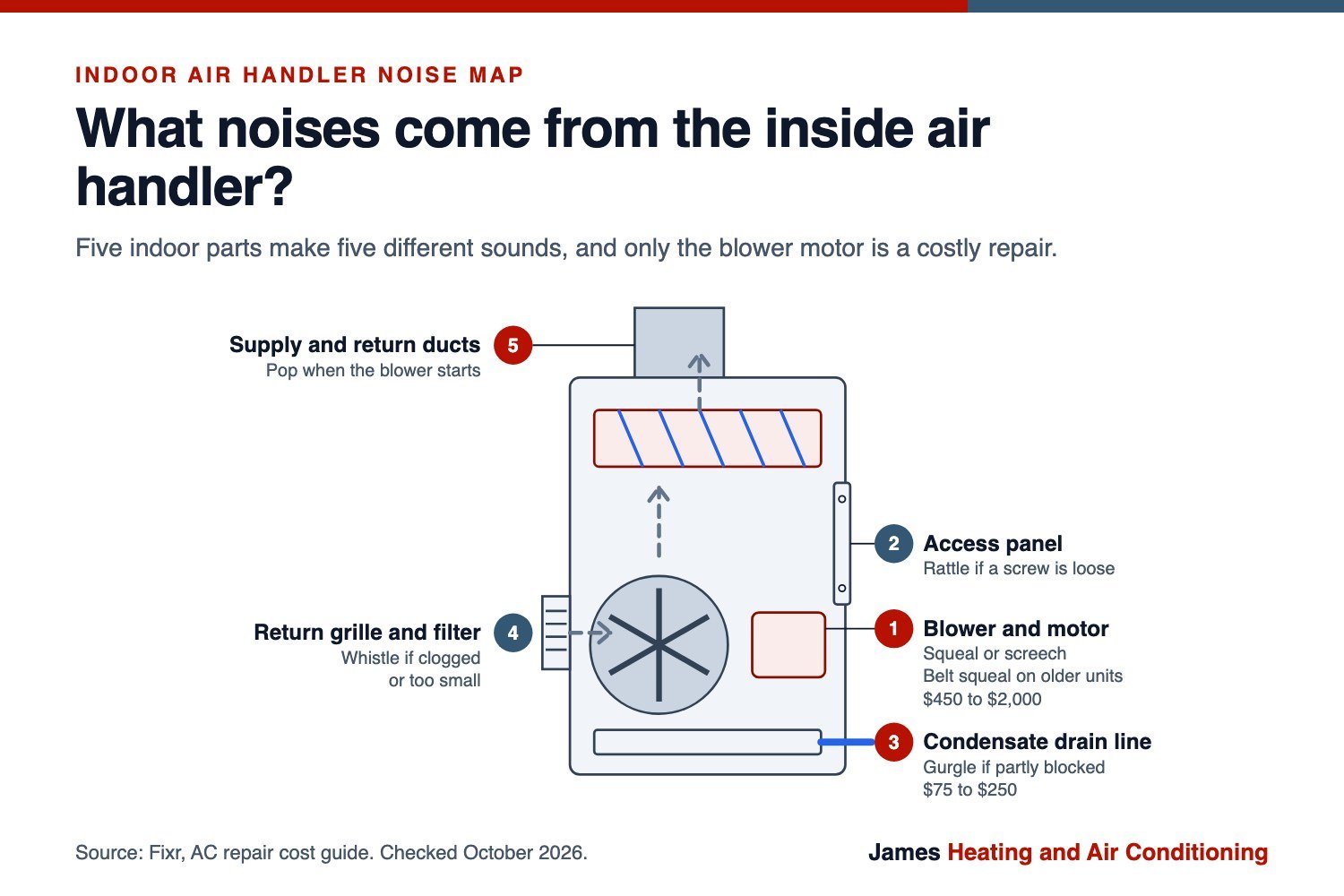
The blower wheel and motor push air through your ducts, and a dry motor bearing squeals there just as it does outside. On an older belt-driven blower, a slipping belt squeals too. Fixr puts a blower motor at $450 to $2,000 installed, and we test the motor before we quote it. A loose access panel rattles, and a screw tightens it. We check the panel screws and inspect the return grille and the filter slot on every airflow noise call.
Gurgling often comes from a condensate drain that is partly blocked, and a cleared line runs about $75 to $250. Our technicians test the drain flow after we clear it. We clean a blocked condensate drain line and check the pan for water. If the air also stops cooling, check for a frozen evaporator coil.
Whistling at a return grille usually points to a clogged filter or a return that is too small for the airflow. Swap your filter first. We check the duct panels and the return size if the whistle stays. A pop or bang from the ductwork when the blower starts is duct metal flexing, annoying but not dangerous.
Why is my AC hissing?
A steady hiss while the system cools can mean refrigerant is escaping, and a short hiss at shutdown is normal pressure release.
This Old House lists hissing or bubbling from the AC unit as a sign of low refrigerant. Weak cooling, ice on the lines or a coil that won’t hold temperature point the same way. The low refrigerant symptoms guide lists the other signs.
Topping off does not cure a leak, and the cost depends on where the leak is, $200 to $1,600 in Fixr’s guide and $400 to $1,500 at This Old House. The EPA requires certified technicians to buy refrigerant under its Section 608 sales restriction, so a leak is never a do-it-yourself job. Our technicians hold EPA Section 608 certification for refrigerant work, as federal law requires. We test for the leak before we add any refrigerant, and we repair the leak before we recharge.
Is a noisy air conditioner dangerous, and should I shut it off?
It can be, so shut it off at the thermostat for grinding, a nonstop screech, loud banging, crackling, a burning smell or a hum with no fan spin.
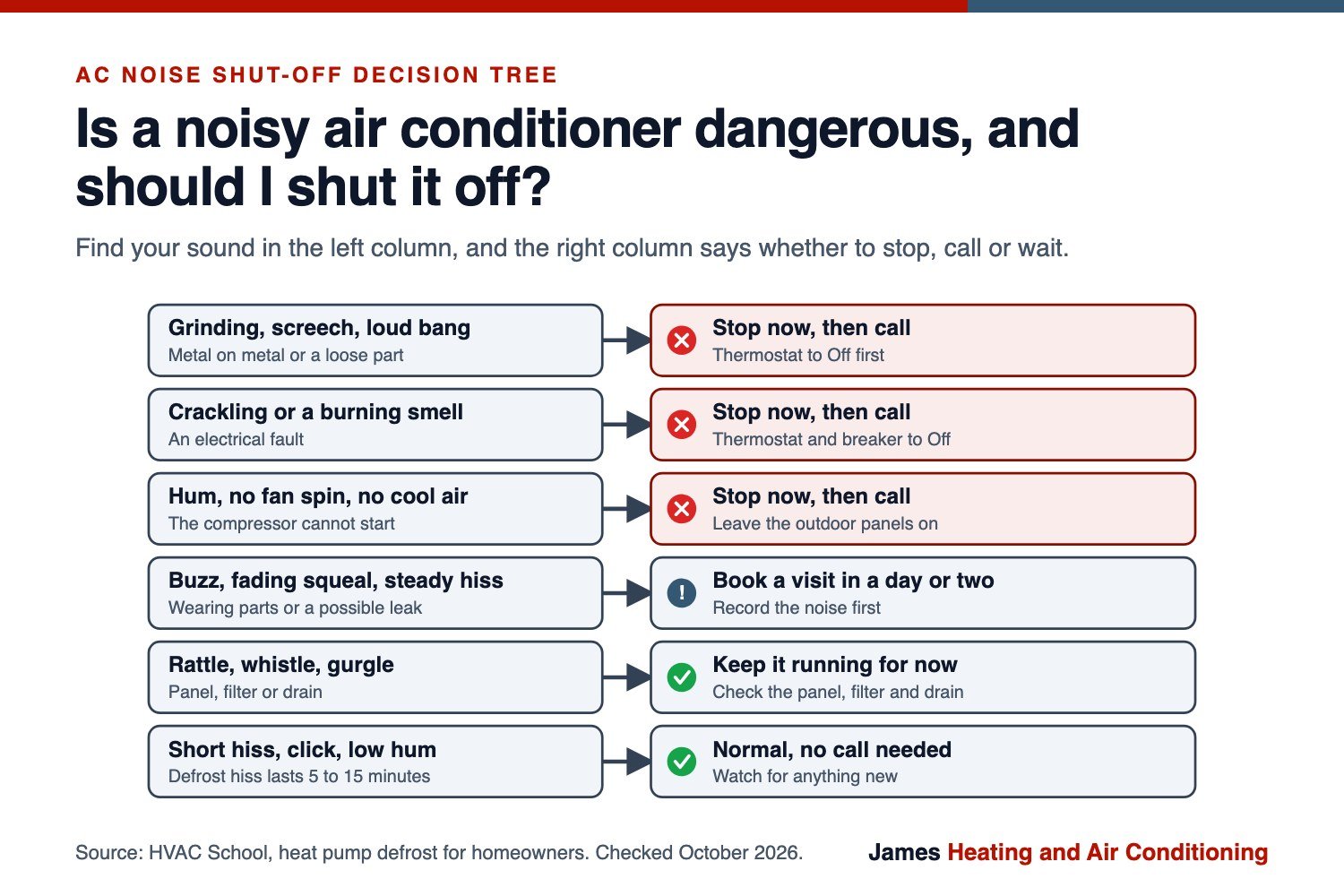
Each of these sounds has its own risk.
- Grinding or metal-on-metal scraping. Bearings or a compressor are wearing against each other.
- A screech that doesn’t stop. A seizing motor shaft can overheat the winding.
- Banging or clanking. A loose blade or wheel can smash into the housing or the coil.
- Crackling, popping from the electrical side or a burning smell. Switch the breaker off too.
- A hum with no fan spin and no cool air. A compressor that can’t start keeps drawing current.
Turn the thermostat to Off first. If the smell is electrical, flip the outdoor unit’s breaker too. Then call, and we dispatch a technician at any hour. We inspect the unit before anyone restarts it. Leave the outdoor unit’s panels on, because a capacitor can hold a charge after the power is off.
A buzz while the system still runs, a squeal that fades or a steady hiss can wait for a visit within a day or two. A rattle, a whistle or a gurgle can run while you check the panel, the filter and the drain.
Is it normal for an AC or heat pump to make noise?
Yes. Your system makes a few short, predictable sounds every cycle, and those are no reason to call. We service central AC and heat pumps across both counties.
- A steady, low hum from the outdoor unit while it runs.
- One click when the system starts or stops.
- A short hiss or whoosh at shutdown as refrigerant pressure settles. It should end within seconds.
- Air moving through the ducts.
On a heat pump, add the defrost cycle in winter. HVAC School says defrost runs every 30 to 90 minutes of compressor run time when conditions call for it, and each cycle lasts 5 to 15 minutes. The outdoor fan pauses, steam rises from the cabinet, and you may hear a hiss from the changing refrigerant pressures. That is the unit melting frost, not a leak. We inspect the outdoor coil when a defrost never ends.
The same source says to call only if the heat stops entirely or the coil is covered in a sheet of ice. We check a heat pump’s outdoor coil for ice before we call a noise a fault. Ice on the lines means a frozen evaporator coil, and a heat pump that is loud in cool, damp Willamette Valley weather may show other heat pump repair signs.
How much does it cost to fix a noisy air conditioner?
Noise repairs run from $75 for a cleared drain line to $2,800 for a compressor, according to Fixr’s national ranges.
The table above lists each part’s range. Rattling, whistling and popping are usually small jobs, often a tightening or a filter change. We quote your repair before we start work.
When your quote is a compressor on an older system, we put a replacement quote beside it so you can compare the two. Age matters too: how long air conditioners last helps you weigh a big repair.
What should I do before I call about an AC noise?
Record the noise on your phone, because a sound that stops when the technician arrives is hard to diagnose.
- Stand a few feet from the loud end, indoors or out, and record 20 to 30 seconds.
- Say aloud when it happens: startup, running or shutdown.
- Note whether it comes with weak cooling, a smell, a tripped breaker or ice.
- Keep the video for the call or the visit.
Our technicians check your video against what they hear on site.
Who do I call about a loud AC in Eugene or Salem?
Call the office that covers your town, (541) 461-2101 for Lane County or (503) 581-9982 for Salem and Marion County.
We serve Eugene, Springfield and Lane County from our Eugene office, and our Salem office serves Salem, Keizer and Marion County. We answer both lines around the clock, we dispatch technicians to both counties at any hour, and 24-hour AC repair spells out what counts as urgent. For a scheduled visit, see air conditioning repair.
James Heating & Air Conditioning has served Oregon since 1983, and we hold CCB #47396. The price ranges here are national guides, and your price is set after a technician looks at your system.
Frequently asked questions
Is a buzzing air conditioner dangerous?
It can be. A buzz usually means a failing capacitor, worn contactor or loose wiring, and electrical faults can overheat a motor. Turn the thermostat off and call us. We test the electrical parts first.
Can a dirty filter make my AC louder?
Yes, at the return. A clogged filter or an undersized return makes air whistle through the grille. We check your filter first, since it is the cheapest fix.
Why does my AC only make noise when it turns on?
A startup-only noise usually means a part is struggling to turn over, such as a weak capacitor or a dry bearing. One click at startup is normal, but a hum or squeal is not. We test the capacitor first, and we check the bearings next.
Can I keep running a noisy AC?
For a rattle, whistle or gurgle, yes, while you check the panel, filter and drain. For grinding, banging, a nonstop screech or a burning smell, no. Turn it off and call us, and we dispatch a technician.
Why is my heat pump so loud in winter?
Defrost cycles are the most common reason. Every 30 to 90 minutes of run time your unit may pause its fan, steam and hiss for 5 to 15 minutes. We inspect the outdoor unit when the noise is constant, grinding or paired with ice that stays after defrost.