






A central air conditioner lasts 15 to 20 years, a ducted heat pump 12 to 15 and a ductless unit 12 to 20. Sizing, run time and yearly service move those numbers more than brand does. Brand matters least. We service Willamette Valley systems under Oregon CCB #47396. Call (541) 461-2101 in Eugene and Springfield or (503) 581-9982 in Salem.
How many years does an air conditioner last?
A central air conditioner lasts 15 to 20 years, and heat pumps and ductless units run in their own ranges. CBS News says many central air conditioning systems last 15 to 20 years, with some running longer under good maintenance and others failing early. PickHVAC gives heat pumps and ductless units the ranges below.
| Equipment | Typical lifespan | Best case | Source |
|---|---|---|---|
| Central air conditioner | 15 to 20 years | Longer with steady maintenance | CBS News, June 2026 |
| Ducted air-source heat pump | 12 to 15 years | 15 to 20 years | PickHVAC, Sept 2025 |
| Ductless mini-split | 12 to 20 years | 18 to 22 years | PickHVAC, Sept 2025 |
We service central air, ducted heat pumps and ductless units across Eugene, Springfield and Salem. The ranges above are national guides. They are not warranties. A unit that was sized wrong or never serviced can quit well short of them. A clean, well-sized one can pass them. We check your unit’s age, service history and refrigerant before we quote anything. Then we explain which end of the range you sit on. Those ranges also raise a question about the 10-year mark you may have heard.
Why does ENERGY STAR say 10 years when other guides say 15 to 20?
ENERGY STAR’s 10 years marks when a replacement starts to save money, while 15 to 20 years marks how long a unit can keep running. ENERGY STAR rates any heat pump or air conditioner more than 10 years old as worth replacing for efficiency, since a new ENERGY STAR unit can cut heating and cooling costs by up to 20 percent when installed correctly. We hold your repair quote against that 10-year marker. We also hold it against the cost rule below. The Department of Energy puts the gain higher for older equipment: a new unit can cut cooling costs by 20% to 40% compared with a pre-2006 air conditioner.
Between year 10 and year 15, your system still cools. We check what it costs to keep it that way. That starts with the parts inside the outdoor unit.
Which air conditioner parts wear out first?
Five parts in the outdoor unit decide how long an air conditioner lasts. Here they are: the compressor, the fan motor, the capacitor, the condenser coil and the sealed refrigerant circuit. PickHVAC lists the compressor and fan motor at 10 to 15 years and the capacitor at 10 to 20 years. It lists the whole condenser unit at 15 to 20 years.
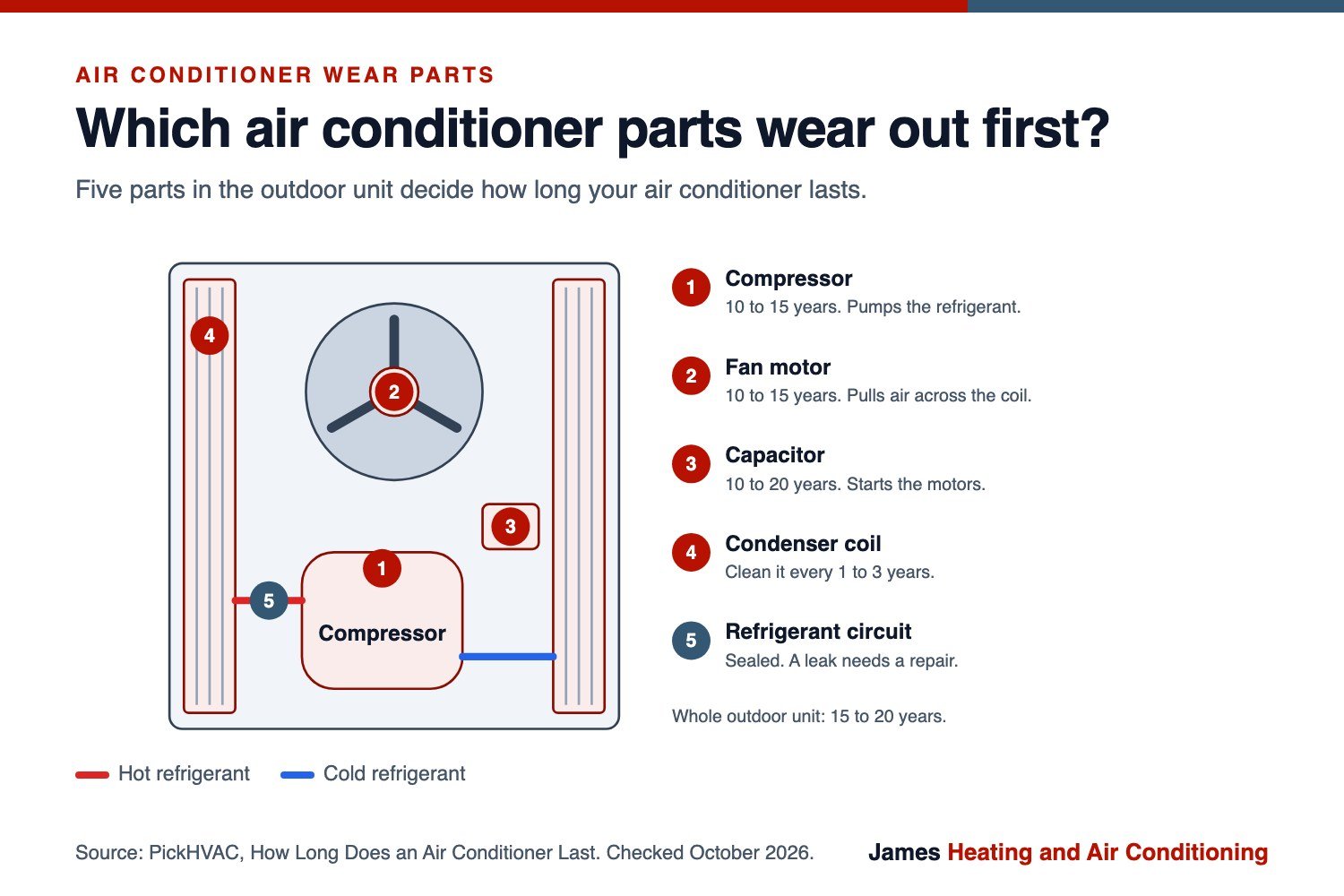
The indoor evaporator coil sits in the same 10 to 15 year band. Same window. The refrigerant circuit is the odd one out. PickHVAC says refrigerant should last forever in a sealed system, so a leak means a failed joint or coil, not a part that wore out on schedule. Our technicians test the circuit and locate the leak before anyone adds refrigerant. The Environmental Protection Agency (EPA) asks homeowners to request exactly that. Topping off a leaking system is not a fix.
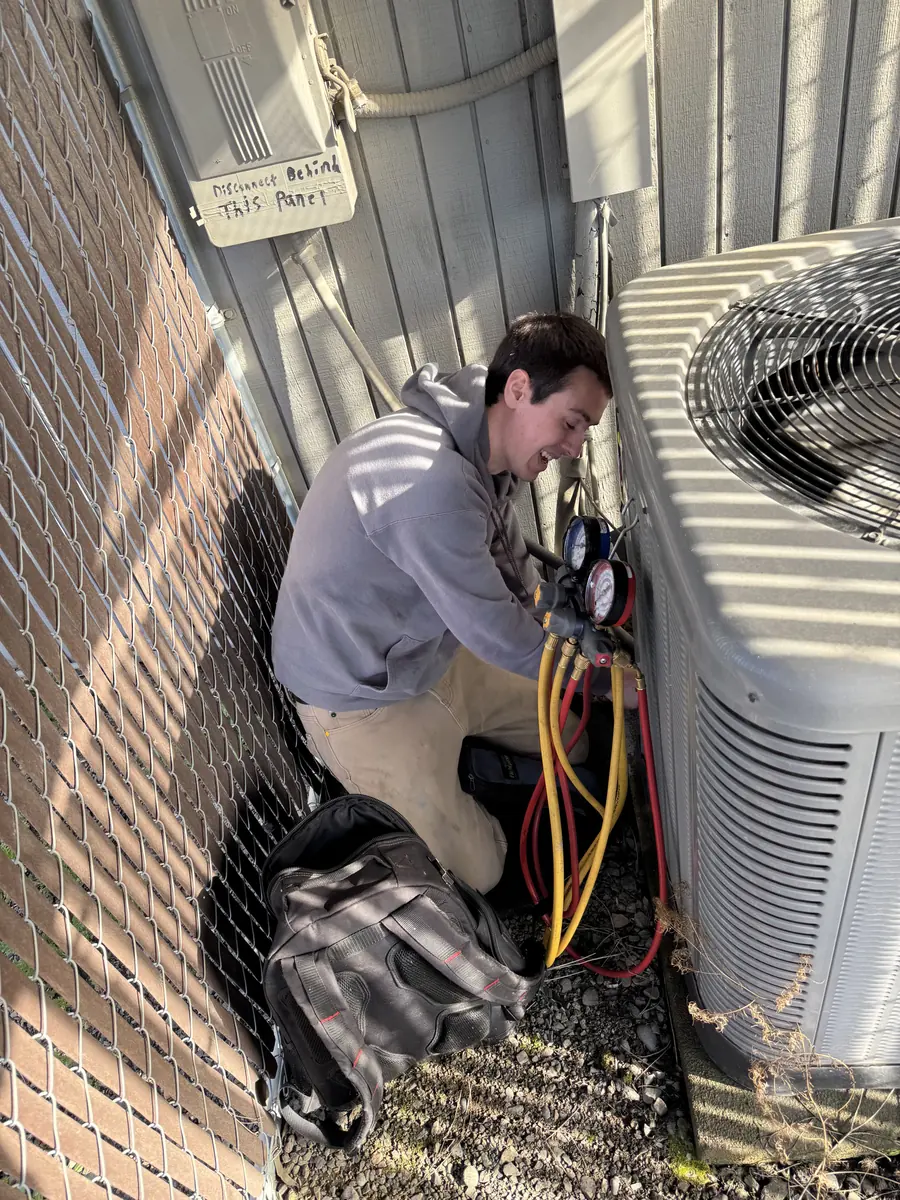
We inspect the coil and charge on every tune-up. We test the capacitor and contactor too. A weak one strains the compressor, the part you least want to replace.
What shortens an air conditioner’s life?
Four causes show up again and again, and the first two come from the install, not from your use.
- Wrong size. PickHVAC notes that an oversized system short-cycles and an undersized one runs almost nonstop. The Department of Energy says oversized units cycle on and off frequently, which cuts efficiency and raises maintenance costs. We run a Manual J load calculation (the ACCA sizing standard) on every replacement, so the mismatch never starts.
- A wrong refrigerant charge. The Department of Energy warns that under- and over-charged systems cause premature component failures, so we check the charge at every service.
- Dirty coils and filters. Dirt on the condenser coil makes the system push harder to shed heat. We clean the coil on a tune-up, and PickHVAC suggests every 1 to 3 years.
- Run time. PickHVAC puts it plainly, saying the more often a unit runs, the faster it wears out.
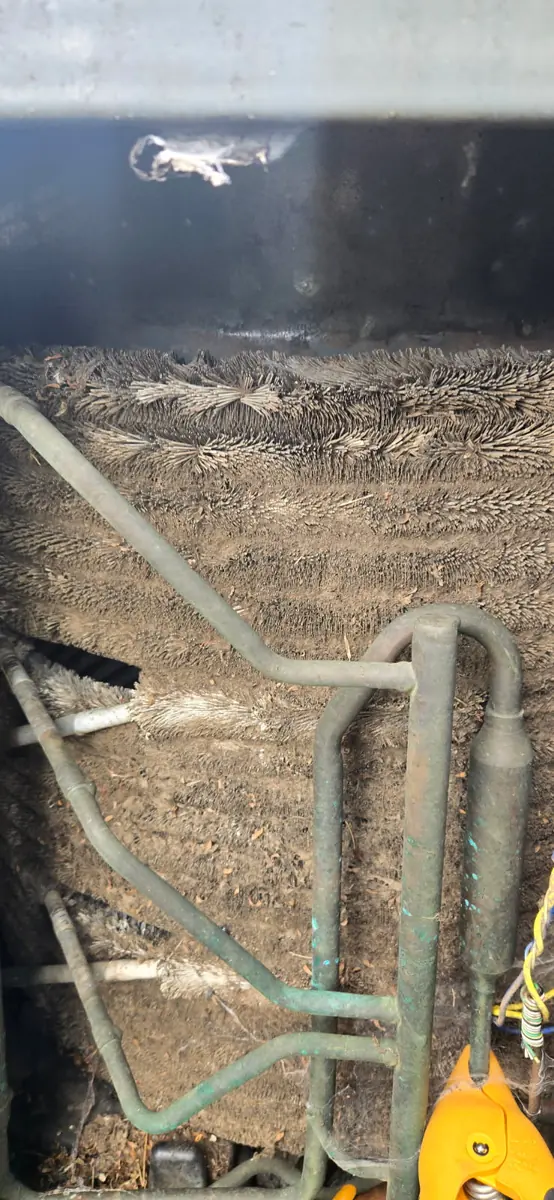
A heat pump has one more factor. It runs in winter as well as summer. Its compressor logs hours across the whole year, which is why its range sits below central AC. Run time is also where Oregon helps you.
Does Oregon’s mild climate help an air conditioner last longer?
Yes, partly, because Eugene and Salem summers are dry and the hottest stretch is short, so a central AC here runs fewer hours than the same unit in a hotter state. PickHVAC says mild climates reduce runtime and stress, which tends to extend life. No one has published a local run-hour figure. Treat that as a reason, not a promise.
Two local things work against it. Spring cottonwood fluff and cut grass pack into condenser fins, so we clean the coil on a yearly visit. The other is the heat pump case above. Since a valley heat pump that heats every winter ages faster than an AC that sits idle for nine months. Coastal salt air also speeds corrosion, per PickHVAC. That applies to homes near Florence. It does not apply to inland Eugene, Springfield or Salem.
How can I make my air conditioner last longer?
You can add years with four habits, and the first is a yearly tune-up. We clean the coils and check the refrigerant charge, then we test the capacitor and contactor and measure airflow. See what a HVAC tune-up includes.
- Change the filter. A clogged one cuts airflow and can freeze the indoor coil. Check it monthly. Our technicians check the filter on every visit and tell you when it is clogged.
- Repair small problems early. We replace a weak capacitor early, which stops it from loading the compressor.
- Clear space outside. Keep plants and debris back from the condenser, and rinse cottonwood off the fins in spring.
Habits stretch the range. They do not stop the clock. You also need to know the signs of the end.
How do I know my air conditioner is near the end?
Your air conditioner is near the end when repairs stack up, cooling turns weak or uneven, bills climb on the same use, a unit past 15 starts short-cycling, or a refrigerant leak keeps returning. Each of these signs your AC needs repair has its own likely cause, and we test the refrigerant side first whenever cooling turns weak. We inspect the unit for each sign on a repair visit.
One sign you can check yourself is age. Don’t know it? The unit’s nameplate tells you.
How do I find out how old my air conditioner is?
You can read your air conditioner’s age and refrigerant off the nameplate on the outdoor unit in four steps.
- Find the metal nameplate on the outdoor condensing unit, on a side panel.
- Read the model number. The Department of Energy says two digits in it give the size in tons.
- Read the serial number. Its code carries the build date, and the manufacturer’s format decides how to decode it.
- Read the refrigerant line. EPA says the nameplate lists the refrigerant.
We check the nameplate first on every call. The serial number on the data plate usually encodes the build year. That year, plus the refrigerant, shapes the repair decision.
Does my refrigerant type decide whether to repair my air conditioner?
Partly, because the refrigerant on your nameplate tells you which generation of system you own and what a leak repair involves, but it never decides alone. R-22, R-410A and the newer A2L refrigerants (R-454B and R-32) each point to a different first move.
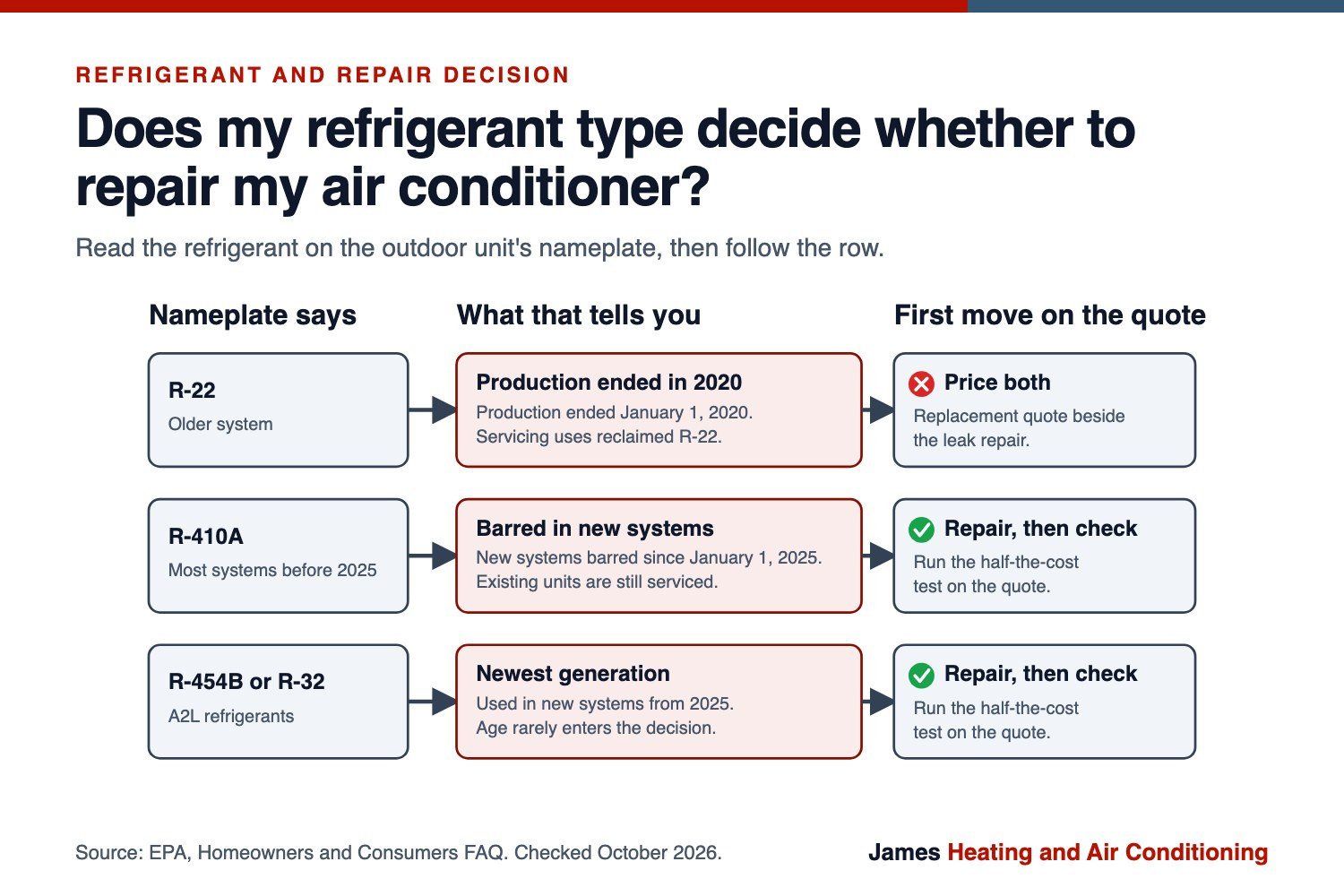
- R-22. The EPA requires no owner to replace an R-22 system, though production and import ended January 1, 2020. Servicing relies on reclaimed and stockpiled R-22, and EPA expects the price to rise. EPA also says no drop-in replacement exists. We service R-22 systems with reclaimed refrigerant, and we quote a replacement beside any leak repair.
- R-410A. That makes it the refrigerant in most systems built before 2025, because since January 1, 2025, new residential split systems cannot be manufactured with it. Existing R-410A systems can still be serviced and recharged. Refrigerant is getting more expensive. We repair these systems and run the half-the-cost check below.
- A2L (R-454B or R-32). New equipment uses these from 2025. A system on A2L is the newest generation, so age rarely enters the decision, and the half-the-cost check still applies. A2L systems go in to the manufacturer’s instructions and local code.
We recover the old charge before any refrigerant work. You never handle it. With the refrigerant known, the repair quote gets one test.
Should I repair or replace my air conditioner?
Replace it when the repair costs more than half of a new system. Repair it when the quote stays under that line. The U.S. Department of Energy’s Building America guide sets that half-the-cost rule for central air conditioning. The same flowchart says to replace any pre-2006 unit, one rated below SEER 10, when it needs work.
For example, Fixr’s national average for an installed central air conditioner is $8,750, so half is $4,375. A repair quote under that is a repair. We quote the repair and the replacement in writing. Hold one against the other. We also check the repair history and the refrigerant before we recommend either.
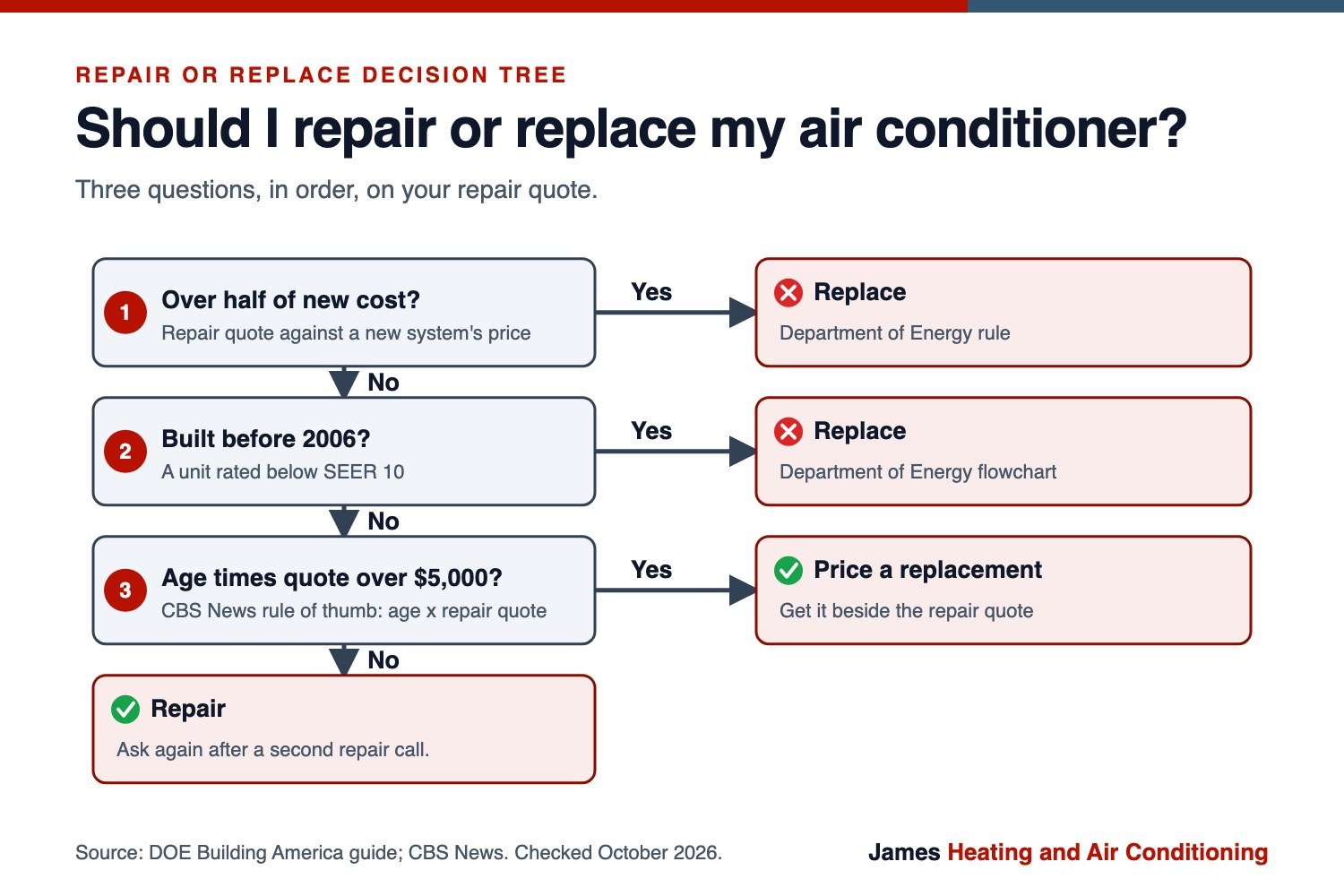
We run your quote through all three questions on the tree. CBS News describes an alternative rule of thumb, the $5,000 rule: multiply the unit’s age by the repair quote. Above $5,000, replacement is often the better long-term choice. Below it, repair may make sense. CBS calls it a guideline. Not the final word.
| Unit age | Repair quote | Age times quote | Usual lean |
|---|---|---|---|
| 7 years | $400 | $2,800 | Repair (CBS example) |
| 9 years | $450 | $4,050 | Repair |
| 12 years | $500 | $6,000 | Consider replacing (CBS example) |
| 14 years | $450 | $6,300 | Consider replacing |
Three things both formulas ignore can flip the answer. The type of repair matters, since a capacitor is not a compressor. The refrigerant matters. An R-22 leak is costly. Repair history matters too: a second call in two summers means the unit is wearing out. If you decide to replace, the next question is the price.
How much does a new air conditioner cost, and what changes when I replace it?
A new system costs roughly $3,000 to $14,400, depending on type. Cost guides disagree because they price different homes. That’s normal. Fixr’s central AC guide (August 2025) puts an installed system at $5,800 to $14,400, with an average of $8,750. PickHVAC (September 2025) lists a ducted heat pump at $6,500 to $13,500 and a single-zone ductless unit at $3,000 to $6,000.
| System | Installed cost range | Source |
|---|---|---|
| Central air conditioner | $5,800 to $14,400 | Fixr, Aug 2025 |
| Ducted air-source heat pump | $6,500 to $13,500 | PickHVAC, Sept 2025 |
| Ductless, single zone | $3,000 to $6,000 | PickHVAC, Sept 2025 |
These are national guides. We install Ruud systems in Eugene and Salem and Rheem systems in Salem, and we quote a firm written price after we inspect your home. For what moves the number, read what drives the cost of a new AC. If you are weighing ductless against a ducted system, see our ductless heat pump systems.
Oregon requires a mechanical permit and inspection for an AC replacement. We pull the permit. We book the inspection. The federal 25C tax credit ended December 31, 2025, so it does not apply to a 2026 install. Utility programs depend on your address, and we check which utility serves it so you know which rebate applies. Energy Trust of Oregon serves PGE, Pacific Power, NW Natural, Cascade and Avista customers. EWEB runs its own programs, as do SUB and Salem Electric. Oregon’s new heat pump code starting October 2026 covers new homes only, not replacements.
Frequently asked questions
Is a 15-year-old AC worth fixing?
Only for a small repair. At 15, we hold the repair quote against half of a replacement quote. A $400 quote gives $6,000 on the age-times-repair rule, and ENERGY STAR’s 10-year efficiency marker is five years behind you. A major repair at that age belongs toward replacement.
How long do heat pumps last compared with air conditioners?
Ducted heat pumps run 12 to 15 years, per PickHVAC, which is shorter than central AC. They run all year, so their parts log more hours. We service heat pumps and central air side by side.
Do mini splits last longer than central AC?
They can. PickHVAC gives ductless units 12 to 20 years and 18 to 22 in the best case. The indoor and outdoor parts age separately, so a repair on one part does not always mean replacing the system. We repair the one part that failed whenever the rest is sound.
Does a bigger air conditioner last longer?
No. The Department of Energy says oversized units cycle on and off frequently, which lowers efficiency and raises maintenance costs. We size every system by Manual J, not by rule of thumb.
Can an air conditioner last 25 years?
It can, but it is the exception. PickHVAC gives a 10 to 25 year range that depends on build quality and how heavily the unit runs. Steady maintenance and a short cooling season push a unit toward the top. We still service units past 20 when the repair quote stays under the half-the-cost line.
Do I need a permit to replace my air conditioner?
Yes. Oregon requires a mechanical permit and inspection for AC replacement, and we pull the permit as part of the job.
Call James Heating and Air Conditioning for an honest read on your system
If your air conditioner is past 10 years or has needed repeat repairs, we check the age, test the refrigerant side and quote you a repair price and a replacement price in writing. Call the Eugene and Springfield office at (541) 461-2101 or the Salem office at (503) 581-9982. Emergency calls are answered around the clock at both numbers. You can also read about AC repair and installation, or compare it with how long a furnace lasts.