





A thermostat that isn’t working has usually lost power, or it’s set wrong. We check fresh batteries first, then run five checks in order: the breaker, the furnace power switch, the blower door switch, the low-voltage fuse and the condensate float switch. If all five pass, the fault is wiring, the transformer or the control board, and that’s work for our technicians. We test the 24-volt side with a meter.
Want us out now? We answer both lines 24 hours a day. Lane County, including Eugene and Springfield, uses (541) 461-2101. Marion County, including Salem and Keizer, uses (503) 581-9982.
What does my thermostat symptom point to?
What you see on the screen narrows the search before you touch anything. On every thermostat call we diagnose the symptom first and the power second.
| What you see | Likely cause | First check | Who fixes it |
|---|---|---|---|
| Blank screen, nothing responds | Lost power from dead batteries, a tripped breaker, an open door switch, a tripped float switch or a blown fuse | Batteries, then the breaker and furnace switch | You, then a technician if power checks pass |
| Screen on, system won’t start | Wrong mode, setpoint or hold; or the call isn’t reaching the equipment | Mode, setpoint, then the furnace switch and door | A technician for wiring or the control board |
| Temperature reading looks wrong | The thermostat sits in sun, a draft or warm air from a register or lamp | Compare it with a separate thermometer | You for the test, a technician to relocate it |
| System starts and stops every few minutes | Placement, settings, or an equipment problem | Look at what sits beside the thermostat | A technician if placement is clean |
| Smart thermostat offline or rebooting | Weak power (no C-wire) or a Wi-Fi drop | Lit screen with an offline app means Wi-Fi; dim or rebooting means power | A technician for a new C-wire |
Find your row, then run the checks below in order. We check the same points in the same order on a service call.
Why is my thermostat screen blank?
A blank screen means the thermostat has no power. It’s usually dead batteries, a tripped breaker, an open safety switch or a blown fuse somewhere between the panel and the wall.
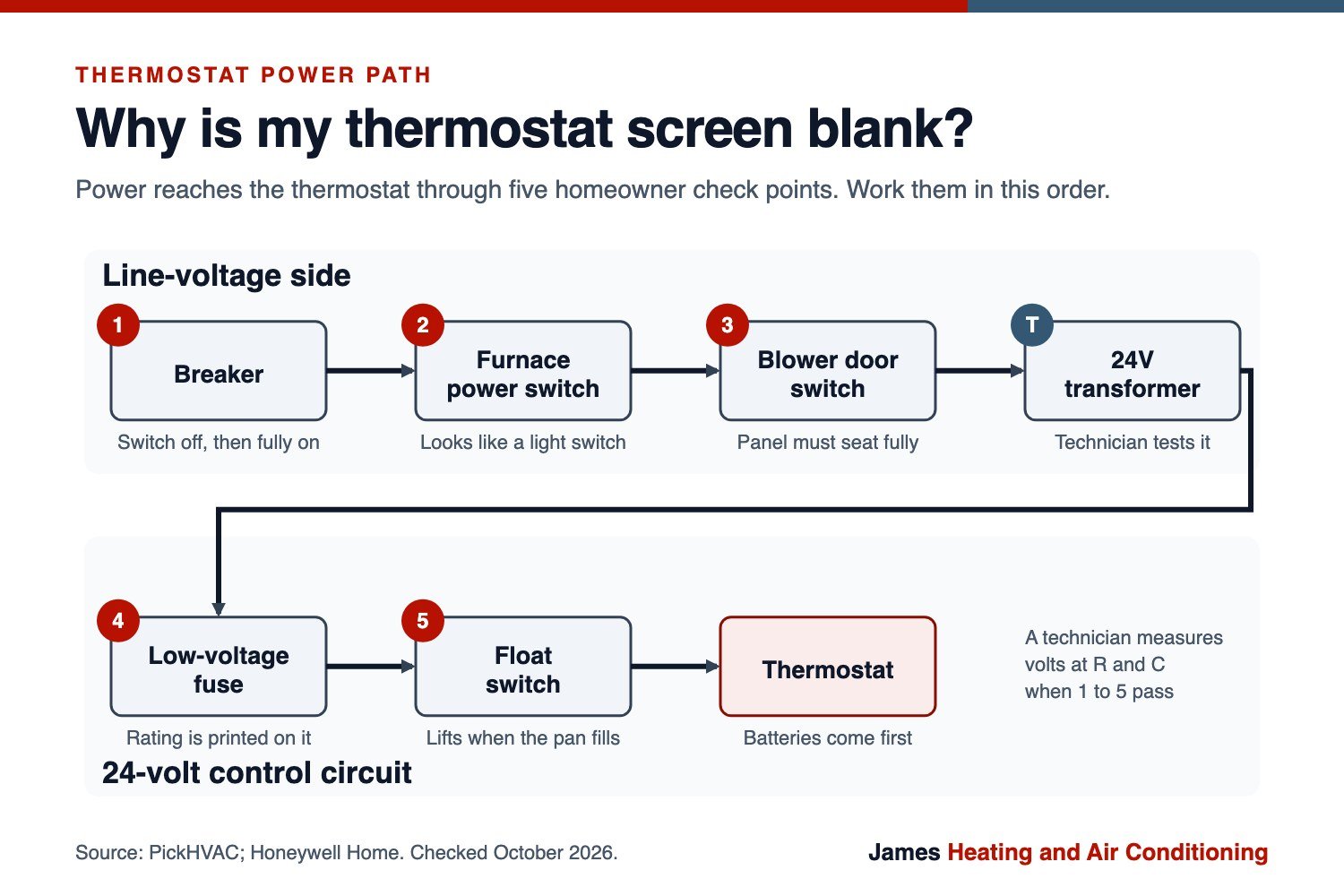
Power reaches your thermostat in a line, and a break anywhere along it blanks the screen. We check the cheapest and safest points first, and we test the rest with a meter. We suggest you start at the same end.
Start with the batteries. If your thermostat takes AA or AAA cells, put in fresh ones. Honeywell Home’s support page gives the same first step. On a thermostat wired for power, the batteries are only backup, so it may stay dark.
Then work through the numbered points on the drawing.
- Breaker. Find the breaker for the furnace or air handler, switch it fully off, then on.
- Furnace power switch. It looks like a light switch, on or near the furnace. Make sure you’ve got it on.
- Blower door switch. A furnace blower door that isn’t fully seated trips a safety interlock and cuts power. Honeywell lists the furnace door kill switch alongside the breaker and power switch.
- Low-voltage fuse. The next section covers it.
- Float switch. The section after that covers it.
The transformer, marked T, is the one point we test with a meter rather than ask you to touch.
Why is my thermostat still blank after I changed the batteries?
The thermostat is probably wired for power, and the batteries are only backup. If it wakes up on batteries but the system still won’t run, or it only runs on batteries, Honeywell’s guidance is to involve a technician. We diagnose that kind of fault from the thermostat back to the board, and we inspect the wall plate for a loose wire first.
Can a blown low-voltage fuse blank my thermostat?
Yes. A short in the thermostat wiring or an accessory can blow the small fuse that protects the 24-volt control circuit, and that kills the controls and the display.
Most furnaces and air handlers use an automotive-style blade fuse on the control board. PickHVAC puts it at 3 to 5 amps. Read the rating printed on your fuse, because ratings differ by equipment. We check the printed rating before we replace a fuse.
If you’re comfortable opening the unit, turn the furnace power switch off first. Look at the fuse. You’ll see a broken metal strip or a dark fuse if it’s blown. Replace it with the same rating, once.
If the new fuse blows, stop. Something is shorting, such as a nicked or pinched thermostat wire, an accessory, or the board itself. A bigger fuse doesn’t fix a short. We inspect the board for scorch marks before we power it back up. It lets the short run hotter through the transformer and board, so never upsize it. On these calls we inspect the thermostat cable at both ends. We test the board next, and we replace nothing on a guess.
Can a clogged drain make my thermostat go blank?
Yes. A clogged condensate drain fills the pan, a float switch lifts, and the switch opens the 24-volt control circuit that powers your thermostat.
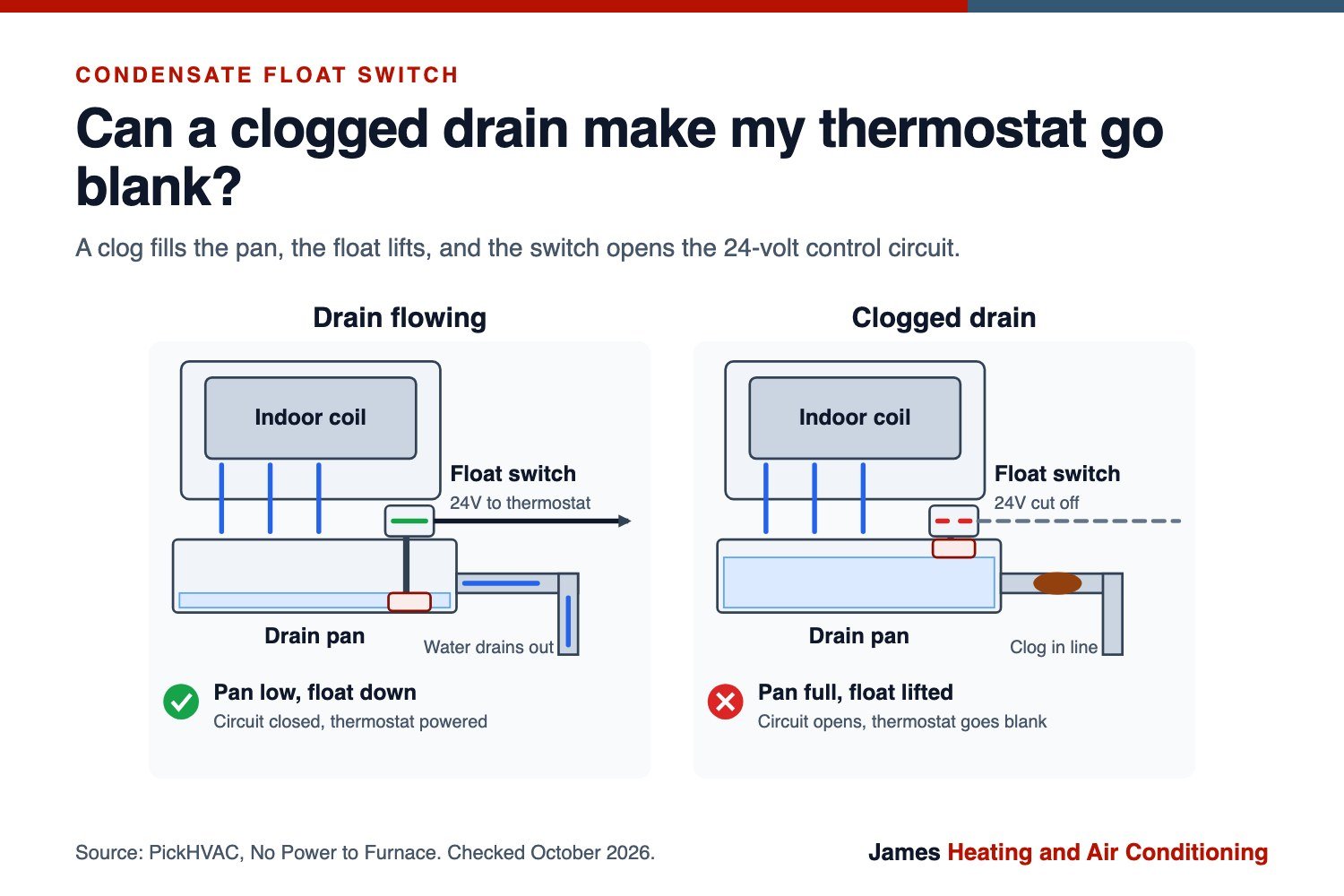
The float switch sits in or beside the drain pan. PickHVAC’s no-power guide describes it on condensing furnaces, and the same logic applies to an air conditioner’s pan. The equipment stops, and so does the power running to the thermostat.
Cooling season is when drains clog, but a pan that stayed full in September can still hold your circuit open in November. If your air handler sits in a crawlspace or attic, the float switch is up there with it. If you see water in the pan or a float riding high, that’s the tell.
We clean the drain line during air conditioning repair or a maintenance visit, because a drain that clogged once can clog again. When we service a pan like this, we clean the drain line and test the float before we leave. We inspect the pan for standing water first, and we test the float by hand with the power off. A clogged condensate drain is a maintenance item, which is why preventative maintenance is the cheaper way to meet it.
Never splice the two float-switch wires together to get the system running. PickHVAC’s warning is plain: never bypass limit, rollout, door or condensate switches. That switch is the only thing standing between a clogged drain and water on the ceiling below.
What do the thermostat wires and terminals do?
Each terminal on the thermostat base carries one job in the 24-volt control circuit. R brings power in, and the other letters send calls out to the furnace, air conditioner, blower or heat pump.
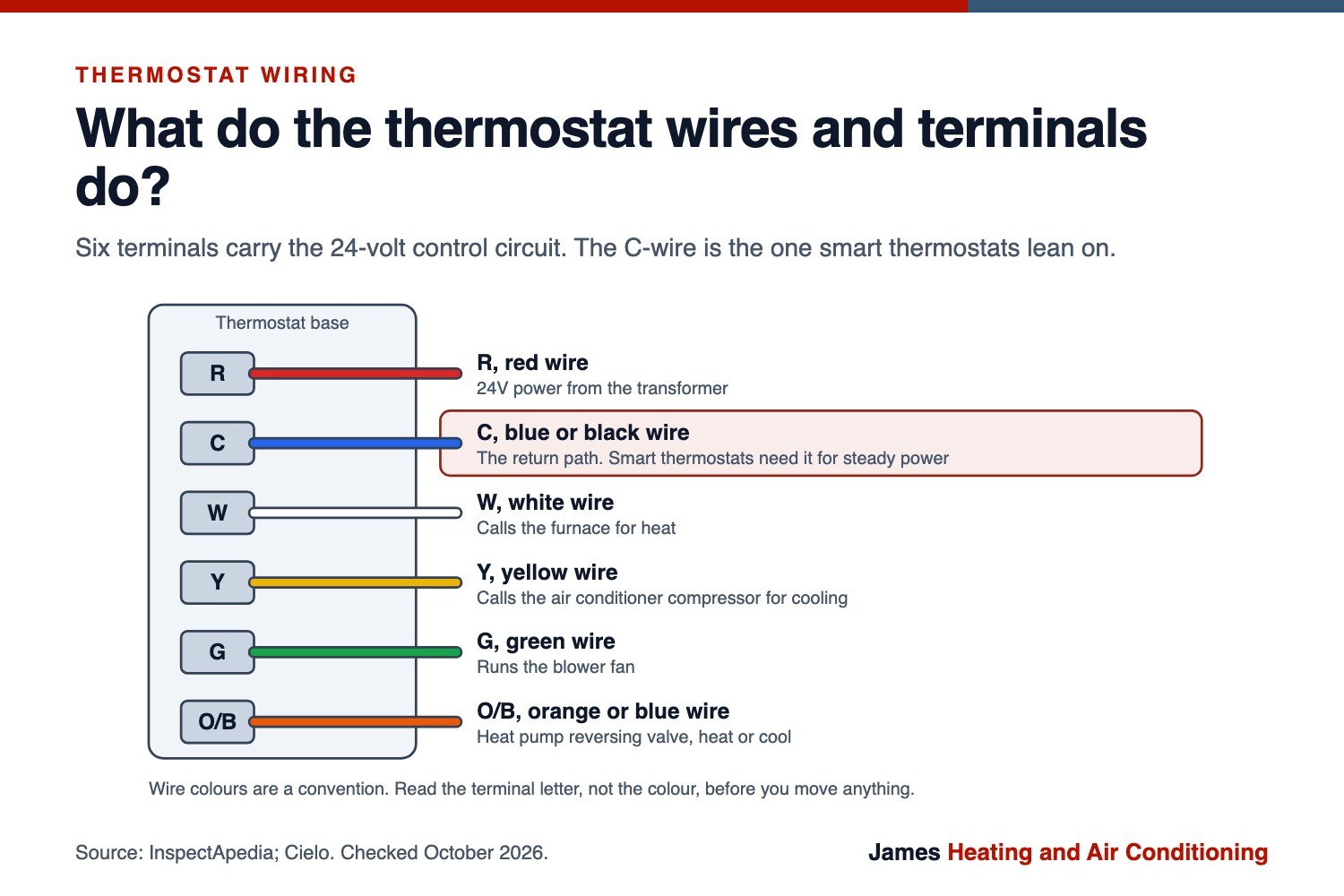
This is how InspectApedia and Cielo describe the usual layout.
- R, red. It carries 24-volt power from the transformer. Systems with two transformers split it into RC for cooling and RH for heating.
- C, blue or black. It’s the return path for that power. It can be any colour that the other terminals don’t use.
- W, white. It calls for heat.
- Y, yellow. It calls for cooling.
- G, green. It runs the blower fan.
- O/B, orange or blue. On a heat pump, it controls the reversing valve.
Colours are a convention, not a rule. InspectApedia notes that Rheem and Ruud units use a dark blue wire where other makes use orange, and both sources warn that colour and connection points vary. Our technicians check the terminal letter and the equipment’s own diagram, never the colour alone. We inspect each terminal for a loose or corroded wire. If you open yours, photograph the wires first.
Does my smart thermostat need a C-wire?
Often, yes. A smart thermostat runs a screen, a processor and a Wi-Fi radio around the clock, and the C-wire supplies the steady power that keeps them alive.
Google’s Nest help says heat-only, cool-only, zone-controlled and heat pump systems require a C wire, and that a thermostat may need a C wire or the Nest Power Connector for enough consistent power. Without it, expect random reboots, a blank or dim screen, a “no power” alert or an app that shows the thermostat offline.
We check for a spare wire first, and you can too. A thermostat cable often carries a spare conductor tucked behind the wall plate, and Google’s guidance is to connect it to the C terminal if one’s available. If there isn’t one, we install a power adapter or a new run of cable. Google states that a new C wire installation generally requires a pro, and we handle that job. We check what sits behind your wall plate before we quote it.
Two cautions from the same help page. Turn the system off before you touch the thermostat wires. And a “no power” alert doesn’t always point at the thermostat, since the cause can also be the breaker, the system switch, or something else stopping power from reaching the thermostat wires.
Why does my thermostat say heat is on but I get no heat?
The thermostat is calling for heat and the equipment isn’t answering, or a setting is overriding what you typed. We check the settings first because they cost nothing.
- Mode. After a summer on Cool or Off, a thermostat can sit in the wrong mode. Set yours to Heat.
- Setpoint. Heat starts only when the setpoint is above the room temperature. Raise yours five degrees to test.
- Hold, vacation or schedule. A forgotten hold or an away schedule can override your input. Cancel the hold and look at the schedule’s current block. We check both before we blame the equipment.
- Fan. Fan On runs the blower continuously. It doesn’t start the heat.
- Placement. If yours sits on a sunny wall, over a supply register, near a lamp or in a drafty hallway, it reads the wrong room temperature. Stand a separate thermometer beside it for 15 minutes and compare. If the two disagree by a few degrees, the location or the sensor is the issue, and we relocate the thermostat.
If the settings are right, the fault is usually on the equipment side. We check the furnace switch and door next. Then read our furnace blowing cold air guide, or see furnace repair in Eugene for what comes next.
The U.S. Department of Energy says turning a thermostat down 7 to 10 degrees F for 8 hours a day in fall and winter can save as much as 10% a year. It also says not to do that with a heat pump unless the thermostat is designed for heat pumps, because a manual setback can trigger backup electric-resistance heating, which the DOE calls more expensive.
Why does my heat pump blow cool air in heat mode?
The thermostat’s O/B setting is the first suspect. A heat pump uses a reversing valve to switch between heating and cooling, and the thermostat controls it through the O/B terminal.
Google’s heat pump help for Nest says to flip the setting. If O is selected, choose B, and if B is selected, choose O. Then test heat and cool modes separately, as we do after any change. The same page says a conventional furnace system shouldn’t have a wire in the O/B connector at all.
If changing the setting doesn’t fix it, our technicians check the wiring and the reversing valve. A heat pump that leans on its backup strips is a different issue, covered in our emergency and aux heat guide, and ice on the outdoor unit has its own guide. We test the wiring and the valve. The thermostat setting is the only part you should test yourself.
When do I stop and call a technician?
Stop when you’ve checked the batteries, breaker, switches, fuse and float all check out and the thermostat is still dead. Low voltage is gentler than line voltage, but the work still sits next to it.
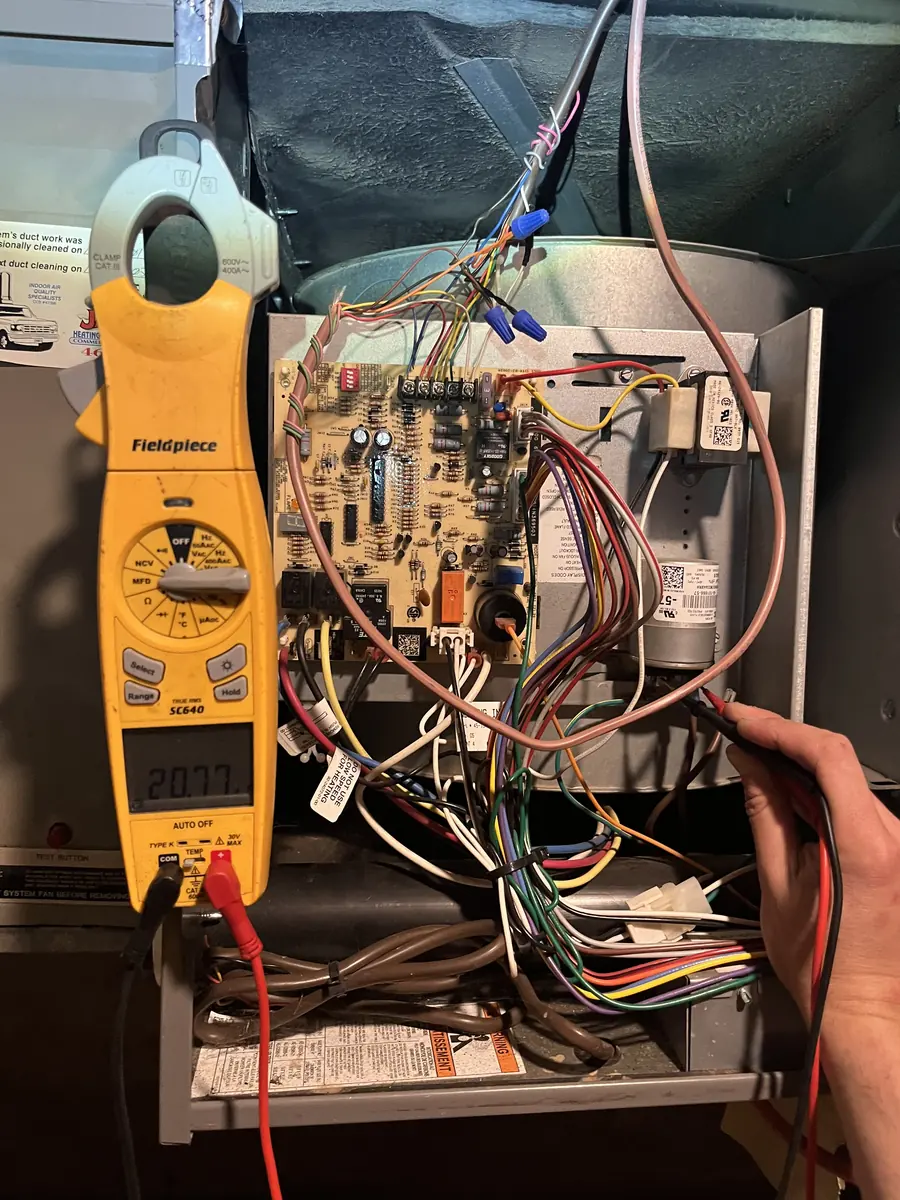
The fault is then in one of three places, and we check them in this order.
- Thermostat wiring. A cut, pinched or corroded wire, or a loose terminal at either end, interrupts the 24-volt circuit.
- Transformer. It steps line voltage down to 24 volts. If it fails, the control circuit goes dead with every switch and fuse in good order.
- Control board. The board takes the thermostat’s call and starts the sequence. A failed board can blank the thermostat or ignore it.
We diagnose this with a meter. Our technicians check voltage at the board’s R and C terminals, then test along the thermostat cable. That tells us whether the 24 volts are missing at the source or lost somewhere in the run, so we replace nothing on a guess. If you smell gas or burning, or a breaker trips the moment you reset it, leave it off and call.
How much does it cost to fix a thermostat that isn’t working?
The cheap causes cost nothing, meaning batteries, a breaker or a door panel. When the cause is deeper, these are national guide ranges, not James Heating and Air Conditioning prices. We quote a written price after we inspect your system, and wire runs through a finished wall move the number.
| Repair | National guide range | Source |
|---|---|---|
| Thermostat replacement, installed | $85 to $300 (average about $200) | Fixr |
| Smart or Wi-Fi thermostat, installed | $185 to $600 | Fixr |
| New thermostat wiring (added to the job) | $90 to $400 | Fixr |
| 24-volt transformer replacement | $120 to $220 typical (low $45, high $500) | PickHVAC |
| Furnace control board replacement | $300 to $900 for most homeowners | PickHVAC |
A new thermostat is the low end. A transformer or control board only enters the picture when everything upstream tested clean, and we test it with a meter before we replace anything.
Frequently asked questions
Why won’t my thermostat turn on the AC?
A tripped condensate float switch or a blown low-voltage fuse can cut power, as can a thermostat set to the wrong mode. Check that you’re in Cool mode with a setpoint below room temperature first. We check the pan, the fuse and the breaker next.
Why is my thermostat blank after a power outage?
An outage can leave a breaker tripped or the furnace power switch off. Check both, then run the numbered checks above. If the thermostat only wakes on batteries, we check the wiring and the board.
Can I replace a thermostat myself?
A like-for-like swap is a reasonable DIY job with the power off at the breaker and a photo of the wires before you disconnect anything. Adding a C-wire or fixing a wire in the wall isn’t. We replace thermostats and check every wire against its terminal letter. Google says a new C wire installation generally requires a pro.
How much does it cost to replace a thermostat?
Fixr puts installed replacement at $85 to $300, about $200 on average, and smart models at $185 to $600. New wiring adds $90 to $400. Those are national figures. We quote a written price after we inspect your system.
Is a blank thermostat an emergency?
In cold weather it can be. A blank thermostat can’t call for heat, so a furnace or heat pump won’t start. Once the power checks fail and the house is cooling, call. We answer both lines 24 hours a day.
Call James Heating and Air Conditioning
When the checks don’t turn up the cause, we diagnose it from the thermostat to the board. Founded in 1983, James Heating and Air Conditioning holds Oregon CCB license #47396. We answer both offices day and night. We install and service thermostats, and our technicians serve Eugene, Springfield, Salem and Keizer homes. See HVAC diagnostics and repair or heating repair.
- Eugene-area homes in Lane County: (541) 461-2101.
- Salem-area homes in Marion or Polk County: (503) 581-9982.