






A heat pump frozen outside is normal when you see a thin layer of frost that melts in a defrost cycle of about 5 to 15 minutes, with steam and a stopped fan. It’s a problem when solid ice stays after a full cycle, reaches the fan, or comes back within 30 minutes.
Want a technician now? Eugene, Springfield and Lane County homes call (541) 461-2101. Salem, Keizer and Marion County homes call (503) 581-9982. James Heating and Air Conditioning answers both numbers day and night, every day of the week.
Is it normal for a heat pump to be frozen outside?
Thin, even frost on the outdoor coil is normal. A solid block of ice that stays after a full defrost is not.
Walk out and look at your unit while the heat is running. We check what you describe against the table below, and you can run it yourself in a minute.
| What you see | Normal? | What to do |
|---|---|---|
| Thin, even frost on the coil on a cold, damp morning | Yes | Nothing. The next defrost clears it |
| Steam rising off the unit with the fan stopped | Yes | Leave the system alone and let the cycle finish |
| A hiss, then a whoosh or grinding sound as the unit switches modes | Yes | Same. That’s refrigerant changing direction |
| Frost gone in 5 to 15 minutes, back hours later | Yes | Nothing |
| A solid sheet of ice over the coil that’s still there after a full defrost | No | Turn the heat pump off at the thermostat and call us |
| Ice reaching the fan blade or building up the cabinet | No | Same |
| Defrost starting more often than every 30 minutes | No | Call us, and note the times |
Frost on the copper lines alone isn’t a verdict. We check the coil and the fan first.
How long should a heat pump defrost cycle last?
About 5 to 15 minutes, with a new cycle every 30 to 90 minutes of compressor run time.
Those are the figures HVAC/R School gives homeowners, and we check your unit’s behavior against them. In heating mode your outdoor coil runs colder than the air, because that is how the heat pump pulls heat out of the air. Moisture freezes onto that cold coil.
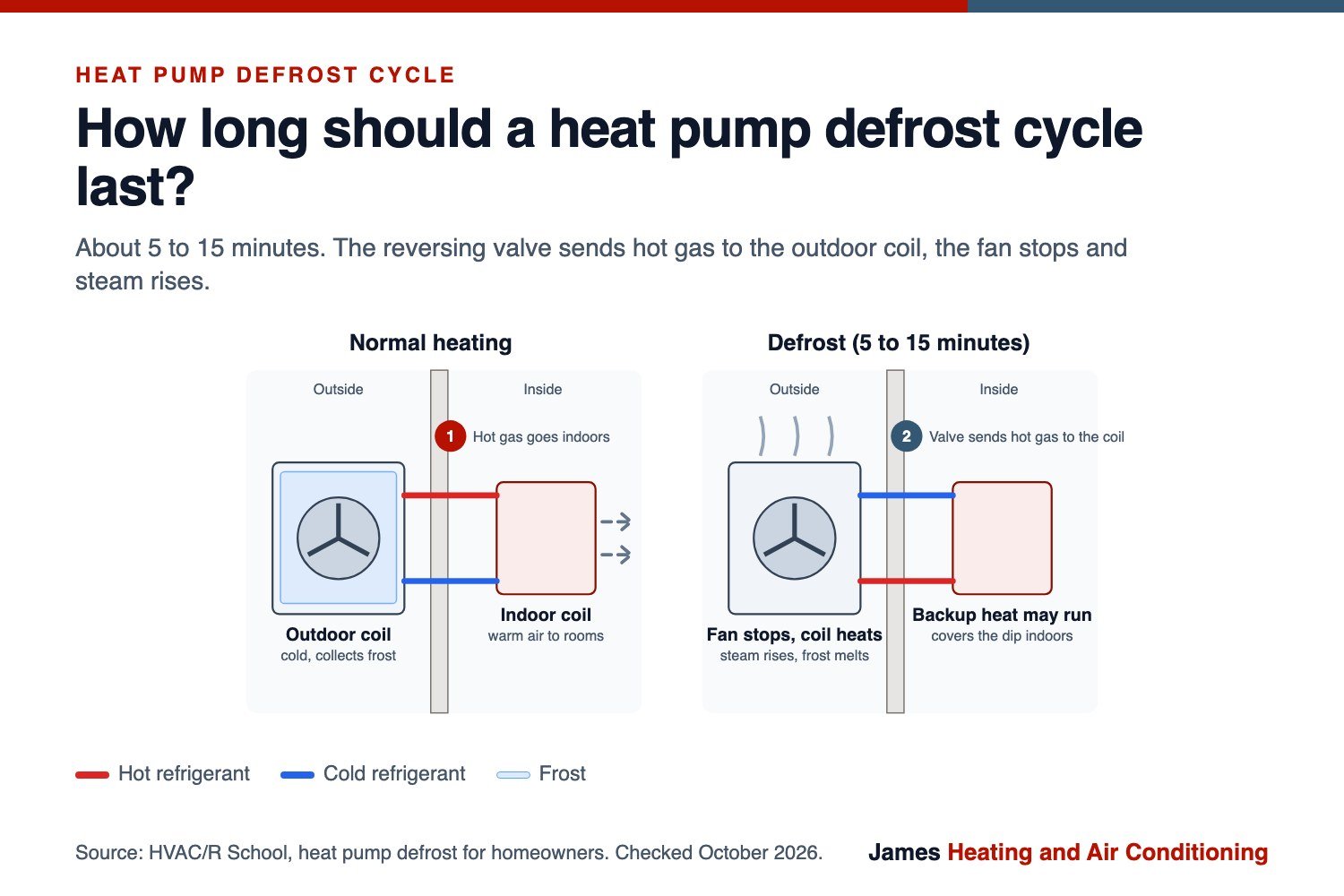
The reversing valve flips the refrigerant flow so hot refrigerant runs through the outdoor coil and melts the frost. We check that the fan stops and the steam rises, because those two signs tell us the valve flipped. You may also hear a hiss and then grinding as the pressures change.
Indoors, your air can feel slightly cooler for a few minutes. Electric backup heat may run during a defrost, and a brief, faint burning smell can come with it. That’s a separate topic from ice.
InspectApedia adds two limits for timer-style units. A cycle ends after about ten minutes at most, and a unit that defrosts at intervals under 30 minutes has something wrong with it. Our technicians check the time between your cycles against that 30-minute line, so tell us what you noticed when you call.
Why does my heat pump frost up in Eugene and Salem winters?
Willamette Valley winters are cold enough to frost a coil and wet enough to keep feeding it.
Frost doesn’t need a hard freeze. InspectApedia says that below 35°F you should expect ice to form on your outdoor unit, and the unit should defrost itself. NOAA’s 1991-2020 climate normals show how often that happens, using Mahlon Sweet Airport for Eugene and McNary Field for Salem. Our technicians service units in both cities, so these are the winters your unit faces.
| Month | Eugene nights at 32°F or lower | Eugene nights at 40°F or lower | Eugene days with 0.01 inch of rain or more | Salem nights at 32°F or lower |
|---|---|---|---|---|
| November | 7.5 | 18.5 | 17.5 | 6.5 |
| December | 11.6 | 24.8 | 18.7 | 11.9 |
| January | 11.2 | 24.3 | 17.9 | 11.0 |
| February | 10.4 | 21.3 | 15.5 | 10.2 |
In December, Eugene’s average overnight low is 34.3°F and Salem’s is 35.1°F. Eugene normally gets 7.21 inches of precipitation that month, spread over 18.7 wet days. A typical December night sits right at the temperature where a coil frosts. With 24.8 nights a month at 40°F or lower, your outdoor unit in Eugene or Springfield defrosts routinely, and Salem’s numbers run close behind. That’s the design working. Our technicians expect it.
A unit that defrosts all winter has more chances to show a fault, and a failed defrost part rarely announces itself in September. Our technicians test the defrost parts before the cold arrives, during a tune-up visit. We check the overnight low and the rain before we blame your equipment.
How can I tell normal frost from a real problem?
Our technicians look at three things on every frozen-unit call. Is ice still there after a full defrost, has it reached the fan, and how often does defrost start?
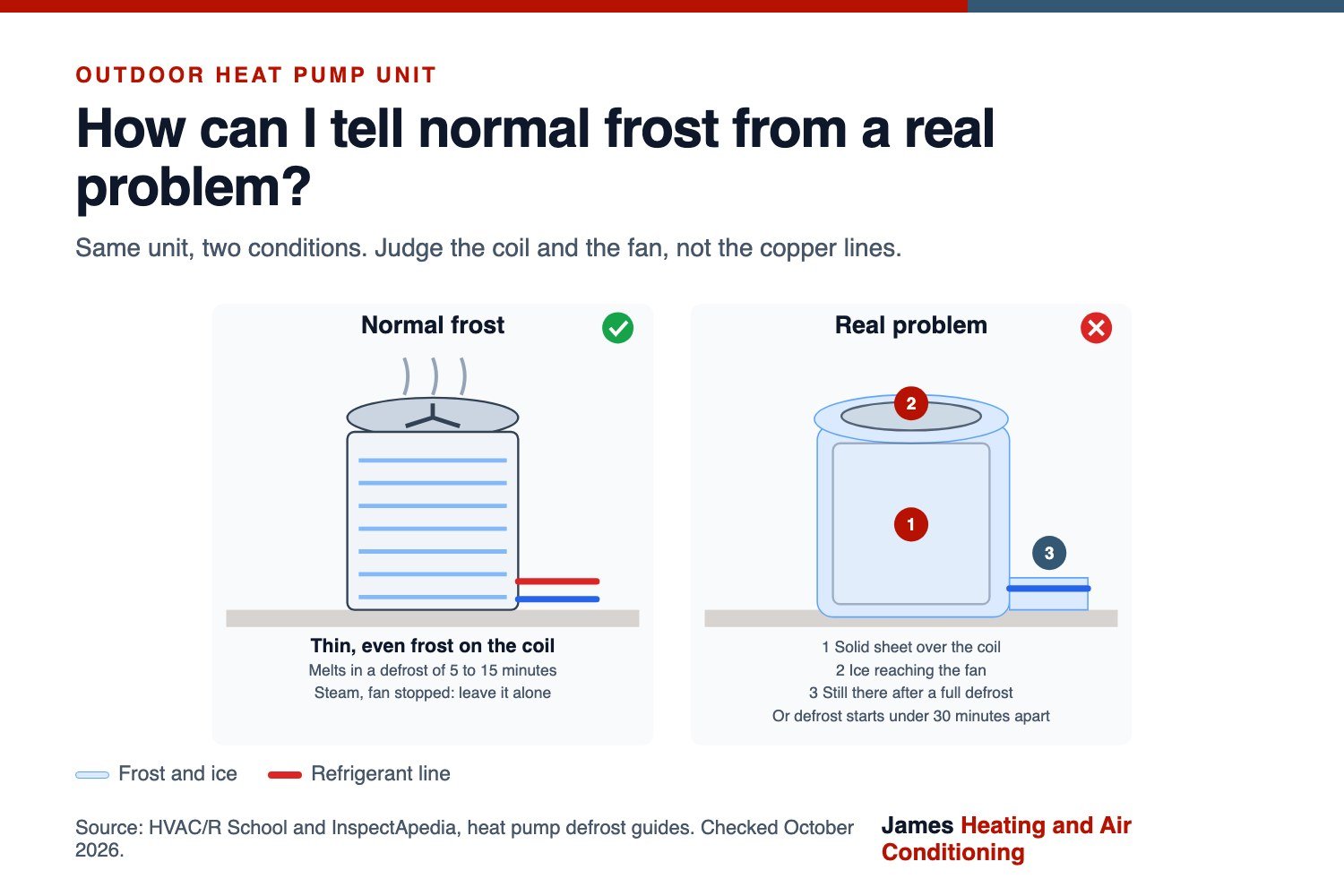
HVAC/R School calls a light layer of frost standard and warns that unaddressed frost can build into thick sheets of ice. Frost insulates the coil, so a heat pump wearing a thick coat moves less heat and works harder for less. We check ice against these six signs on a service call, and you can check the same six before you phone.
- Ice remains after a complete cycle. PickHVAC’s rule is the simplest. If ice persists after a complete defrost cycle, call a technician.
- The coil is a solid sheet of ice instead of an even frost, or the ice has reached the fan.
- Defrost keeps starting inside 30 minutes. That interval is InspectApedia’s line for something wrong.
- The unit never defrosts at all. Below 35°F it should defrost itself, so if yours stays frosted over for hours in that weather, a defrost part isn’t doing its job.
- Steam never stops, or a burning smell comes from the unit itself instead of a faint, short whiff from backup heat indoors.
- Cold air comes from your vents for long stretches while the outdoor unit sits in defrost.
What should I do when my heat pump is iced over?
Wait out one full defrost cycle, clear what blocks the unit, and call us if the ice is still there. Our technicians answer day and night, so you never wait for morning to ask.
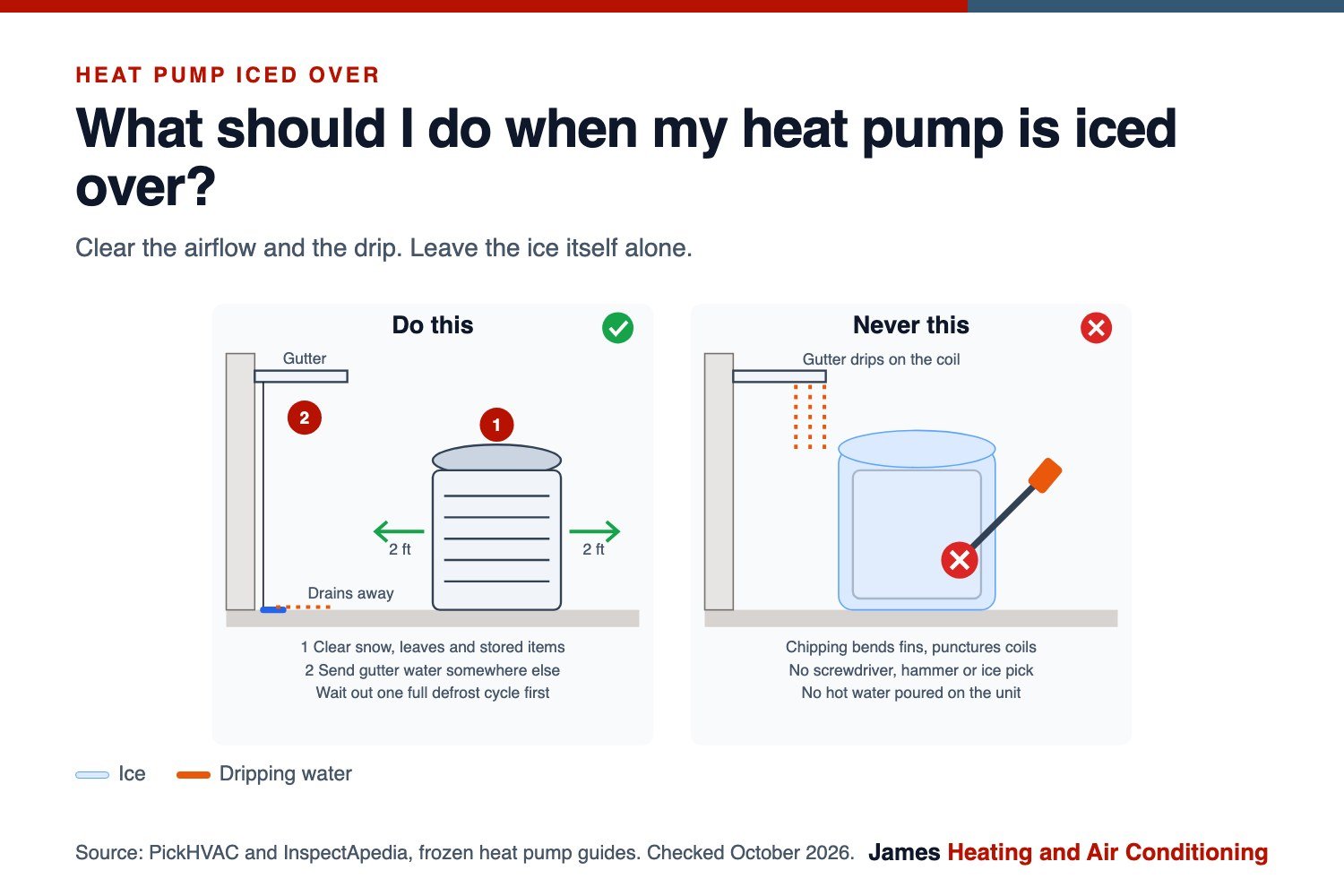
We run through this order with you on the phone.
- Watch one full defrost cycle, 5 to 15 minutes, and don’t switch the unit off while it runs.
- Clear leaves, bark, snow and stored things so about 2 feet of space stays open around the unit. Your installation manual has the exact figure for your model, and nothing should sit on top of the unit.
- Look at the gutter above the unit. December brings 18.7 wet days in Eugene, and a gutter that overflows onto your coil adds to every one of them. PickHVAC notes that runoff dripping onto the coil and freezing can quickly encase a unit, so redirect the downspout.
- Leave the ice alone. Skip the screwdriver, the hammer, the ice pick and the hot water.
- If ice is still there after a full cycle, turn the heat pump off at the thermostat and call us. If the unit is sealed in ice, switch to emergency heat until a technician arrives.
The fins are thin aluminum, and the tubing behind them carries refrigerant. We repair bent fins and punctured coils after someone chips a unit. PickHVAC says those are expensive repairs. InspectApedia adds one more rule. Never shut your heat pump off mid-defrost. If you have to turn it off, leave it off at least 30 minutes before restarting so the compressor isn’t harmed.
Why won’t the ice on my heat pump melt?
A failed defrost part, low refrigerant or a weak outdoor fan explains most ice that won’t clear.
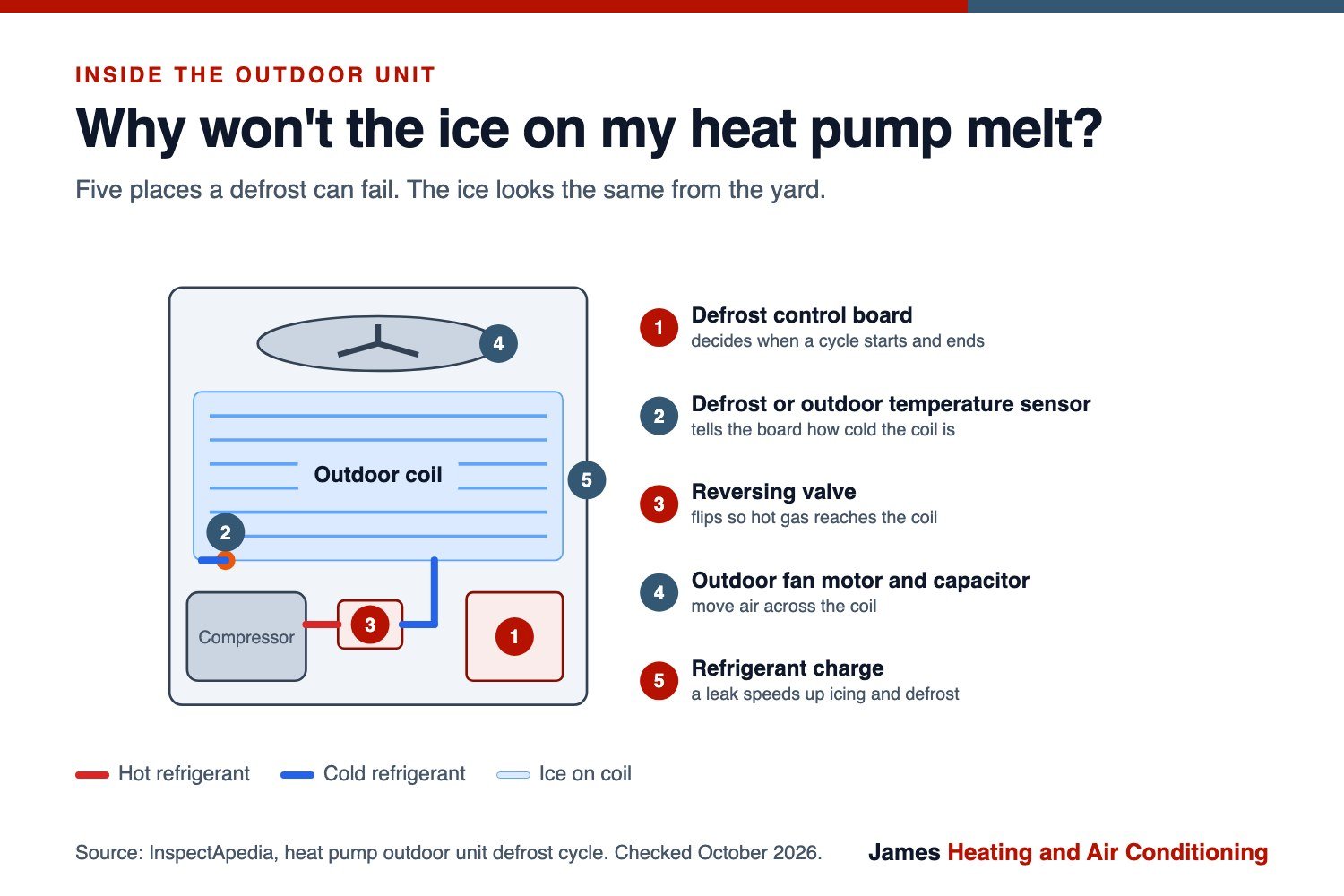
We check these five parts in this order on a no-defrost call, numbered as they are in the drawing.
- The defrost control board decides when a cycle starts and ends. We test it by forcing a defrost, because a failed board can stop defrost entirely or run it wrong.
- The defrost or outdoor temperature sensor tells the board how cold your coil is. We check it against a thermometer reading, since a failed sensor, or one that lost contact with the refrigerant line, can leave the unit stuck out of defrost or cycling too often.
- On most units, if the reversing valve can’t flip, hot refrigerant never reaches the coil, so nothing melts. We check whether the valve flips and whether the fan stops during the forced defrost.
- InspectApedia lists a bad fan motor, relay or run capacitor as causes of a fan that runs slowly or not at all, which starves the coil of air. We test the motor and capacitor, which the board can’t see.
- A leak lowers the system temperature and speeds up the defrost cycle rate, so your unit ices and cycles more. We check refrigerant pressures with gauges before we call it a leak.
A blocked coil, a blocked side or a gutter dripping onto the unit looks the same as a failed part until someone checks. A failed board and a failed sensor can look identical from your yard too. Our technicians inspect the coil, the sides and the gutter first, and the diagnosis comes before any parts order.
How does a technician find the cause of a frozen heat pump?
We work in a fixed order. We look at the unit, run the system, force a defrost, then test the parts the board can’t see.
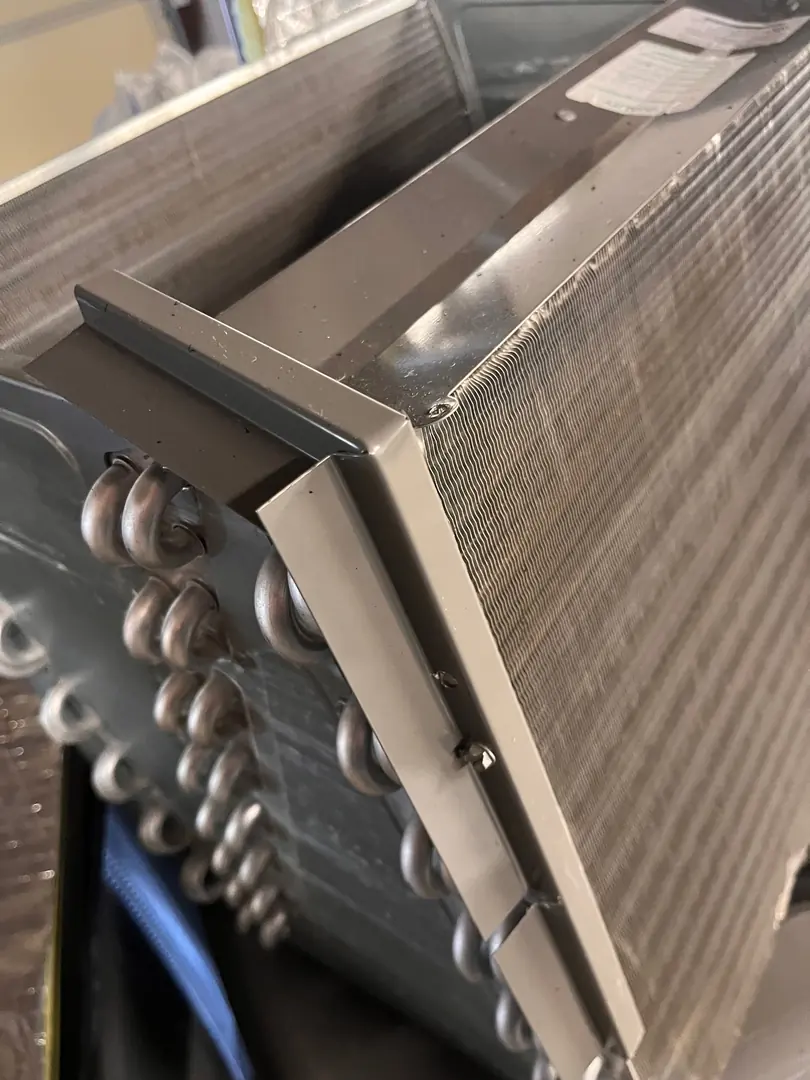
Our technicians service Ruud and Rheem heat pumps in Eugene, Springfield and Salem. Our technicians first ask whether the ice comes from weather and drip or from a failed part. Your visit goes like this.
- We inspect the unit, including coil condition, fan, clearances, and where water lands on it.
- We watch the system and note whether it enters defrost.
- We run a forced defrost at the control board (most boards have test pins for that) and check whether the valve flips and the fan stops.
- We check the outdoor temperature sensor against the actual line temperature with a thermometer.
- If the symptoms point to a low charge, we check refrigerant pressures with a gauge set.
- We test the fan motor and capacitor, which the board can’t see.
That sequence either clears the unit or names the part,. We quote the price before we start any work, whether the part is a defrost board, a sensor, a capacitor or a reversing valve.
Ice that keeps returning is also a reason to look at your system’s age. We check that too. ENERGY STAR advises considering replacement of an AC or heat pump past about 10 years old. We cover what a new one runs in our heat pump cost breakdown. We service ductless outdoor units too, and they defrost by the same logic, so everything above applies to a mini-split.
What does a heat pump defrost repair cost?
National guides put most defrost repairs between about $120 and $1,000, and we quote the exact price after we inspect your unit.
We inspect first, because the price depends on which part failed. The figures below come from HVAC.com, not from our price list. Your quote moves with the model, the parts and access to the outdoor unit. We handle the quote before any parts get ordered.
| Repair | National guide range | Source |
|---|---|---|
| Defrost control board, installed | $200 to $500 | HVAC.com |
| Reversing valve replacement | $400 to $700 | HVAC.com |
| Refrigerant leak repair | $200 to $1,000 | HVAC.com |
| Capacitor or contactor replacement | $120 to $250 | HVAC.com |
HVAC.com notes that a sensor fix usually costs less than a whole board, though it gives no figure for one. No reliable price turned up for an outdoor fan motor either, so none is listed. These ranges come from a November 2024 article and shift with labor and parts.
Call James Heating and Air Conditioning
If your coil is still iced after a full defrost, don’t wait for it to melt on its own. James Heating and Air Conditioning holds Oregon CCB #47396 and has served the valley since 1983. We service heat pumps in Eugene, Springfield, Salem and Keizer, and we answer around the clock. We offer HVAC diagnostics and repair and heating repair for frozen units. We also inspect the outdoor coil, fan and controls during a yearly preventative maintenance visit, ahead of the frost.
- Eugene, Springfield and the rest of Lane County: (541) 461-2101.
- Salem, Keizer and the rest of Marion and Polk counties: (503) 581-9982.
Frequently asked questions
Why is steam coming off my heat pump?
Steam means the defrost cycle is melting frost. Hot refrigerant is running through the outdoor coil, and warm metal meeting cold ice and air makes vapor. It’s harmless and should stop when the cycle ends in about 5 to 15 minutes. We check for steam that never stops, since that points to a stuck cycle.
Should I pour hot water on a frozen heat pump?
No. At near-freezing temperatures the runoff can refreeze on the coil, and a unit in a working defrost cycle melts its own frost in minutes. If ice is still there after a full cycle, we diagnose it instead of forcing it. Our technicians repair the fin and coil damage that hot water and tools leave behind.
Should I turn my heat pump off if it’s iced over?
Not while it’s mid-defrost. If your unit is sealed in solid ice or ice persists after a full cycle, turn it off at the thermostat and call us. We run it again only after at least 30 minutes off.
Does a heat pump ice up in Eugene when it isn’t freezing?
Yes. Frost forms when the coil runs colder than the air, and InspectApedia says to expect ice formation below 35°F. Eugene’s December nights average 34.3°F, so frost is routine. Our technicians check the overnight low against that 35°F line before they suspect a fault.
Why is my heat pump frozen in the summer?
In cooling mode the indoor coil is the cold one, so summer ice usually points to airflow or refrigerant trouble inside your house. We service the indoor coil and the airflow around it. A frozen evaporator coil has its own fixes.
Is a frozen ductless mini-split the same problem?
Yes. A ductless outdoor unit defrosts by the same cycle, so the same 5 to 15 minute rule, the same clearance and drip checks and the same call-us signs apply. We service ductless outdoor units the way we service ducted heat pumps.