




Your furnace blows cold air when the blower runs while the burners are off, or before the heat exchanger has warmed. Cool air for the first moments of a cycle is normal. Cold air that lasts usually traces to the fan setting, a dirty filter or a stalled ignition step.
Want a technician now? In Eugene, Springfield or Lane County, dial (541) 461-2101. In Salem, Keizer or Marion County, dial (503) 581-9982. We answer both lines around the clock. If you smell rotten eggs or a carbon monoxide alarm is sounding, go outside first and read the safety section below.
Is it normal for a furnace to blow cold air at first?
Yes. A gas furnace blows room-temperature air for the first moments of every cycle because the blower waits until the heat exchanger has warmed.
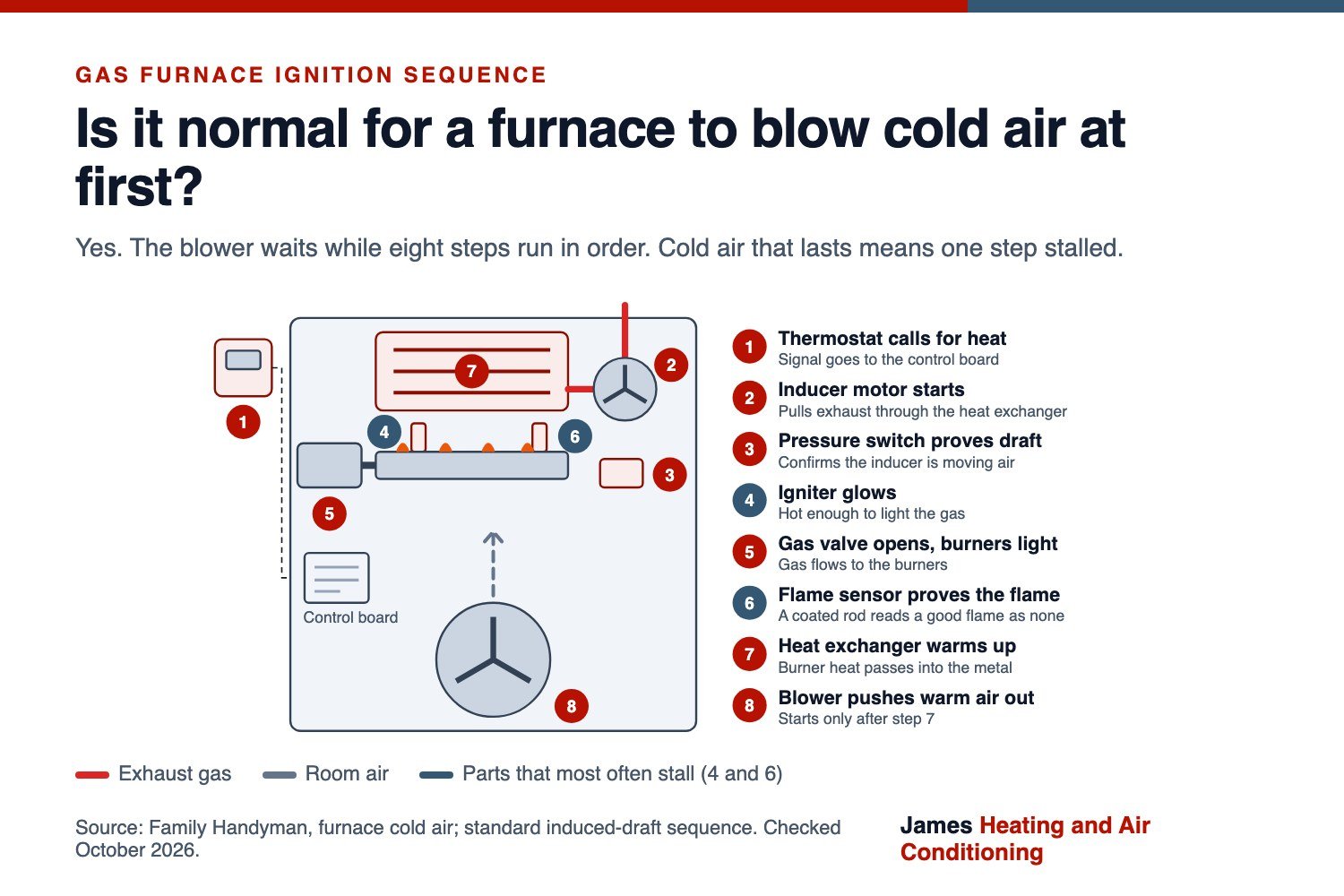
The order never changes. We test it in that sequence on every no-heat call. The thermostat calls for heat and the control board starts the inducer motor. The inducer pulls exhaust through the heat exchanger, and the pressure switch confirms the draft is moving. Then the igniter glows, the gas valve opens and the burners light. The flame sensor proves the flame, and the blower starts once the heat exchanger is warm.
A fault at any step stops the sequence right there. Family Handyman describes a failed igniter as a strong, steady flow of cold air followed by an abrupt stop. We check timing first because timing separates the two cases. Cool air that turns warm is your furnace working. Cold air that stays cold, or stops abruptly, means one step stalled. We inspect that step, and we test it before we replace anything.
Why is my furnace blowing cold air instead of heat?
Your furnace blows cold air instead of heat when the blower runs and the burners do not, so match when the cold air shows up to a cause.
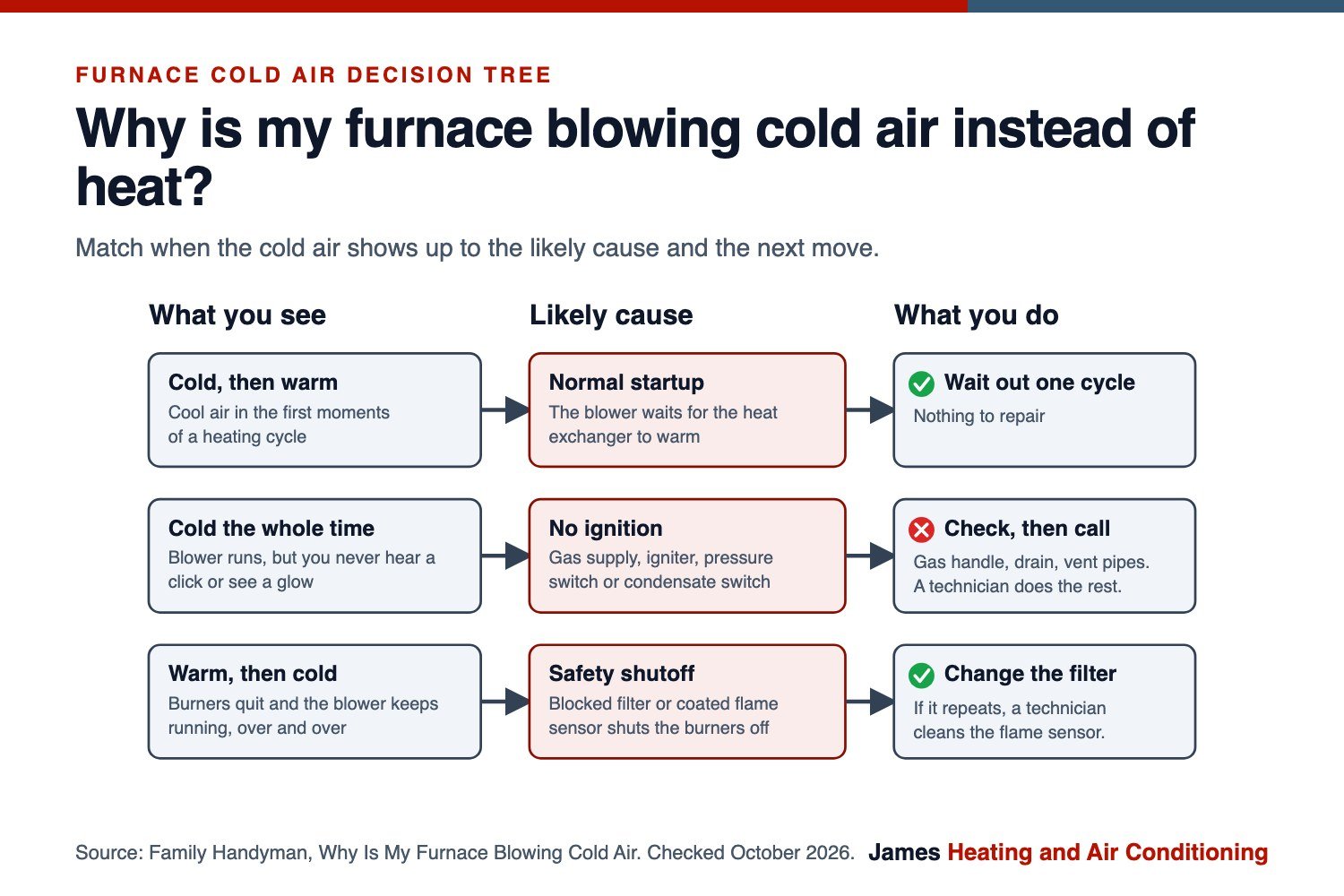
We diagnose every cold-air call the same way. Our technicians check when the cold air starts, how long it lasts and whether the burners ever light. We inspect nothing inside the cabinet until those answers point at a pattern.
| What you notice | Likely cause | Safe check | Who fixes it |
|---|---|---|---|
| Cool for the first moments, then warm | Normal startup | Wait out one full cycle | Nobody |
| Air blows only when the fan is set to On, warm only sometimes | Fan setting | Set the fan to Auto | You |
| Cold air for a short stretch, then the burners quit, over and over | Dirty flame sensor or weak igniter | Filter only, then stop | Technician |
| Blower runs, air stays cold, you never hear a click or see a glow | No ignition: gas supply, igniter, pressure switch or condensate safety switch | Gas valve handle, condensate line, outside vent pipes | Technician |
| Warm air that fades to cool in cycles | Limit switch tripping on overheating | Filter and registers | Technician if a new filter doesn’t fix it |
| No blower, no air | Power, door switch or breaker | Breaker, wall switch, door | Technician if the checks pass |
We check the fan setting before the filter, and the filter before any part. Heat pump homes read this table differently and get their own section below. Which rows can you handle yourself?
What can I check myself when my furnace blows cold air?
You can check eight things without tools or an open panel, starting with the thermostat and filter and ending with the control board light.
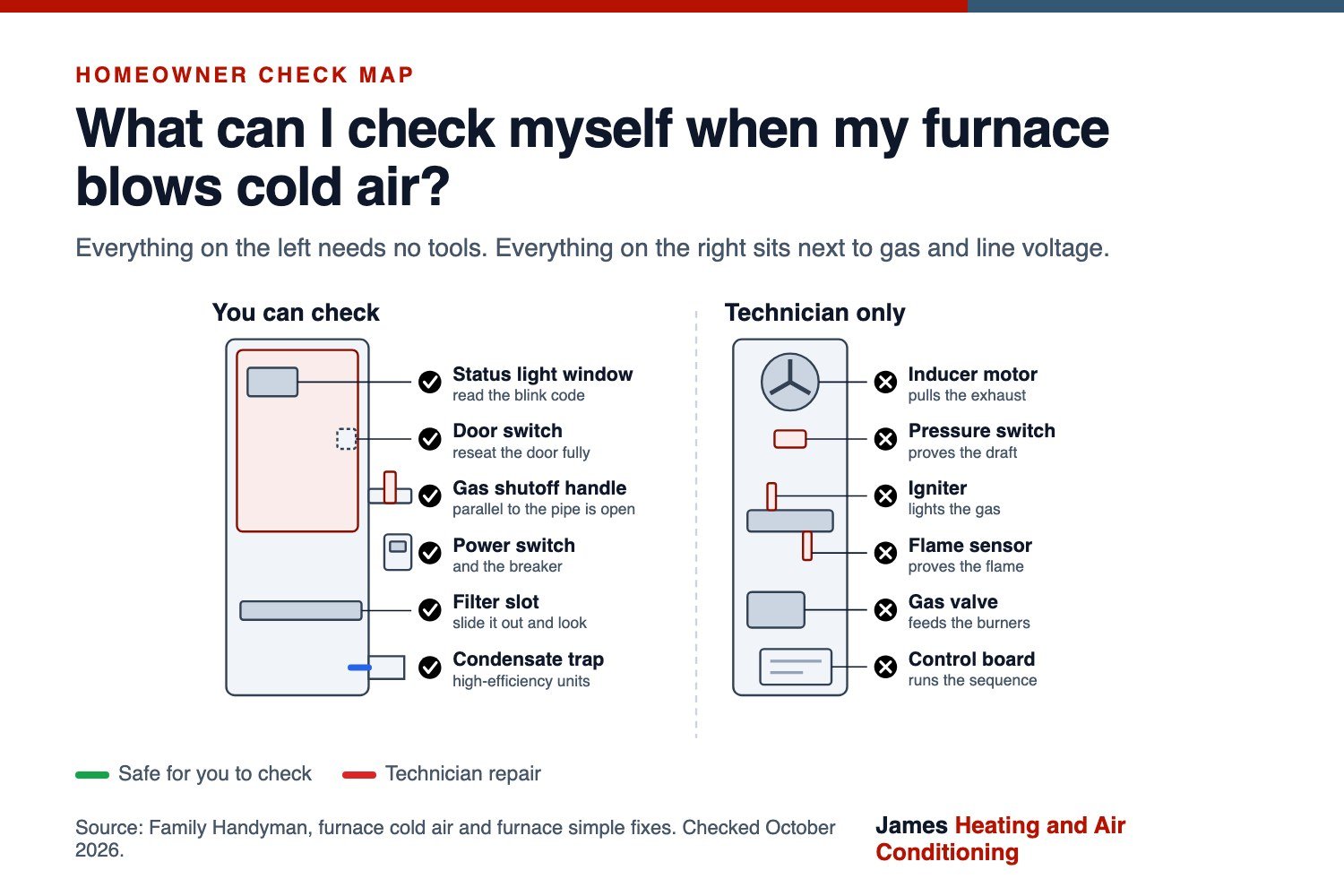
If you smell gas at any point, stop and go to the safety section. Otherwise, work through these in order.
- Thermostat. Set it to Heat, set the fan to Auto and raise the temperature a few degrees above the room. A fan left on On blows air whether or not the burners are lit, and our technicians check that setting before anything else. We test the call for heat only once the setting is right. Thermostat power, battery and wiring problems are a separate topic, so this is the one thermostat check that belongs here.
- Filter. A clogged filter overheats the heat exchanger, and the furnace shuts off to protect it. ENERGY STAR covers filter care in its maintenance checklist, which says to inspect, clean or change the filter once a month. See how often to change the air filter for pets, dust and wood smoke.
- Furnace door. A push-in switch behind the blower door cuts power if the door isn’t fully seated. We check that switch on every no-blower call, and you can press the door in until it seats.
- Wall switch and breaker. The switch near the furnace looks like a light switch, and someone may have bumped it. We check the breaker panel too, and you can do the same.
- Gas shutoff valve at the furnace. A handle running parallel to the pipe is open; crosswise is closed. If it was closed, open it once and let the furnace try again. We test for a gas smell before we touch any valve, and you should do the same.
- Condensate drain on a high-efficiency furnace. These units drain several gallons of water a day during heating season, and a restricted line trips a safety switch that stops the burners. Water pooled at the furnace or a trap full of sludge is your lead. We clean the trap and test the drain line, so call us if you aren’t sure where it sits.
- Outside vent pipes. On a high-efficiency furnace, the white PVC intake and exhaust pipes can clog with leaves, a nest or ice. Clear what you can reach from the ground. We clean the pipe ends and test the draft. We inspect both pipes end to end, and ice inside a pipe means a bigger problem.
- Control board light. Look through the small window in the furnace door. Most boards blink a code, and a label on the door decodes it. We diagnose from that pattern, so write it down before you call.
If the furnace locks out after failed ignition attempts, switch it off at the wall for a minute and back on. We run one reset, never a string of them. We check the gas valve and filter before it. A second lockout means a part is failing.
Why does my furnace blow cold air and then shut off?
Your furnace blows cold air and then shuts off when it loses the flame or overheats right after the burners start, usually from a coated flame sensor, a weak igniter or a clogged filter.
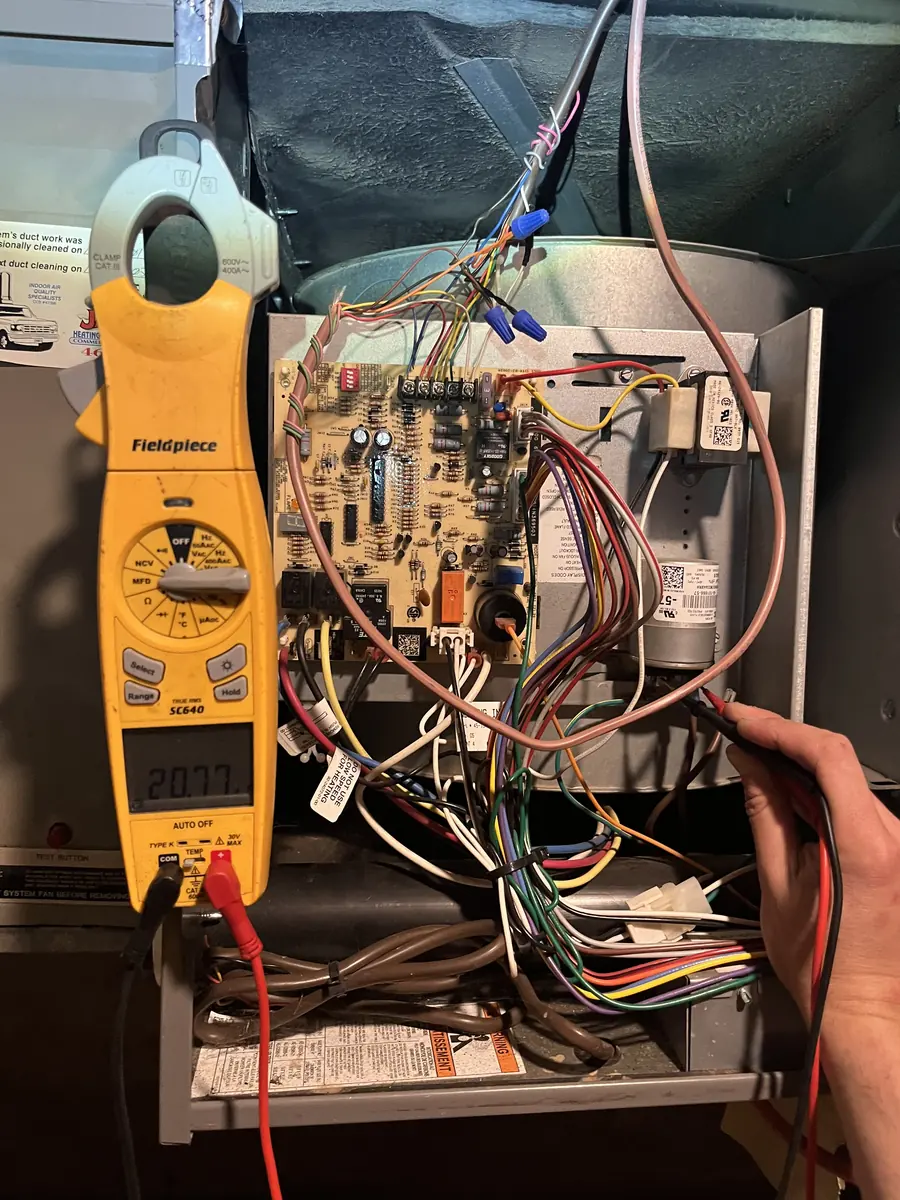
Everything below sits inside the cabinet, next to gas and line voltage. We service gas valves and control boards too. On a no-heat call we check the flame sensor first, then the igniter, then the safety switches. We test the inducer and the pressure switch with a meter. We replace the failed part and we check the sequence again.
| Part | What it does | What failure looks like |
|---|---|---|
| Inducer motor and pressure switch | Pull exhaust out and confirm the draft | Furnace won’t start, or starts and stops before lighting |
| Igniter | Glows to light the gas | Blower runs, no glow, no flame, cold air |
| Gas valve | Opens to feed the burners | Igniter glows, no flame |
| Flame sensor | Confirms the flame is burning | Lights, runs briefly, shuts off, repeats |
| Limit switch | Shuts the burners off if the furnace overheats | Warm air that fades to cool, usually from restricted airflow |
| Control board | Runs the sequence | Blinking fault code, or no response at all |
The flame sensor causes many repeat shutoffs. It sits in the flame’s path, and a coated rod misreads a good flame as no flame. Family Handyman puts the part itself at around $10 and calls cleaning it a quick fix, but reaching it means working inside a live gas appliance. We clean the sensor, then we test the flame signal and the rest of the sequence in the same visit.
Our technicians test the limit switch and the pressure switch; they never jump them to get heat back. Those switches exist for one reason. They shut a failing furnace off before it overheats or vents exhaust into your house. And when the valve at the furnace is open but the burners still get no gas, the fault sits upstream, and we hold the license for that repair.
Does your furnace keep running when you want it off? A fan set to On does that, and so does a tripped limit switch. Set the fan to Auto and change the filter, then call.
Is it a gas leak or carbon monoxide when the furnace blows cold air?
A furnace that blows cold air does not mean gas is leaking, but a rotten-egg smell means you leave the house first and troubleshoot later.
NW Natural says gas smells like rotten eggs or sulfur and that you should leave the house no matter what, even if the smell seems mild. Get out first. Don’t use a phone inside, flip a switch, light a match or start a car. NW Natural answers its 24-hour line at 800-882-3377, so call it once you’re outside and away. If gas ignites, don’t try to put it out; call the fire department.
Carbon monoxide has no smell. The EPA covers its sources and symptoms in a guide to carbon monoxide, and the sources include leaking furnaces, blocked or leaking flues and back-drafting. Headaches, dizziness, confusion and nausea are the effects, along with flu-like symptoms that clear up after you leave the house. If an alarm sounds or anyone feels those symptoms, get everyone outside and call 911. We check the flue and test for carbon monoxide only after the house is safe.
If both are true, a cold furnace and a gas smell, the smell wins. Leave first. NW Natural handles the leak, and we run the furnace diagnosis only after the house is cleared.
Why is my heat pump blowing cold air?
A heat pump delivers cooler air than a gas furnace even when it works, so cool-feeling air alone does not mean it has failed.
Most Lane County homes heat with electricity. The Oregon Department of Energy’s county profiles list electricity as the primary heating source for 75 percent of Lane County homes and 52 percent in Marion County, with natural gas at 18 and 41 percent. Electricity there includes heat pumps, baseboard and electric furnaces, so not every electric home has a heat pump.
Your heat pump can also run cool for a spell during a defrost cycle. Air that stays cold the whole time, or an outdoor unit buried in ice, needs a technician, and we inspect the outdoor unit for ice before anything else on that call. Ice has its own guide, and this post stays on gas furnaces. We service dual fuel systems too, where a heat pump pairs with a gas furnace, and the flame sensor and igniter checks above apply to the furnace half. An electric furnace never lights a flame, so we diagnose it by power, limit switch and heating element.
When does a Eugene or Salem furnace first fail in the fall?
Furnaces most often fail in the first week of real cold, because they sat idle all summer and meet their first full workload then.
In a count of NOAA daily station records for 1996 through 2025, the first day each fall at or below 32 F came around October 22 at Eugene’s Mahlon Sweet Field and around November 7 at Salem’s McNary Field. That’s a count, not a forecast. Across 30 seasons per station, individual years ran earlier and later.
Gas is the primary heat in 41 percent of Marion County homes against 18 percent in Lane County, so Salem and Keizer homeowners are more likely to need the NW Natural steps above. A filter loaded since spring, a condensate trap full of stagnant water and a flame sensor coated over last winter all show up the first week of real heating. Our technicians inspect each of those on a preventative maintenance visit, and we clean the trap and the sensor during it. Book before the cold arrives, while the schedule has openings.
How much does it cost to fix a furnace that blows cold air?
Furnace repairs run $100 to $600 overall in national guides, and small parts like an igniter or flame sensor land at the low end.
These are national averages from published cost guides, not a James Heating and Air Conditioning quote. We diagnose first and quote after, in writing, and the part, the access and the time of day all move the number.
| Repair or cost | National guide range | Source |
|---|---|---|
| Furnace repair, overall | $100 to $600 | Bob Vila |
| Technician labor, after hours | $140 to $210 per hour (versus $75 to $150) | Bob Vila |
| Igniter or flame sensor, installed | $120 to $250 average (range $40 to $450) | PICKHVAC |
| Gas valve | $350 to $700 average | PICKHVAC |
| Control board | $350 to $750 average | PICKHVAC |
The national guides checked give no separate figure for limit switches, pressure switches or inducer motors, so assume they sit inside the overall repair range. Bob Vila adds a rule of thumb. When repairs add up to more than 30 percent of a new furnace’s cost, replacement is often the better move. We run that math with you when the furnace is old, and what a new furnace costs shows the other side of it.
Frequently asked questions
Why is my furnace blowing cold air and then warm?
Cool air for a short stretch at the start of a heating cycle is normal. If the air takes several minutes to warm, or the furnace cycles on and off without ever staying warm, a dirty filter or flame sensor is the usual cause. We clean a dirty flame sensor on the same visit.
Why is my furnace running but there is no heat?
The blower is running without the burners. Check the thermostat, filter, furnace door, gas shutoff valve and condensate drain. If those are fine, an igniter, gas valve, pressure switch or safety switch has stopped the sequence, and our technicians repair those.
Why is my furnace not igniting?
A furnace that won’t ignite has lost a step before the flame, whether draft, the igniter, the gas supply or a safety switch. You’ll hear the inducer start, then no glow or no flame. Make sure the gas valve is open and the filter and condensate line are clear, then call. We diagnose the stalled step, so don’t reset it repeatedly.
Should I reset my furnace if it blows cold air?
You can reset it once. Turn the furnace off at its switch for a minute, then back on. If it locks out again, a part is failing and repeated resets don’t help. Call, and note the blink code on the control board.
Can a dirty filter make a furnace blow cold air?
Yes. A clogged filter restricts airflow, the heat exchanger overheats and the limit switch shuts the burners off while the blower keeps running. We check the filter first on every cold-air call. Replace it and see whether the heat holds; if it doesn’t, the filter wasn’t the only cause.
Why is my furnace blowing cold air after I changed the filter?
A new filter fixes airflow but not a stalled ignition step. If the air is still cold after a fresh filter, the cause sits in the igniter, flame sensor, gas supply or a safety switch, and we repair those.
Call James Heating and Air Conditioning
If the checks above didn’t bring the heat back, we find the failed step and fix it. James Heating and Air Conditioning has been in business since 1983, holds Oregon CCB #47396, and services furnaces and heat pumps from both offices around the clock. We repair furnaces in Eugene, Springfield, Salem and Keizer. See heating repair and installation, or read the broader list of furnace problems and when to call.
- Eugene and Springfield, plus Lane County: (541) 461-2101.
- Salem and Keizer, plus Marion and Polk counties: (503) 581-9982.
When you call, tell us what the furnace does and when. Cold from the start, cold after a short run, or warm and then cool all point us somewhere different. We test the whole sequence before we leave.