






Most gas furnaces last 15 to 20 years, and electric furnaces often last 20 to 30. Once yours passes 15, repair history, a cracked heat exchanger and carbon monoxide risk matter more than the calendar. We inspect furnaces in Eugene, Springfield and Salem, so call (541) 461-2101 for Eugene and Springfield or (503) 581-9982 for Salem.
How long does a gas furnace last compared with an electric furnace?
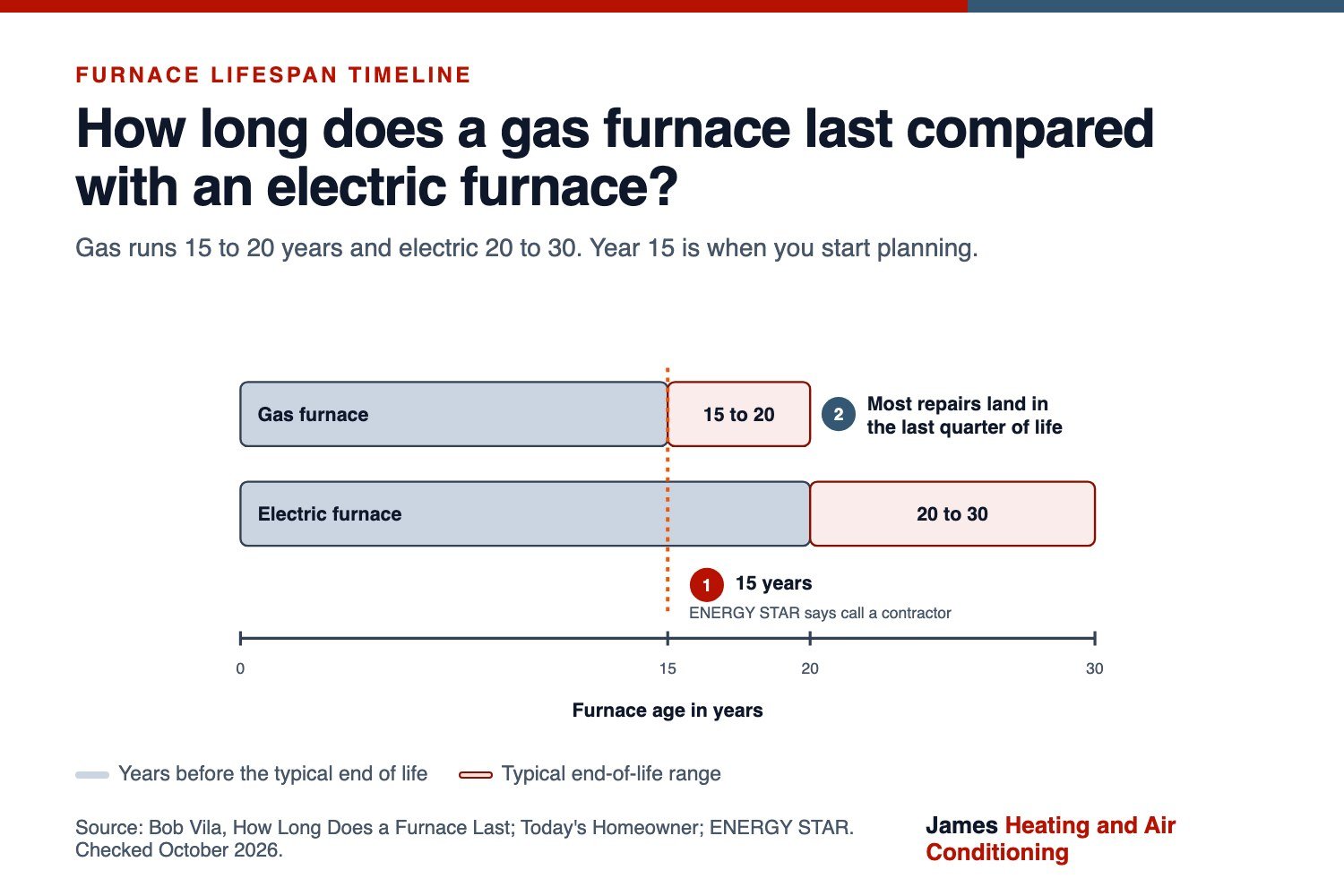
A gas furnace lasts 15 to 20 years, while an electric furnace lasts 20 to 30, because it has no burner or flue to wear out.
Bob Vila’s furnace guide gives 15 to 20 years for the usual furnace and ranks gas units as the shortest-lived and oil as the longest. Today’s Homeowner credits electric furnaces with fewer moving parts and no combustion. ENERGY STAR rates 15 years as the age to call a contractor for a furnace or boiler. Bob Vila adds that most furnace repairs land in the last quarter of a furnace’s life, so we check the repair history first on any furnace near year 15.
| Furnace type | Typical lifespan | Source |
|---|---|---|
| Gas furnace | 15 to 20 years | Bob Vila |
| Electric furnace | 20 to 30 years | Today’s Homeowner |
| Oil furnace | Longest of the three, no firm figure | Bob Vila |
These are national guidelines, not warranties. We service furnaces that fail well short of them and furnaces that run past them, and the maintenance history is the difference. Which parts decide where yours lands?
Which furnace parts wear out, and what do they cost to replace?
Five parts wear out in a gas furnace, namely the heat exchanger, inducer motor, igniter, flame sensor and blower.
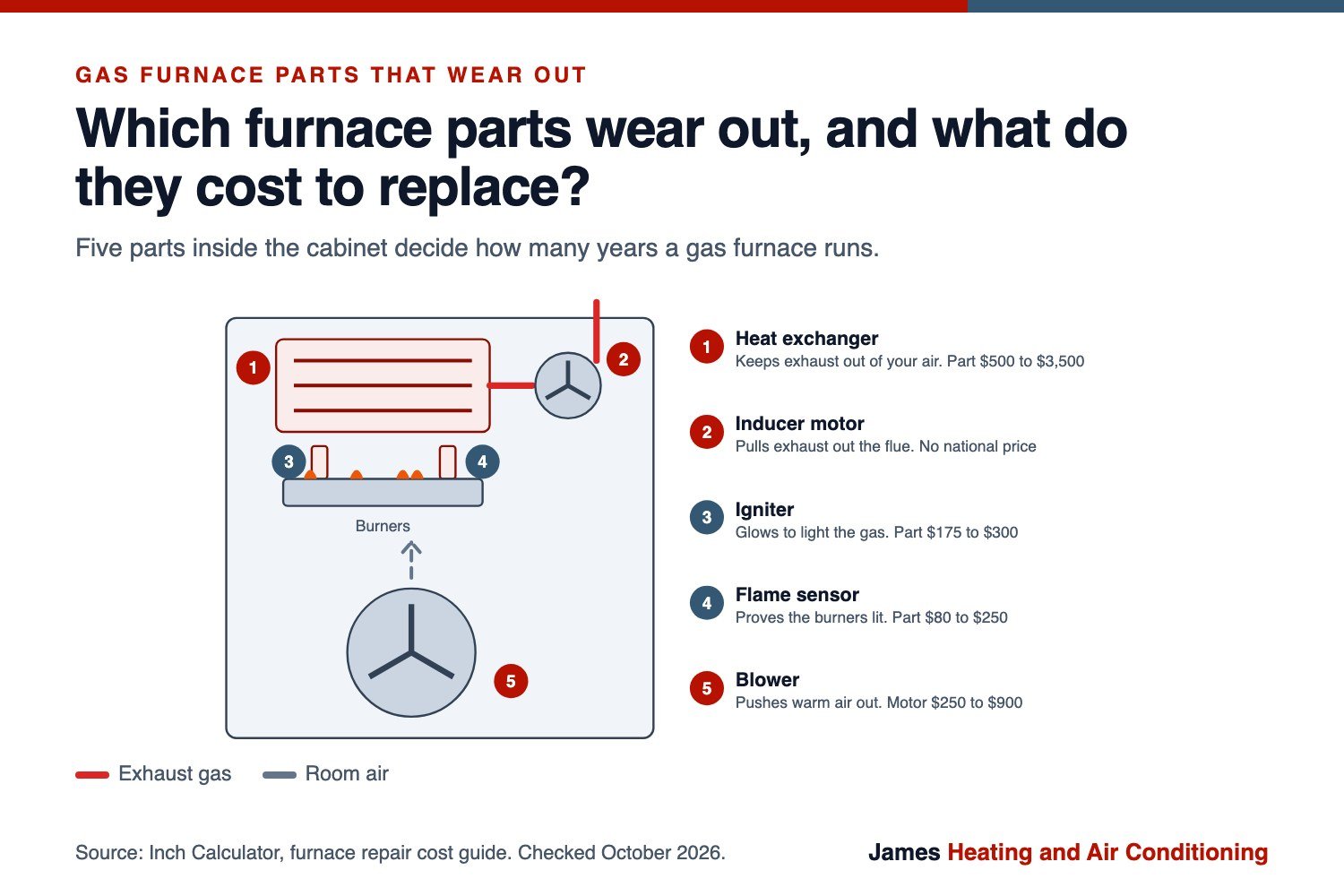
Inch Calculator’s furnace repair guide gives the national part ranges below.
- Heat exchanger. It keeps burner exhaust out of the air you breathe. The part runs $500 to $3,500, and our technicians inspect it on every furnace inspection.
- Inducer motor. It pulls exhaust through the heat exchanger and out the flue. We test it with a meter, and we quote it after the inspection because we found no national price.
- Igniter. It glows hot enough to light the gas and costs $175 to $300. We test it before we replace it.
- Flame sensor. It proves the burners lit, and the part costs $80 to $250. We clean a coated sensor and test the flame signal.
- Blower. The blower motor pushes warm air through your ducts and runs $250 to $900. A control board, $300 to $650, runs the whole sequence.
During a furnace inspection, our technicians clean the burners, test the safety controls and inspect the heat exchanger. We replace a failed igniter, flame sensor or blower motor and then test the full sequence again. Do you know how many years yours has already run?
How do I find out how old my furnace is?
Look for the rating label on the cabinet or inside the furnace door; it carries the model and serial number, and the serial usually encodes the manufacture date.
The date code differs by brand, so we decode it on site when you are not sure. Many Eugene and Salem homes come with a furnace and no service record. In that case, assume it is older than the seller says, and we inspect it before the first cold week. Our technicians read the label, check the repair history and tell you where the furnace sits on the timeline. What can you do to push that date out?
How can I make my furnace last longer?
Change the filter each season, keep the furnace correctly sized with sound ducts, get the venting right and book a yearly tune-up.
- Filter and airflow. A clogged filter makes the blower strain and the furnace overheat and shut off. A fresh filter each season is the cheapest life extension there is.
- Sizing and ducts. Bob Vila points out that an oversized furnace short-cycles and an undersized one runs nonstop, and both wear parts early. Leaky or cramped ducts do the same.
- Venting and installation. Poor venting or fuel-line setup damages the furnace and can leak exhaust.
- Annual service. The EPA recommends a professional tune-up of central heating each year. Our furnace inspection before winter covers the burners, the safety controls and the heat exchanger, and we tune the furnace as we go.
We size and seal every replacement we install, but even with all four habits, parts wear. How will your furnace tell you it is running out of years?
How do I know when my furnace needs replacing?
Your furnace needs replacing when repairs stack up, bills climb and rooms run cold, especially once it is past 15 years old.
- Repairs are stacking up. Two or three calls in a few seasons point to worn parts, not bad luck, and we check those parts first.
- Bills climb with no change in use. Efficiency drops as parts wear, so we check the filter, burners and blower.
- Some rooms run cold. A tired blower or failing heat exchanger moves less heat, and we test both.
- New noises. Banging, rattling or squealing means something loose, dry or failing, so we inspect the blower and inducer.
- The thermostat cannot hold a setting. The furnace is cycling off on a safety control, and we test the limit switch.
- A burner flame that is yellow or orange instead of steady blue. That points to incomplete combustion and carbon monoxide risk. Shut the furnace off, and we test for carbon monoxide when we arrive.
- Soot, rust flakes or water stains around the furnace or its vent. We inspect the vent and the heat exchanger for the source.
One of those signs does not mean replacement by itself. We diagnose the cause first, and we quote the repair against the cost of a new furnace. What does a repair have to cost before replacing makes sense?
Should I repair or replace my furnace?
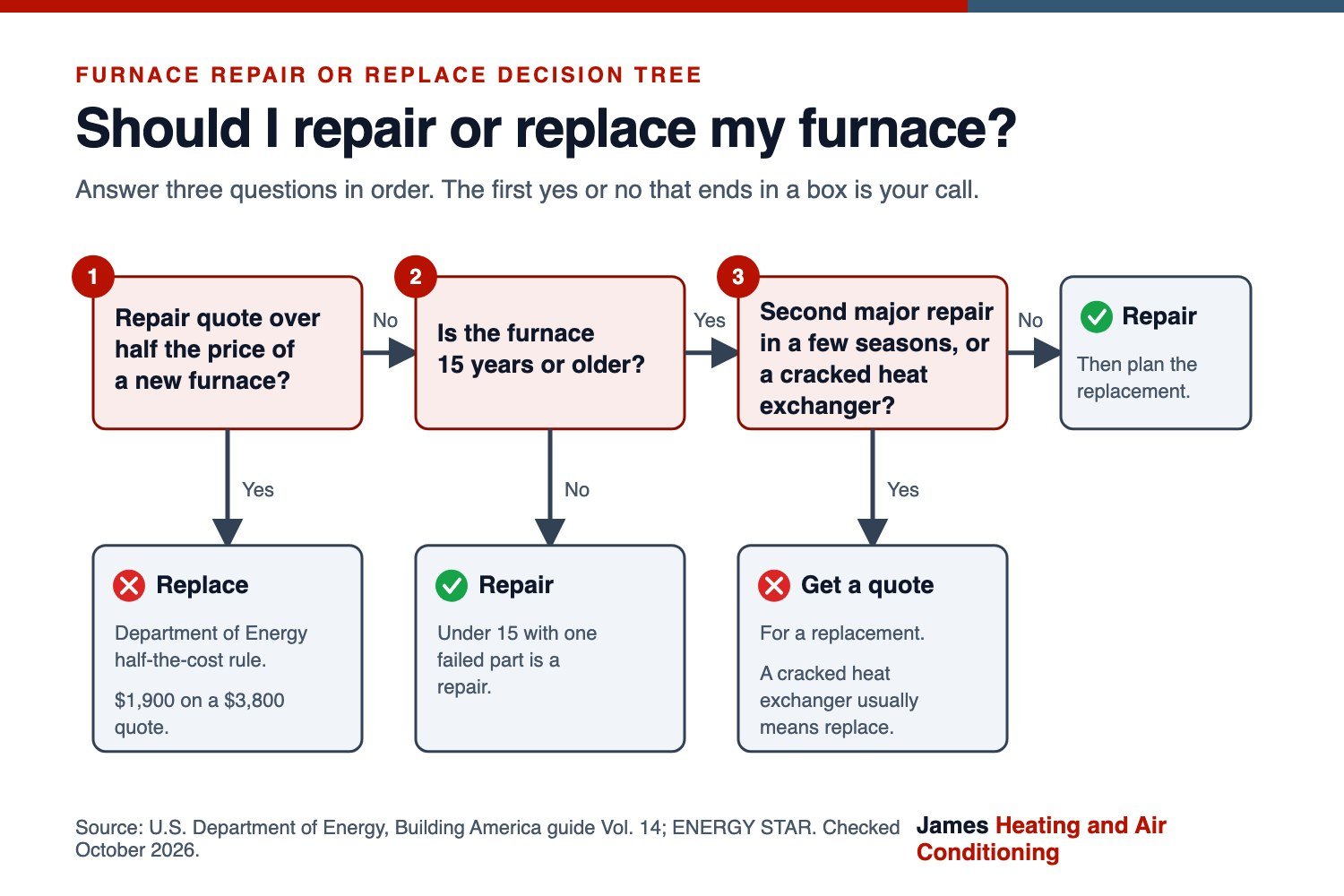
Replace your furnace when a repair costs more than half the price of a new one, or when it is past 15 and failing repeatedly.
The U.S. Department of Energy’s Building America guide sets the half-the-cost rule, and ENERGY STAR rates 15 years as the age to start planning. On a $3,800 replacement quote, for example, the line sits at $1,900. We quote both the repair and the replacement, so you can hold them against that line.
Inch Calculator puts a new furnace at $2,000 to $10,000 installed, and the repair ranges in the table come from the same national guide. They are guides only. We quote a firm written price after we inspect your home.
| Situation | Typical repair cost | Usual call |
|---|---|---|
| Under 15 years, one failed part (flame sensor, igniter, thermostat) | $80 to $450 | Repair |
| Electric furnace, failed element or sequencer | $50 to $300 | Repair |
| Under 15 years, blower motor or control board | $250 to $900 | Repair |
| 15 years or more, second major repair in a few seasons | $250 to $1,200 | Get a replacement quote |
| Any age, repair quote over half the replacement quote | The Department of Energy rule of thumb | Replace |
| Cracked heat exchanger on a furnace 15 years or older | $500 to $3,500 for the part | Replace in most cases |
Inch Calculator’s furnace part table supplies the thermostat range of $100 to $450 and the part ranges listed above. The last row of the table is the one that carries a safety risk, so what does a cracked heat exchanger do to the air in your house?
Can a cracked heat exchanger leak carbon monoxide into my home?
Yes, a cracked heat exchanger can let burner exhaust, including carbon monoxide, mix into the air your family breathes.
The heat exchanger is the metal wall between the burner flame and your blower air. When it cracks, exhaust slips across that wall, and our technicians inspect it for exactly that. Carbon monoxide has no smell and no color, and the EPA covers leaking furnaces and blocked or leaking flues among the common sources.
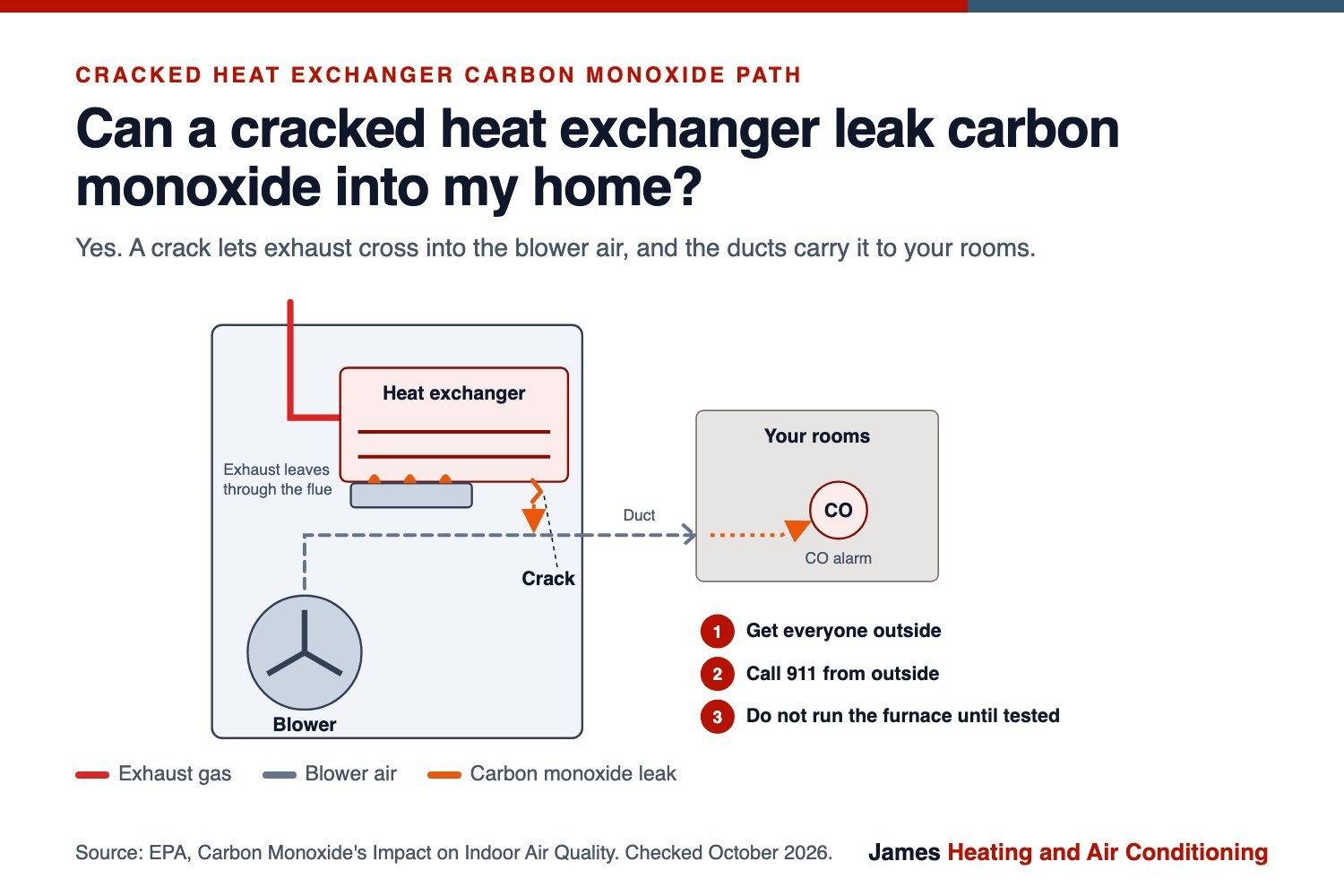
The Consumer Product Safety Commission recommends a CO alarm on each level of the home and outside each sleeping area, as the EPA notes. If an alarm sounds, take these steps in order:
- Get everyone outside into fresh air.
- Call 911 from outside.
- Do not go back in to look for the cause.
- Do not run the furnace again until a technician has tested it.
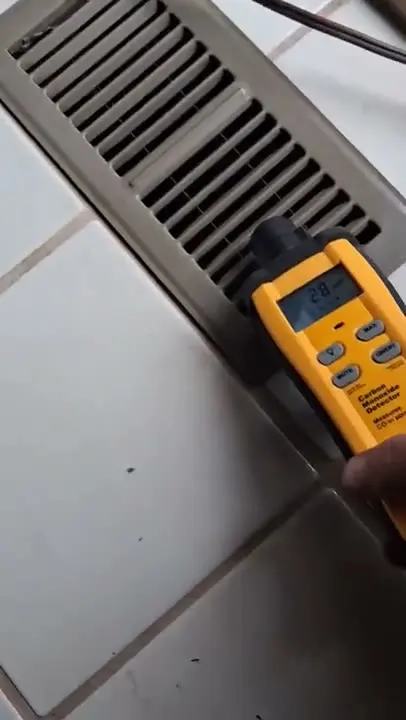
A furnace with a confirmed cracked heat exchanger is not a patch job. On an older unit, that money belongs toward replacement. We test for carbon monoxide at the register and inspect the heat exchanger on every inspection, and a furnace past 15 should get that check every fall. What does a replacement have to meet today?
What efficiency must a new gas furnace meet today?
A new non-weatherized gas furnace must meet 80 percent AFUE today, and a 95 percent federal standard is set for late 2028.
The Department of Energy’s rule tables set the 80 percent figure. DOE finalized a 95 percent AFUE standard for these furnaces, but the rule is back in court and DOE has been asked to push the date to at least January 1, 2030. Check energy.gov for the current status before you rely on a date.
A 95 percent furnace is a condensing unit, so we run PVC vent pipes and a condensate drain, which changes the job from an old 80 percent flue. Oregon requires a mechanical permit for furnace replacement, and we pull it. See what drives furnace replacement cost and our furnace replacement service.
The federal 25C tax credit ended December 31, 2025, so it does not apply to a 2026 install. Utility programs differ by address. Energy Trust of Oregon serves PGE, Pacific Power, NW Natural, Cascade and Avista customers, EWEB and SUB run their own programs, and Salem Electric runs its own. When should you schedule the swap?
Should I replace my furnace before winter or wait for it to fail?
Replace it before the first cold snap, because a planned replacement lets you compare quotes and pick the install date, while a mid-winter failure gives you one day.
If your furnace is past 15 and has had a repair in the last two seasons, book the assessment in October or November. We answer emergency calls around the clock if it fails first, and we send a technician to check it. To understand the machine before you decide, read how a furnace works, and see our furnace repair in Eugene page if yours needs a fix first.
Frequently asked questions
Is it worth replacing a 20-year-old furnace?
Yes, when it needs a major repair or has had repeat repairs. A furnace at 20 is past the typical gas range of 15 to 20 years. We test the safety controls and inspect the heat exchanger before we tell you to keep one, and even then you should plan the replacement now.
Can a furnace last 30 years?
For an electric furnace, yes, and Today’s Homeowner puts electric units at 20 to 30 years. For gas it is the exception, and we inspect the heat exchanger on a gas furnace that old every year.
Does a gas furnace last longer than an electric furnace?
No. Bob Vila puts a typical furnace at 15 to 20 years and says gas units have the shortest life, while Today’s Homeowner gives electric furnaces 20 to 30. Gas furnaces burn fuel and vent exhaust, so more parts take heat stress.
How often do furnaces need to be replaced?
Roughly every 15 to 20 years for gas and every 20 to 30 for electric. Maintenance history and sizing can move that either way.
Is a 20-year-old furnace safe to run?
Only after we inspect the heat exchanger, test the venting and check the safety controls. Have a CO alarm on each level either way.
Does a furnace’s age alone mean it needs replacing?
No. Age sets when you start planning. We check the repair history, quote the repair against the half-the-cost rule and test the safety controls, and those decide the rest. A furnace under 15 with one failed part is a repair.
Call James Heating and Air Conditioning for a furnace assessment
If your furnace is past 15, or has started to cost you repairs, we check its age, test the safety controls, inspect the heat exchanger and quote a written price before any work starts. James Heating and Air Conditioning (Oregon CCB #47396) has serviced furnaces in Eugene and Salem since 1983. Call the Eugene and Springfield office at (541) 461-2101 or the Salem office at (503) 581-9982. We answer 24 hours, 7 days. You can also read about Eugene and Springfield service or Salem service.