






The R-410A phase out ended new R-410A equipment, not repairs. The EPA requires new residential systems to meet a 700 GWP limit from January 1, 2025, and existing systems can be serviced and repaired for as long as they run. We repair R-410A and R-22 systems in Eugene, Springfield and Salem, and we service them for the life of the equipment.
Want us to read your nameplate? Lane County homes, Eugene and Springfield included, call (541) 461-2101. Marion County homes, Salem and Keizer included, call (503) 581-9982. Both lines are open 24 hours, every day.
Is R-410A being phased out?
Yes, for new equipment. The EPA requires new residential air conditioners and heat pumps to stay under a 700 GWP limit, and that limit began on January 1, 2025.
GWP is global warming potential, the index the EPA uses to rank refrigerants. The EPA rates R-410A at a GWP of 2,090 and R-454B at 470. R-454B fits under the 700 limit, so new systems carry it. R-410A doesn’t fit, so the limit rules it out of newly built systems.
What the rule leaves alone matters more to you. The EPA’s fact sheet says the rule “does not restrict the continued use of any existing products or RACHP systems.” The EPA requires no replacement of a working system, and we still service every R-410A system we’re called to.
How do you know which refrigerant your AC uses?
Read the nameplate on the outdoor condenser. The EPA says the refrigerant is listed there, and the owner’s manual or the manufacturer can tell you if the plate has worn off.
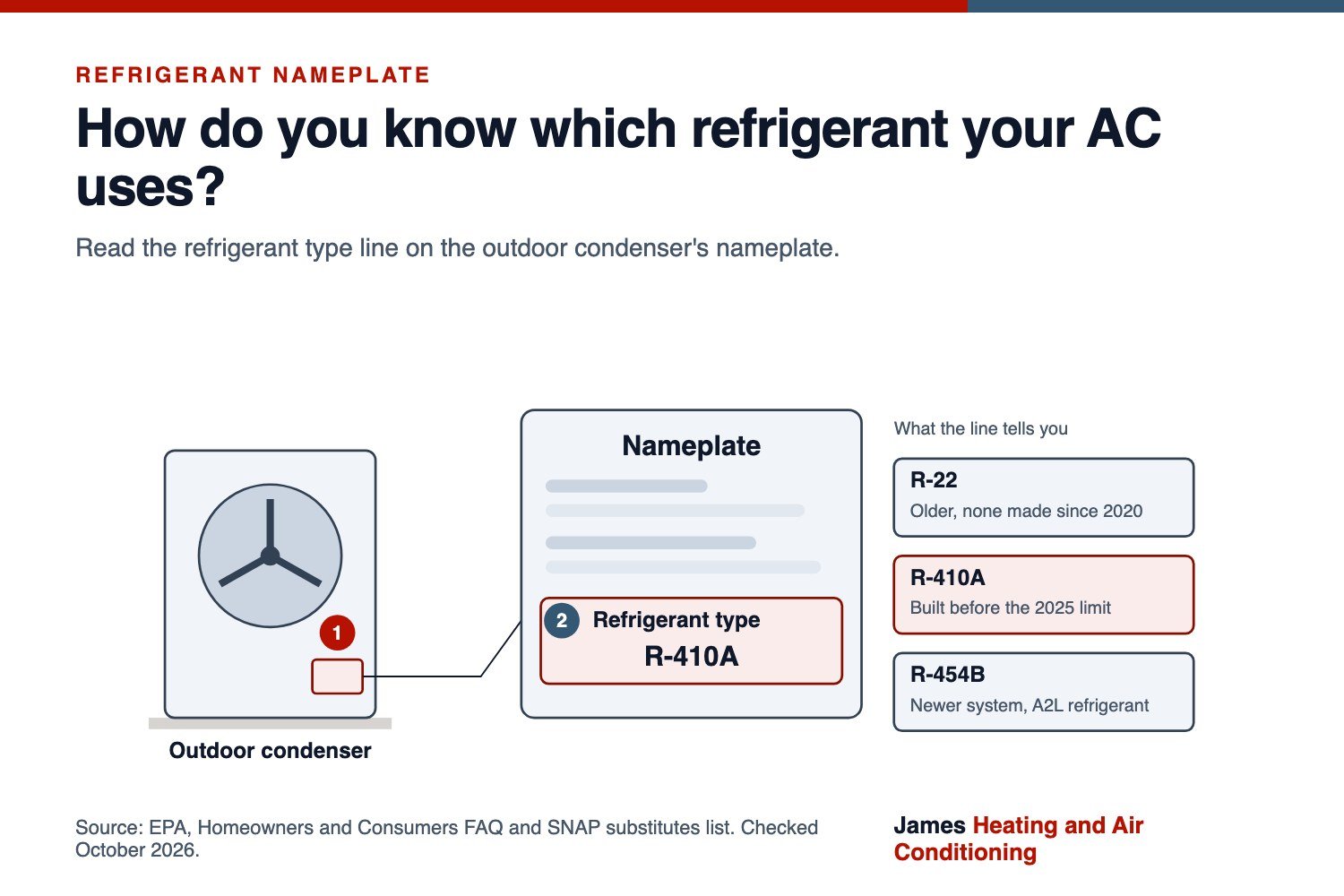
We check that line first on every refrigerant call. We check it before anyone connects a gauge, and we tell you what it says. R-22 usually means an older system. R-410A means most central air and heat pumps built before 2025. R-454B means a newer system built under the 2025 limit.
If you can’t reach the nameplate safely, we check it during the visit. You don’t need to open a panel or touch a refrigerant line, and we handle the gauges.
When do the R-22 and R-410A dates hit, and what happens after?
Two dates matter. January 1, 2020 ended new R-22, and January 1, 2025 starts the limit on new R-410A systems. After both, existing systems can still be serviced.
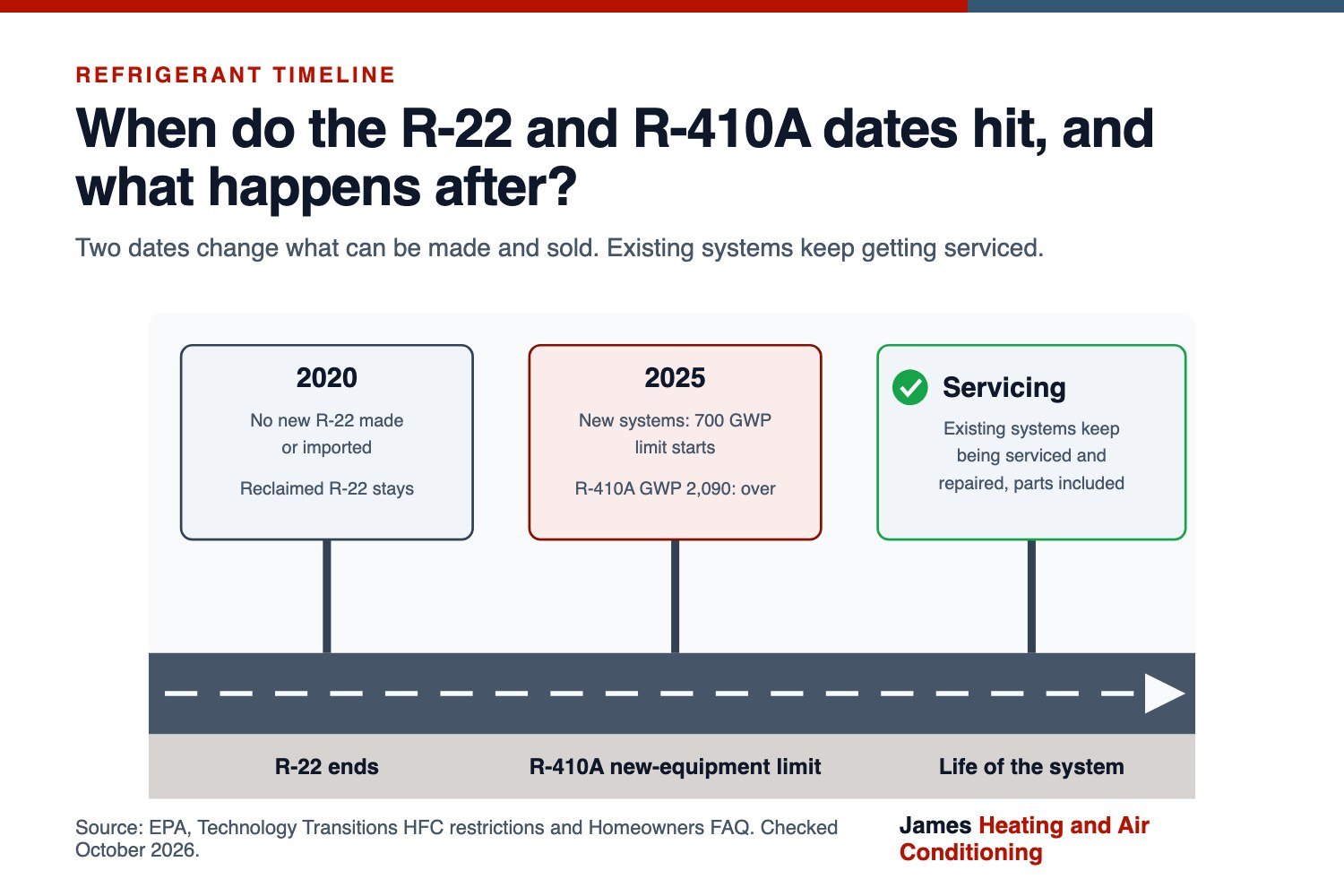
As of January 1, 2020, the EPA requires that no new R-22 (HCFC-22) be made or imported into the United States. The EPA also says you can no longer buy a central AC unit that uses it. The 2025 date works the same way for R-410A. It limits what manufacturers build and what goes in as a new system, and it leaves installed units alone, so we still service them.
Then came May 26, 2026. The EPA’s reconsideration rule changed the installation side. The EPA’s current sector page shows no installation compliance date for residential systems whose components were all manufactured or imported before January 1, 2025. Equipment built after that date uses a lower-GWP refrigerant such as R-454B. We install the system you choose by the manufacturer’s instructions, and we pull the permit.
Behind those dates sits a supply cap. The EPA requires HFC production and consumption to fall to 90 percent of baseline in 2023, 60 percent in 2024 and 30 percent in 2029. That cap is why refrigerant supply gets its own question next.
Can you still repair an R-410A air conditioner?
Yes. We repair R-410A systems, because the EPA lets a system be serviced and repaired throughout its useful life, components included.
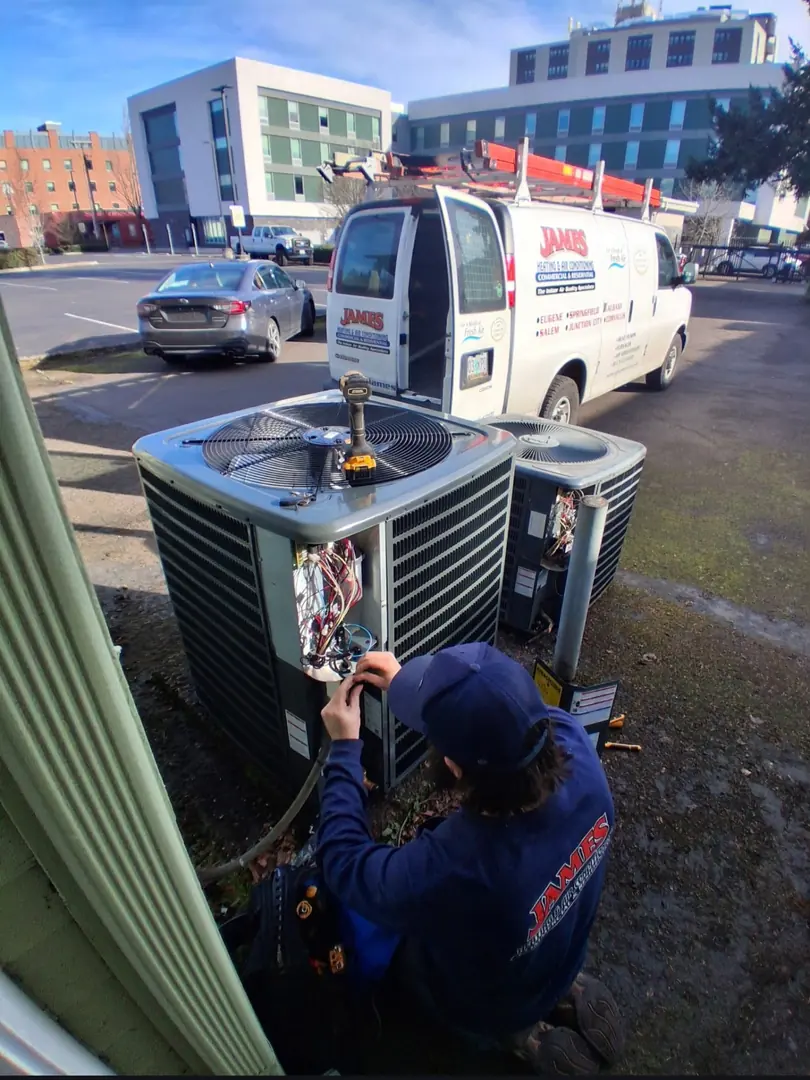
The EPA’s sector page adds that components used to repair existing systems aren’t subject to the new restrictions. So when your R-410A system loses cooling, we repair the leak and recharge with R-410A. Our technicians service the outdoor unit, test the charge and check the lines on the same visit. Your R-410A system has no expiry date. Nothing in the EPA’s rules sets one.
The EPA asks contractors to locate and repair leaks instead of “topping off” a system. Our technicians test for the leak before we add refrigerant, because refrigerant added to a leaking system just escapes again. Fixr’s cost guide says the same from the repair side. An AC should never need a refill, except after a leak repair or a major repair that opens the system.
Not sure it’s low? The signs of low refrigerant are things you can spot at home.
Can you still get R-410A refrigerant, and will it cost more?
Yes. We service existing systems with R-410A, and the EPA’s rules don’t stop any certified technician from doing the same.
The 2024 and 2029 steps in the HFC cap limit how much new refrigerant gets produced and imported. Whether a tighter cap moves what you pay isn’t something the EPA states, because the EPA publishes no refrigerant prices. We won’t forecast a price either. We quote the refrigerant on its own line of your repair estimate, with the type named, so you can see what it adds.
A fitting repair that needs a small charge barely changes the picture. A full recharge after a major coil leak uses the most refrigerant, and that’s the case where the line item deserves a second look. Our technicians service the leak first and quote the recharge second.
Can you put R-454B in an R-410A system?
No. R-454B is a different refrigerant built for equipment designed around it, and the EPA doesn’t list it as a top-off for an R-410A charge.
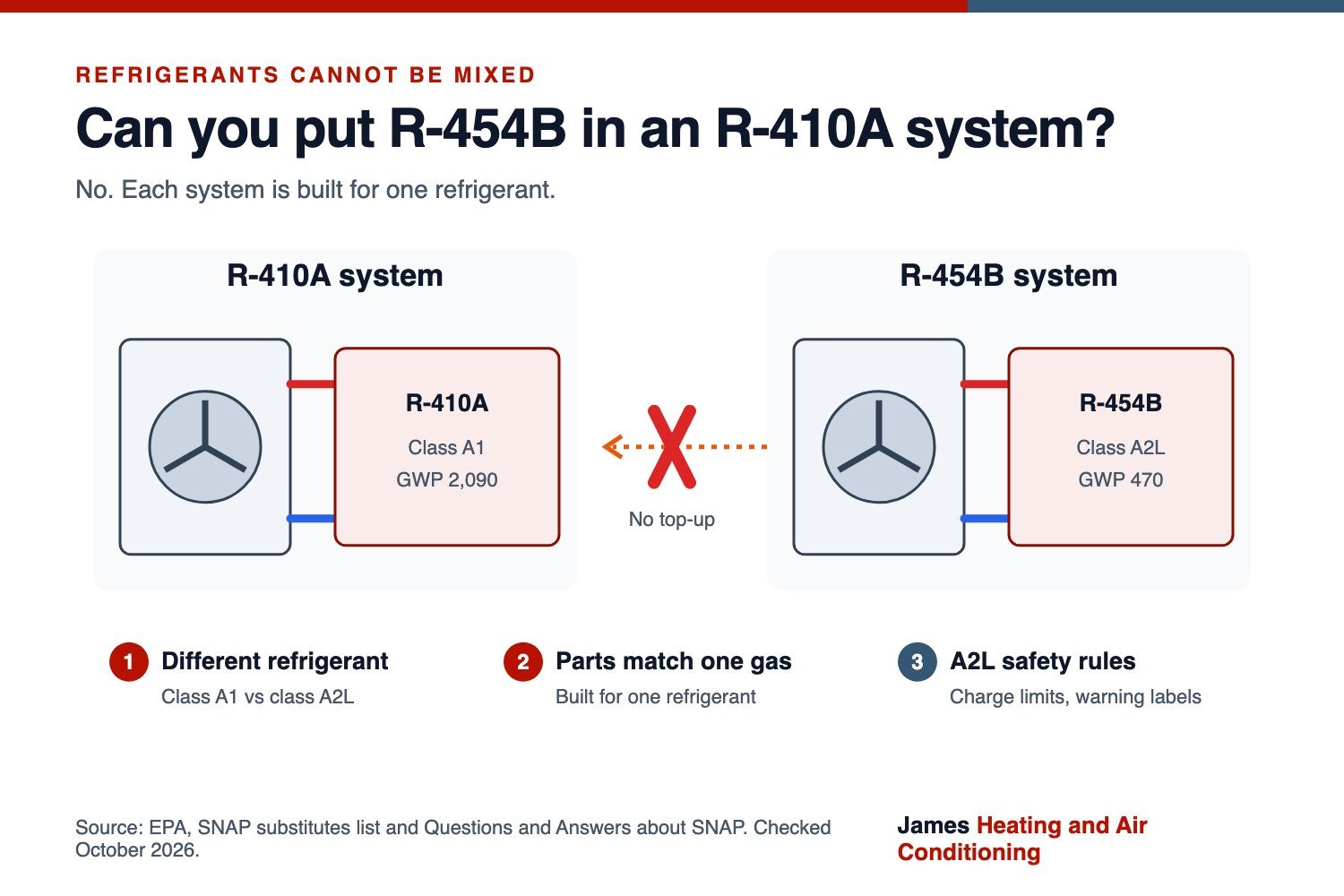
Three points from the EPA’s pages explain why.
- The EPA rates R-410A at GWP 2,090 in class A1 and R-454B at GWP 470 in class A2L, and lists both for new equipment only.
- The EPA says equipment runs most efficiently on the refrigerant it was designed for, so a system’s pressures, controls and parts are built around one gas.
- The EPA requires A2L equipment to meet UL 60335-2-40, including limits on how much refrigerant a system may hold, and the equipment carries flame-symbol warning labels.
So when a contractor says “we’ll just switch you to the new stuff,” ask which refrigerant the outdoor unit, the coil and the indoor unit were designed for. If the answer isn’t the refrigerant on your nameplate, you’re having a replacement conversation, not a repair one. We quote the matched set by refrigerant name, so you can compare estimates line by line.
Intentionally releasing refrigerant is illegal, too. Our technicians recover the old charge instead of venting it. The EPA requires Section 608 certification to handle refrigerant, so ask any contractor, us included, to show it.
What does an A2L refrigerant mean for your home?
A2L is the ASHRAE safety class for lower flammability. R-454B is A2L, and so is R-32. The EPA’s list puts R-410A in class A1.
The EPA requires new A2L systems to carry charge limits and warning labels, so the installer, not the homeowner, handles the refrigerant side. If you smell something odd near the equipment or suspect a leak, switch the system off and call us. We install every system by the manufacturer’s instructions and local code, and we handle the permit. A quote for a new system should name the refrigerant.
For how an A2L gas behaves in a fire, the manufacturer’s installation literature for your equipment is the right source.
What about an R-22 air conditioner?
We repair R-22 systems, and the EPA requires no replacement of one. The EPA says used R-22 cleaned to the same specification as new refrigerant remains available.
The EPA’s wording is blunt. There are no drop-in replacements for HCFC-22. Alternative refrigerants won’t work well without changes to system components, so most R-22 leak repairs still use reclaimed R-22. We service R-22 systems that way. The EPA approves a retrofit only if its SNAP program has found the alternative acceptable, and our technicians recover the old charge first.
One warning from the EPA belongs here. Products sold as “22a” are hydrocarbon blends with propane and butane. The EPA calls them flammable and not acceptable for a home AC system, because an R-22 system has no safety features for flammability. If someone offers you a cheap “R-22 replacement” in a can, that’s the product to ask about.
Should you repair or replace when the system is low on refrigerant?
Repair when the leak is small and accessible. Replace when the leak sits in a coil on an older system, or when several parts are failing together.
This is how we weigh it on a call. We check the leak, the compressor and the age, and the refrigerant change adds one line to the old repair-or-replace logic.
- A small, accessible leak (a fitting, a valve core, a service port) is a repair and recharge for us. Fixr puts leak repair at $200 to $1,500, average about $800.
- A leak in the evaporator coil or condenser coil is the judgment call. A coil is a bigger job than a fitting, so we quote the repair price and the replacement price side by side.
- On an older system with a failed compressor, Fixr lists major components such as the compressor at up to $3,000. Past 10 years old? Replacement starts to win.
- When several things fail at once, a leak plus a weak capacitor plus a noisy motor is a system telling you its age.
ENERGY STAR advises having equipment more than 10 years old evaluated by a professional, and we inspect an older system for exactly that reason. Fixr notes older systems more often need repairs in the $2,000 to $3,000 range. Neither is a formula, but each is a reason to ask for a written repair price next to a written replacement price and compare them on one page.
What should you ask when the quote says replace?
Ask for the refrigerant by name, the matched-set spec in writing, and who pulls the permit. Five questions cover it.
- Which refrigerant does the new system use, by name?
- Are the outdoor unit, coil and indoor unit a matched set, and is that in writing?
- If a partial swap is offered, is it a combination the manufacturer approves?
- Who pulls the Oregon mechanical permit? We pull it as part of the job.
- What’s the price with and without the old unit recovered and removed?
R-454B isn’t a downgrade. It’s the equipment manufacturers now build, and it carries the lower-GWP refrigerant. We size the replacement to your home and we quote the matched set in writing. Ruud offers R-454B on current equipment, for example its Floating Air Ultra ductless outdoor unit, so you’ll see the name on quotes and nameplates for new Ruud systems.
For the next decisions, our guides cover heat pump or furnace and rebates by utility. For replacement pricing, see new air conditioner cost, what a heat pump costs and how long air conditioners last.
How much does refrigerant work cost?
National cost guides put a recharge at $100 to $600 and a leak repair at $200 to $1,500. These aren’t James prices. We quote in writing after we inspect your system.
| Work | National guide range | Source |
|---|---|---|
| Refrigerant recharge | $100 to $600 | Fixr |
| Refrigerant leak repair (includes refill) | $200 to $1,500 (average about $800) | Fixr |
| Replacing a major component such as the compressor | up to $3,000 | Fixr |
Frequently asked questions
Is R-410A being phased out?
New R-410A equipment is. The EPA’s 700 GWP limit for new residential systems began January 1, 2025, and the HFC supply cap keeps tightening through 2029. Existing R-410A systems can keep running and be serviced.
Can I still get R-410A for my AC?
Yes. We service existing systems with R-410A, and nothing in the EPA’s rules stops a certified technician from doing so. The EPA publishes no price forecast, so ask for the refrigerant as its own line on a written repair estimate.
Is R-454B more efficient than R-410A?
The EPA doesn’t rank the two. It says equipment runs most efficiently on the refrigerant it was designed for, so each refrigerant belongs in the system built for it. We install either one by the manufacturer’s instructions.
What is an A2L refrigerant?
A2L is the safety class for lower flammability. R-454B and R-32 are both A2L refrigerants. The EPA requires A2L equipment to meet UL 60335-2-40, including charge limits, and to carry flame-symbol warning labels.
Will my AC still be repairable?
Yes. We repair existing systems, and the EPA’s fact sheet says a system may be serviced and repaired throughout its useful life, including replacing components. Whether repair makes sense is a cost and age question, and we quote both answers.
What is the R-22 replacement?
There is no drop-in replacement. The EPA says alternatives won’t work well without changes to system components, so most R-22 leak repairs still use reclaimed R-22. When you replace the system, the new one uses a current refrigerant. Avoid “22a” products, which the EPA calls flammable.
Does this apply outside the United States?
This post covers United States EPA rules, which apply to homes in Eugene, Springfield, Salem and the rest of Oregon. Other countries run their own refrigerant schedules. We serve homes in Lane, Marion and Polk counties, so everything here follows United States rules.
Call James Heating and Air Conditioning
If your outdoor unit’s nameplate says R-22 or R-410A and the system is low on charge, our technicians test for the leak and we quote you a repair price and a replacement price side by side. We’ve served Oregon homes since 1983 under CCB #47396. See our AC and heat pump repair service.
- Lane County homes, including Eugene and Springfield: (541) 461-2101.
- Marion and Polk County homes, including Salem and Keizer: (503) 581-9982.