






Often yes, but it depends on your filter slot and blower. A MERV 13 catches much finer dust than a MERV 8 and also resists airflow more, so it suits a deep 4-inch media cabinet and can choke a system built around a thin 1-inch filter. We test static pressure at the filter slot and the blower to settle it.
Want us to check your system? From Eugene, Springfield or Lane County, call (541) 461-2101. From Salem, Keizer or Marion County, call (503) 581-9982. We answer either line any hour of the day.
Will a MERV 13 filter hurt my furnace or heat pump?
Not if your filter slot and blower can pull enough air through it, and the box won’t tell you that. The sources disagree because they answer slightly different questions, and we weigh both. Both are right. The EPA says most furnaces and HVAC systems can accommodate a MERV 13 filter without equipment problems, as long as you replace it often. It advises using the highest rating “your system fan and filter slot can accommodate.” Energy Trust of Oregon’s 2015 technical tip for contractors is far more cautious. It says to keep filter pressure drop under 0.10 IWC unless the whole system is designed for more, which in almost all cases limits you to ratings under MERV 8.
Both can be right. We service newer furnaces with a variable-speed blower and a roomy filter cabinet, and those have headroom. An older furnace may not. Picture a 1-inch slot behind a return grille. When we walk into a home, we check the slot depth and the blower first, because those two parts decide the answer. We service gas furnaces and heat pump air handlers with the same kind of blower, so the same rules apply to both.
| Your setup | What usually happens with MERV 13 | Next step |
|---|---|---|
| 4 to 5 inch media cabinet already installed | Usually fine; deep pleats give the filter more surface area | Confirm the cabinet seals, and change media on schedule |
| 1-inch slot, newer variable-speed blower | May work; airflow still needs checking | Measure static pressure before settling on MERV 13 |
| 1-inch slot, older single-speed blower | Airflow drops noticeably | Try MERV 8 or ask about a media cabinet |
| Slot is behind a small return grille | Highest risk of choking the blower | Ask a technician before buying any thick filter |
Not sure which row you’re in? Pull your filter, read the size printed on its frame, and look at how deep the slot is. If you can’t tell, we pull the filter ourselves and check the slot on a visit. We also install media cabinets when the slot is the limit.
Does a MERV 13 filter restrict airflow?
Yes. Denser media resists air more than a MERV 8 does. We call that resistance pressure drop. Our technicians test it in inches of water column (IWC).
The U.S. Department of Energy’s Building America program says most residential systems run efficiently with a total pressure drop across the whole system of no more than 0.4 or 0.5 in. WC. A filter with a 0.25 pressure drop would eat half of that budget before the air reaches the coil, the ducts or your registers. When we size a filter, we check it against that budget, not against the claim on the box. Most filter slots in existing houses were built for a 1-inch fiberglass filter rated about MERV 2. That’s the mismatch. Before we swap anything, we inspect the rack for slot size and depth.
DOE tested 13 filters from MERV 6 to MERV 13 against one MERV 2 fiberglass filter. New MERV 8 filters had 2.7 to 4.7 times the pressure drop of the fiberglass one, and every common MERV 12 filter tested had more than four times as much. Clean MERV 8 filters cut airflow by about 7 percent on a standard single-speed blower. The report gives no number for MERV 13, but a MERV 13 sits at or above the MERV 12 result, so don’t assume a thin one is gentle.
We check which motor your blower has, because the motor changes the answer.
- Standard (PSC) motor: it keeps running, but airflow falls below the design target of about 400 cfm per ton of cooling capacity, so efficiency drops.
- Variable-speed (ECM) motor: it works harder to hold the airflow steady and uses more power doing it. Per DOE, an ECM can use over 50 percent more energy when filters and ducts are poorly sized.
What’s the difference between MERV 8 and MERV 13?
A MERV 13 captures much finer particles. The price is airflow. MERV stands for Minimum Efficiency Reporting Value, a scale from a test method that ASHRAE developed.
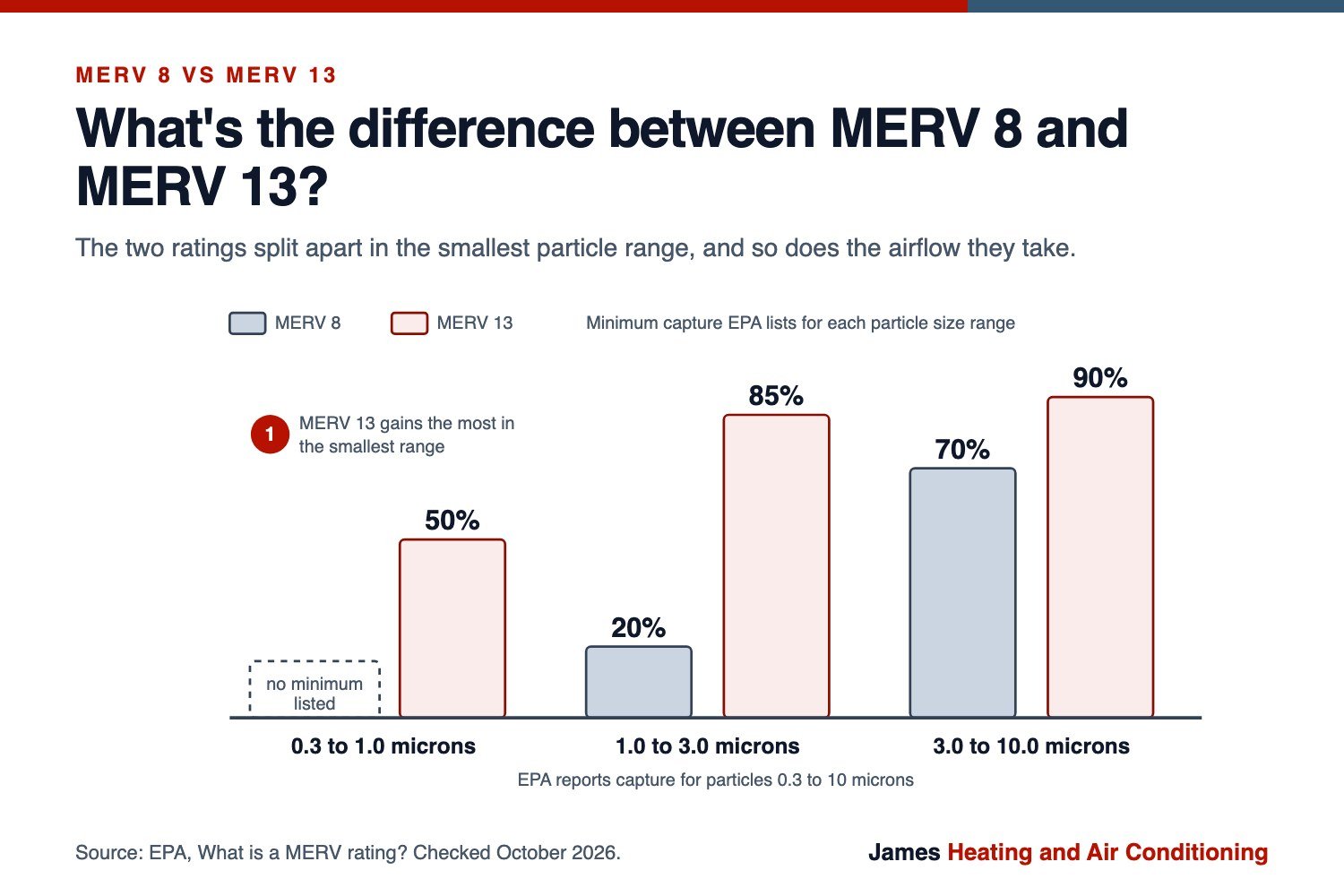
The EPA describes the scale as reporting a filter’s ability to capture particles between 0.3 and 10 microns. Under its table, a MERV 13 filter has to capture at least 50% of particles between 0.3 and 1.0 microns, 85% between 1.0 and 3.0 microns, and 90% between 3.0 and 10.0 microns. A MERV 8 has a 70% minimum for the 3.0 to 10.0 micron range and 20% for 1.0 to 3.0. The EPA’s table sets no minimum at all for MERV 8 below 1 micron. So the real gain from MERV 13 sits in the smallest sizes. That’s the whole difference. We service both ratings, so we have no stake in the higher number.
The same ASHRAE 52.2 test measures pressure drop, but retail filters rarely print it, so most people never see the number that decides whether the filter fits their system. We test it with a gauge instead of trusting the box. Our technicians check that number before we recommend a filter.
Is a 4-inch media filter better than a 1-inch filter?
For high-MERV filtration, usually yes. Deeper pleats give the same air more surface to pass through at lower speed. DOE says a filter with 4-inch pleats has twice the surface area of one with 2-inch pleats.
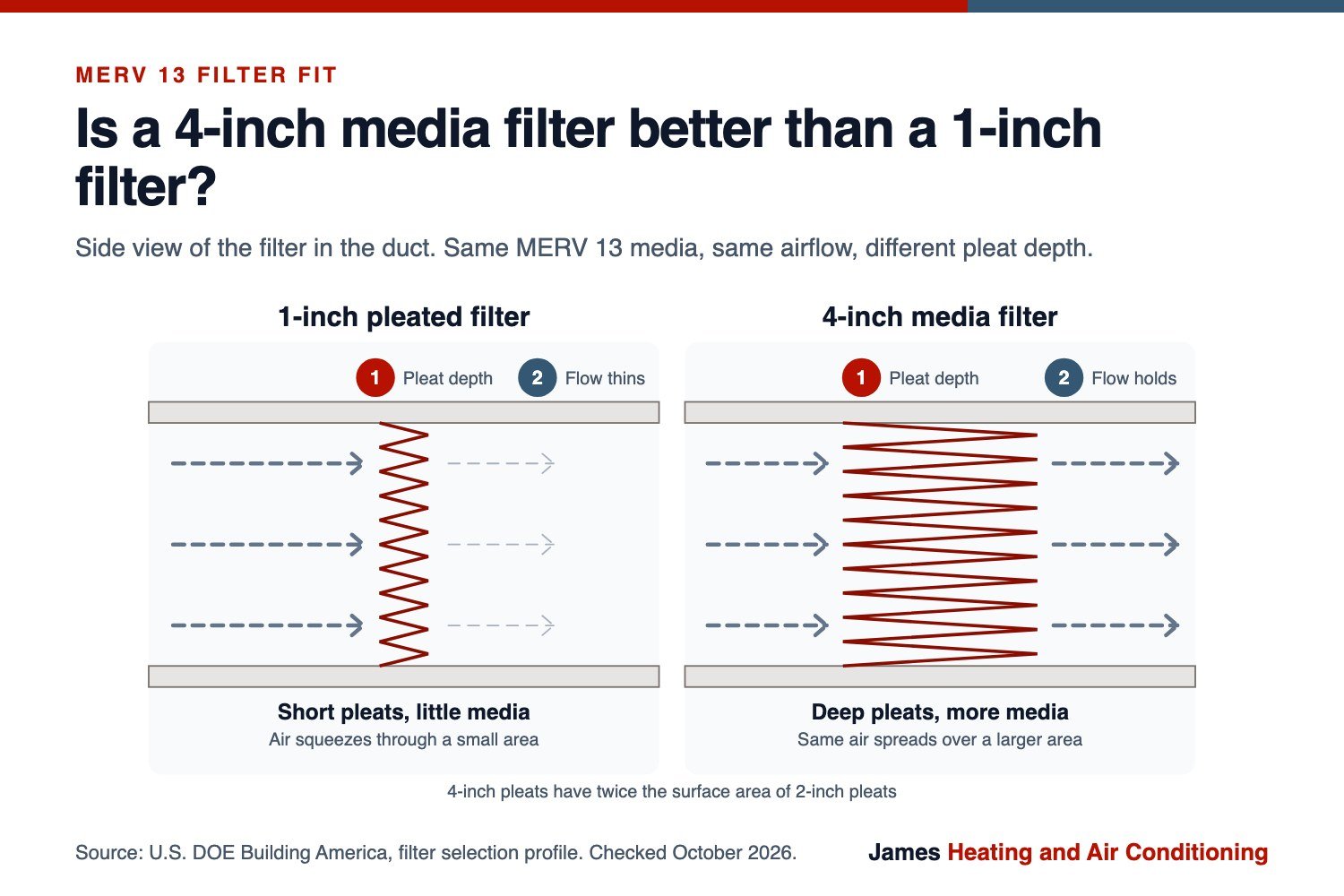
That’s why a deep MERV 13 can feel easier on a blower than a thin MERV 8. There are two ways to get more area:
- A 4 or 5 inch media cabinet. We install the cabinet at the furnace or air handler, and it holds a deep pleated filter or media pad.
- A larger return opening, or two filters side by side. DOE describes building the return so two filters fit together, or adding more return grilles.
Either change means modifying the existing slot, not just buying a bigger filter, and we handle that work at the furnace or air handler. DOE says a technician has to modify the slot to take a deeper one. A thick filter jammed into a 1-inch slot leaves gaps, and unfiltered air takes the easy path around it. The EPA says the filter must fit snugly so air doesn’t leak around it. If a media pad leaks at the edges, the rating on the box means little. Fit beats rating. We seal the frame and we check for gaps with the system running.
How do I know if a MERV 13 filter is choking my system?
You’ll notice weak airflow, odd noises or a furnace that cuts out early. None of these proves the filter is the cause, but any of them after an upgrade is a reason to pull the filter and retest. We check airflow first on any complaint that follows a filter upgrade. Then we test static pressure.
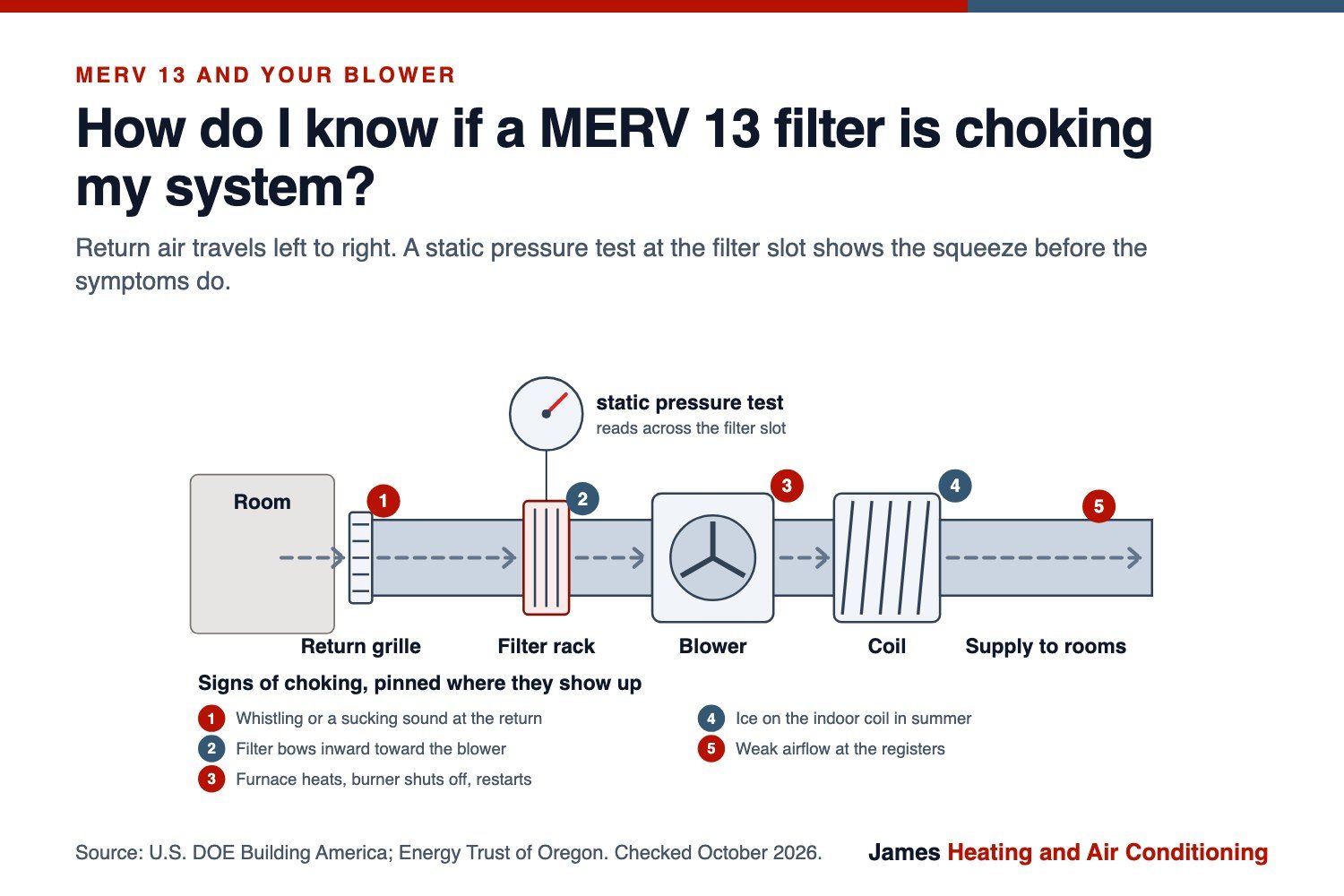
- Weak airflow at the registers. Compare a vent you know well, before and after the swap. If your rooms already suffer, start with weak airflow from vents.
- Whistling or a sucking sound at the return or filter slot. Air squeezing through a restriction or around a loose frame makes noise.
- A filter that bows inward or collapses toward the blower. DOE notes that undersized filters can be deformed or drawn into the duct.
- A furnace that heats, shuts the burner off, then restarts. That’s the high-limit safety switch cutting in because the heat exchanger isn’t getting enough air. The furnace is protecting itself, and we check the airflow instead of bypassing the switch.
- Ice on the indoor coil in summer. DOE says reduced airflow can freeze air conditioner and heat pump coils on systems with standard motors. If you see ice, turn the system off and follow the steps for a frozen evaporator coil.
- Higher power bills or longer run times. The EPA notes that more run time to get more filtration can raise electricity costs. We check run time too.
On those calls we test static pressure at the filter slot, we check temperature rise on a furnace and we check coil airflow on a heat pump or AC. A high-pressure system also pulls harder on every gap, and DOE says it raises air leakage at cabinets, return ducts and plenums. If the swap exposed a leaky return, we handle it as a separate job from picking a filter. Sealing the ducts is its own fix.
Is MERV 13 worth it for wood smoke and wildfire smoke in Eugene and Salem?
It can be, if your system breathes through it, because a filter only cleans air while the system is running. The EPA states that furnace and HVAC filters work only while the system is operating.
Two kinds of smoke send Willamette Valley homeowners to the filter aisle. From October 1 to May 31, the Lane Regional Air Protection Agency (LRAPA) issues daily burn advisories for Eugene, Springfield and Oakridge and their urban growth boundaries. A yellow advisory means poor airflow and smoke lingering at ground level, and a red advisory means no airflow and essential burning only. Wildfire smoke is the other trigger, and the filter advice applies the same in Marion County as in Lane.
Energy Trust of Oregon recommends running the system in fan-only mode during wildfire season and returning to auto before heating season. It also warns that high-MERV filters can make some systems work harder and raise energy use, which isn’t a concern if the system is designed for them. It suggests checking the manufacturer’s manual and changing filters more often during smoke events, and switching back to a standard filter afterward. We replace a loaded filter and we check the fit at every tune-up. For how often, see how often to change your air filter.
We check your blower before we suggest fan-only mode. None of that is a reason to force a MERV 13 into a system that can’t breathe through it, and we test the blower before we recommend one. A choked blower trips safeties and wastes power, and cleaner air doesn’t help if the furnace is cycling off.
How do I test a MERV 13 filter safely?
Swap it in, watch the system, and measure static pressure if anything looks off. You can run the first five steps yourself, and we handle the last one.
- Read the manual or the data plate. Look for the manufacturer’s filter size and any pressure limit.
- Buy the right size and fit it snugly. Seal gaps, don’t crush the frame, and mark the date on it.
- Run the system and compare. Feel the same registers as before, listen at the return and watch the filter for bowing.
- Check again after a day or two. In heating season, watch a full cycle and look for the burner shutting off early.
- If anything is off, go back to the old filter. Don’t leave a restrictive filter in because the box said MERV 13.
- Ask us to measure static pressure. Our technicians test the pressure across the filter slot and across the whole blower with a manometer. We check both readings against the equipment’s rated limit. Then temperature rise on a furnace, or coil airflow on a heat pump. Those numbers tell you whether MERV 13 fits, whether a media cabinet would, or whether the ducts are the real limit.
For a cooling-season check, we cover airflow measurements on our HVAC diagnostics and repair visits. A tune-up from preventative maintenance is a natural time to have it checked, since we inspect the filter, coil and blower while they’re open anyway.
How much do MERV 13 filters and a media cabinet cost?
A MERV 13 filter usually costs two to four times a MERV 8 of the same size, and a media cabinet runs $400 to $2,000 installed. These ranges come from national cost guides, not from James.
| Item | National guide range | Source |
|---|---|---|
| 1-inch disposable filter, MERV 6 to 8 | $4 to $25 (average $10) | PICKHVAC, May 2026 |
| 4-inch pleated filter, MERV 11 | $15 to $60 (average $35) | PICKHVAC, May 2026 |
| MERV 8 to MERV 13, same size | Typically 2 to 4 times the unit cost | PICKHVAC, May 2026 |
| Media cabinet or retrofit, installed | $400 to $2,000 (average $900) | PickComfort, May 2026 |
| Replacement media pad | $30 to $300 (average $95) | PickComfort, May 2026 |
The cabinet figure assumes a 2,000 square foot home with an accessible plenum and no duct changes. Your plenum, return size and any duct work change the price, so we quote the filter and the cabinet together, in writing, after we inspect the system. If you want MERV 13 on a 1-inch system, we install a cabinet, since a deep filter gives a single-speed blower far more room to breathe. The tradeoff is a higher upfront cost and more room around the furnace.
Frequently asked questions
Can I use a MERV 13 filter in a heat pump?
Yes, if the air handler’s slot and blower can pull enough air through it. A heat pump air handler uses the same kind of blower as a furnace, so the same pressure limits apply, and we test static pressure to confirm.
Is MERV 13 too high for a home furnace?
Sometimes. The risk sits in a 1-inch slot on an older single-speed blower. We test the system rather than guess, because the EPA and Energy Trust of Oregon give different limits.
What’s the best furnace filter MERV for a home?
A mid-range MERV is the safer pick in a 1-inch slot, and MERV 13 makes the most sense in a deep media cabinet when smoke or allergies are a concern. We size the rating to your fan and filter slot, as the EPA advises.
How often should I change a MERV 13 filter?
Manufacturers typically recommend every 60 to 90 days, per the EPA, and more often during smoke events. The full schedule is in how often to change your air filter.
Can a MERV 13 filter freeze my AC coil?
It can, indirectly. DOE says reduced airflow can freeze air conditioner and heat pump coils on systems with standard motors. If you see ice, turn the system off and go back to the old filter. We check the coil and the airflow before the system runs again.
Call James Heating and Air Conditioning
If a new filter changed how your system sounds or heats, or you want MERV 13 and aren’t sure your blower can take it, we test it. We serve Eugene, Springfield, Salem and Keizer under Oregon CCB #47396, and we answer both phone lines around the clock. Our furnace repair page covers heating calls, and our air ventilation services page covers whole-home air work.
- In Eugene or Springfield, or anywhere in Lane County, call (541) 461-2101.
- In Salem or Keizer, or anywhere in Marion and Polk counties, call (503) 581-9982.