






Leaky ducts in a crawl space waste about 20 to 30 percent of the air your system moves, according to ENERGY STAR, and they show up as a cold room and a high bill. You find them by looking for disconnected or crushed runs, and you fix them with mastic or metal tape, never cloth duct tape.
Need a technician now? Call (541) 461-2101 from Eugene, Springfield or anywhere in Lane County, or (503) 581-9982 from Salem, Keizer or Marion County. We answer both numbers around the clock, seven days a week.
How can I tell if my ducts are leaking?
Look for one room that stays cold, a bill that runs high for your house, stuffy rooms and dark smudges on the duct insulation.
ENERGY STAR says about 20 to 30 percent of the air moving through a duct system is lost to leaks, holes and poorly connected ducts. Ducts in a crawl space or attic make that loss worse, because every gap vents into a space nobody heats.
| What you notice | What it points to | Quick check |
|---|---|---|
| One room stays cold in winter | A disconnected, crushed or leaking run to that room | Compare airflow at its register with the next room |
| High bills for the size of the house | Leaks plus thin or missing duct insulation | Look at the supply runs from the crawl space hatch |
| Stuffy rooms that never feel right | Leaks that starve the room of air | Check whether it’s the room farthest from the blower |
| Musty smell when the blower starts | A return leak pulling crawl space air | Notice whether the smell is strongest at the return grille |
| Dark smudges on duct insulation | Leaked air depositing dirt on it | Look along the seams and boots |
The smudging sign comes from the Department of Energy’s duct guideline: insulation filters the air leaking through it. When several of these show up in one house, we check the ducts before we blame the furnace or heat pump. We check the room that complains first. On a cold-room call our technicians check airflow at that register, and we inspect the run back toward the plenum. Your own eyes get you most of the way there.
Where do ducts leak in a crawl space or attic?
Ducts leak most at four places: a disconnected flex at a boot, a crushed run, an unsealed plenum seam and a leaky return. We inspect all four before we quote a repair.
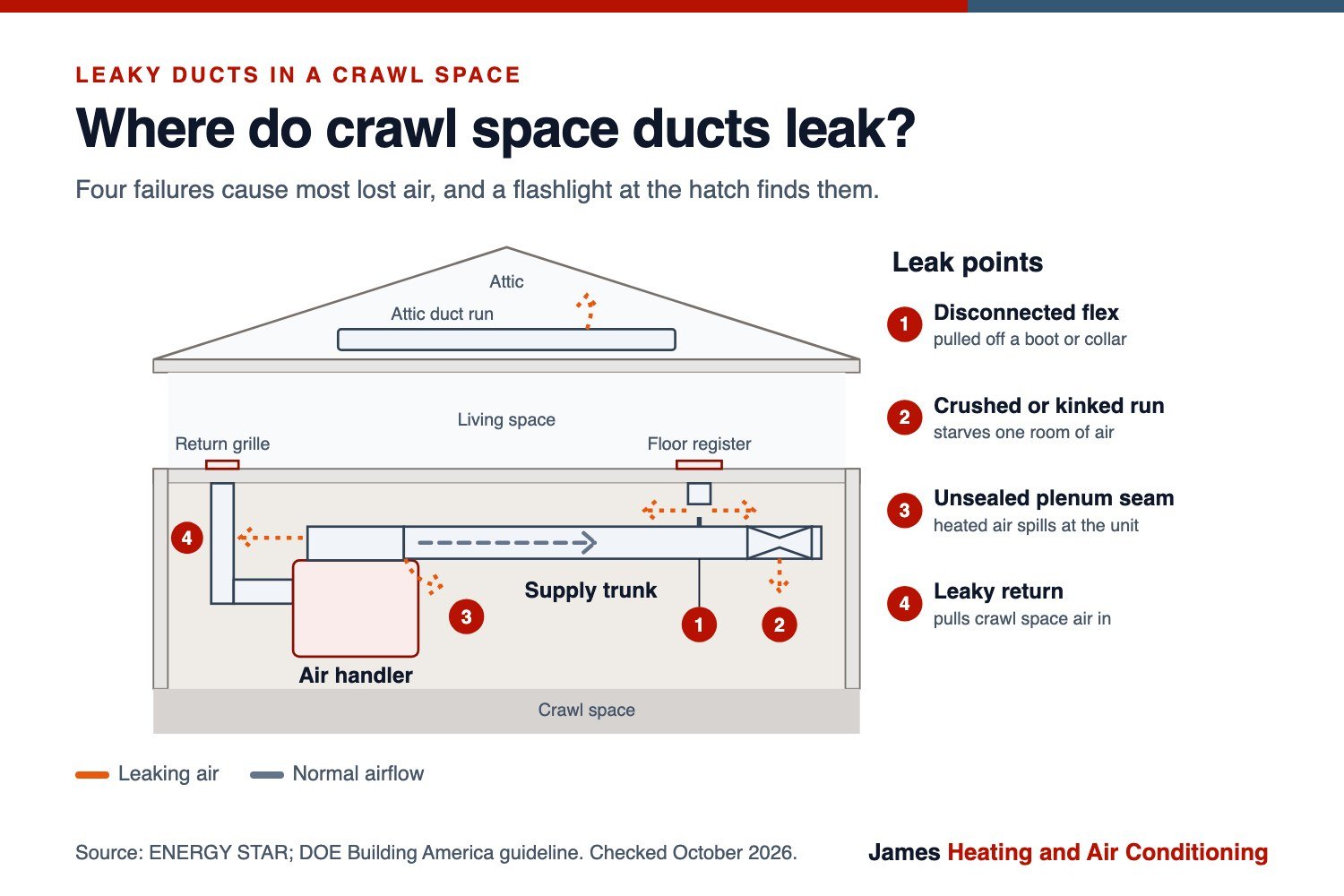
- Disconnected runs. A duct that has pulled off the plenum, a boot or a collar blows heated air straight into your crawl space. The Department of Energy guideline says re-attaching disconnected ducts gives huge energy and comfort savings with very little time and effort. We reconnect the run, fasten it and seal the joint.
- Crushed or kinked flex. The Building America guide on sealed and insulated flex ducts says flex should be pulled taut, with no excessive coils or loops, and the duct wall must not collapse at a kink or sharp bend. We replace flex that’s crushed past straightening.
- Unsealed seams and boots. ENERGY STAR names the connections where vents and registers meet floors, walls and ceilings as common leak points. We inspect the plenum seams and every boot for the same reason, and we seal what we find.
- Uninsulated supply runs. The DOE guideline says uninsulated flex isn’t recommended for supply ducts or for unconditioned spaces, and older homes may have R-4 or no duct insulation at all.
Attic ducts fail the same four ways, and we repair them the way we repair crawl space ducts. They sit under a hot roof, so you notice an attic leak in summer as much as in winter.
We cover weak air at one vent in our weak airflow from vents guide and a room that never matches the rest in uneven cooling in a house. A clogged filter causes similar symptoms and is a separate fix.
Can I check for a disconnected duct myself?
Yes, if the crawl space is dry and you can reach the runs from the hatch without moving anything.
- Wear a mask and gloves, carry a flashlight and stay on the joists or boards. Don’t enter a crawl space with standing water.
- Follow each supply run from the plenum and look at every boot, collar and branch for gaps, kinks or insulation pulled away.
- Reconnect any loose duct you can reach, fasten the joint mechanically and seal it with mastic or UL 181 tape.
- Turn the system on and feel for air at the cold room’s registers.
If a disconnected duct sits near a flue pipe or a gas appliance, call us instead of reconnecting it yourself. Our technicians repair ductwork across Eugene, Springfield and Salem. When a flue is involved, we handle the repair first and check the appliance’s venting afterward.
Can a leaky return duct pull crawl space air into my house?
Yes. A gap in a return duct lets the blower draw air from the crawl space or attic into the system and send it to every room.
Building Science Corporation says unsealed equipment and returns outside the conditioned space can draw contaminants and moisture into the system and distribute them through the building. The National Weather Service normals for Eugene run 5.98 inches of rain in November, 7.21 in December and 6.05 in January, so the air under a Willamette Valley floor is often damp when your furnace or heat pump works hardest. A musty smell that rises when the blower starts is the practical symptom. When you describe that smell on the phone, our technicians check the return side first, and we inspect the return grille, boot and plenum for gaps.
Return leaks change pressure too. The Department of Energy’s Measure Guideline on sealing ducts warns that large return leaks can interfere with the draft of combustion appliances, which is why the next question matters.
Is it safe to seal ducts around a gas furnace or water heater?
Only after the appliance’s venting has been checked, because sealing changes how air moves through the house.
The DOE guideline is blunt: fix combustion problems before sealing, because sealing alters pressure patterns and may aggravate them. The check is a combustion air zone test, where the technician runs the exhaust fans and dryer, cycles the air handler and checks each appliance for spillage and draft. Building Science Corporation documents an unsealed return that depressurized a basement enough to backdraft a water heater. Many codes require carbon monoxide alarms too.
We check the flue draw on a gas furnace or water heater before we seal ducts near it, and we hold off on sealing until the appliance vents correctly. Homes with a gas appliance in a crawl space, garage or closet deserve the closest look. If a carbon monoxide alarm sounds, leave the house and call 911 before you call us.
How do you test ducts for leaks?
A duct leakage test pressurizes the sealed duct system to 25 pascals and reads the fan flow, which equals the total leakage.
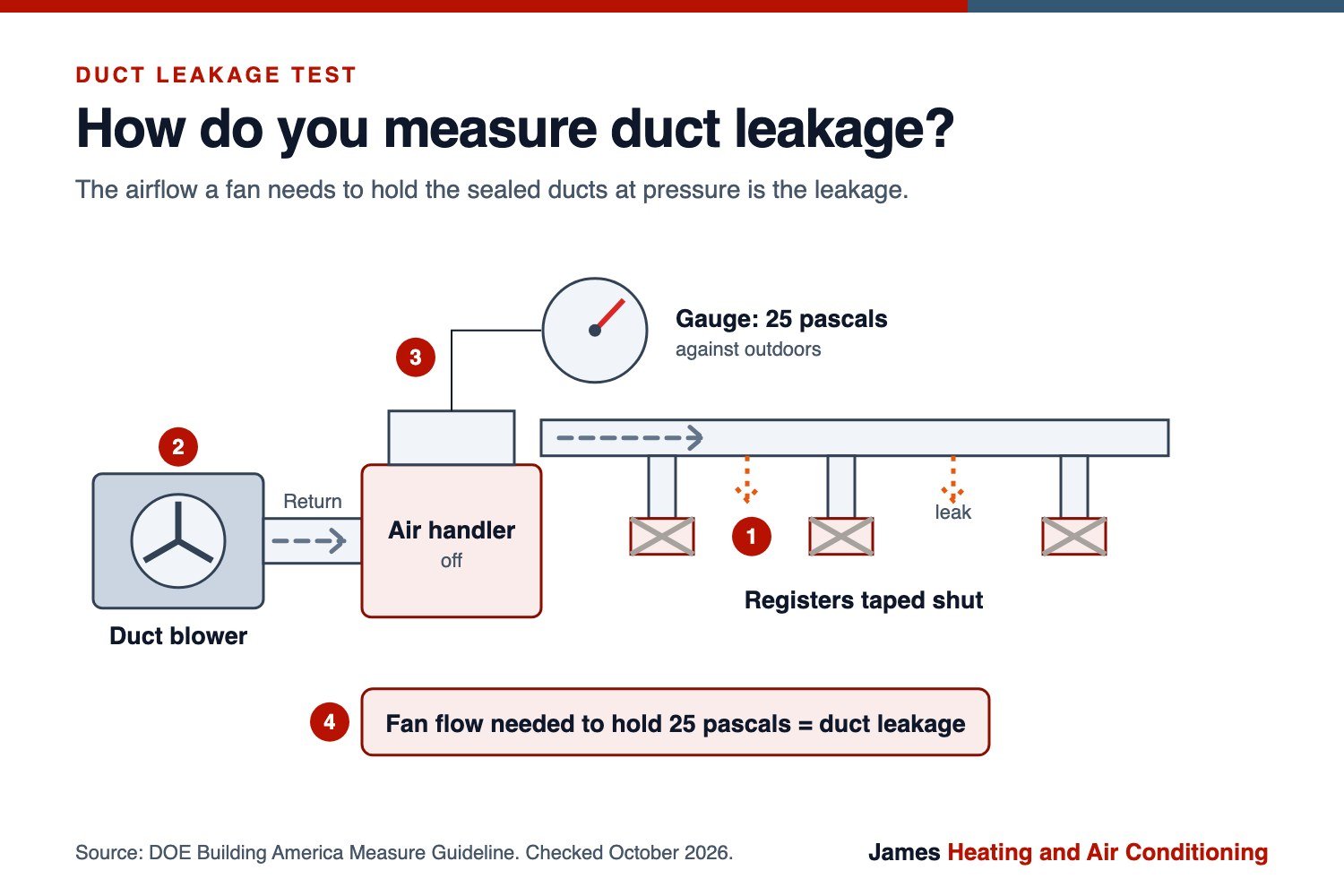
The Department of Energy guideline describes the standard method with a calibrated duct blower.
- Turn the heating and cooling system off and tape over every supply and return register.
- Attach the duct blower to the duct system, usually at the return side of the air handler.
- Insert a pressure tap in the supply plenum.
- Pressurize the ducts to 25 pascals relative to outdoors and read the flow through the fan. That flow is the total duct leakage.
A blower door added to the test finds leakage to the outdoors.
What counts as tight? The Building America duct sealing checklist prefers leakage of 10 percent or less of total airflow, tested before and after sealing.
The same guideline adds that sealing a very leaky system raises pressure and can reduce total airflow, so airflow gets measured before and after. Its authors also say reachable ducts should be sealed regardless, since testing can cost about as much as the sealing itself. Measure, repair, measure again. A test earns its keep when your ducts are mostly hidden or the cause of a high bill isn’t obvious. Our technicians check airflow at the register before and after a repair. Ask any contractor, us included, whether your quote covers a measured test or a visual repair.
Should I use mastic, foil tape or aerosol sealing?
Use mastic or UL 181 foil tape on any joint you can reach, and consider aerosol only for leaks you can’t.
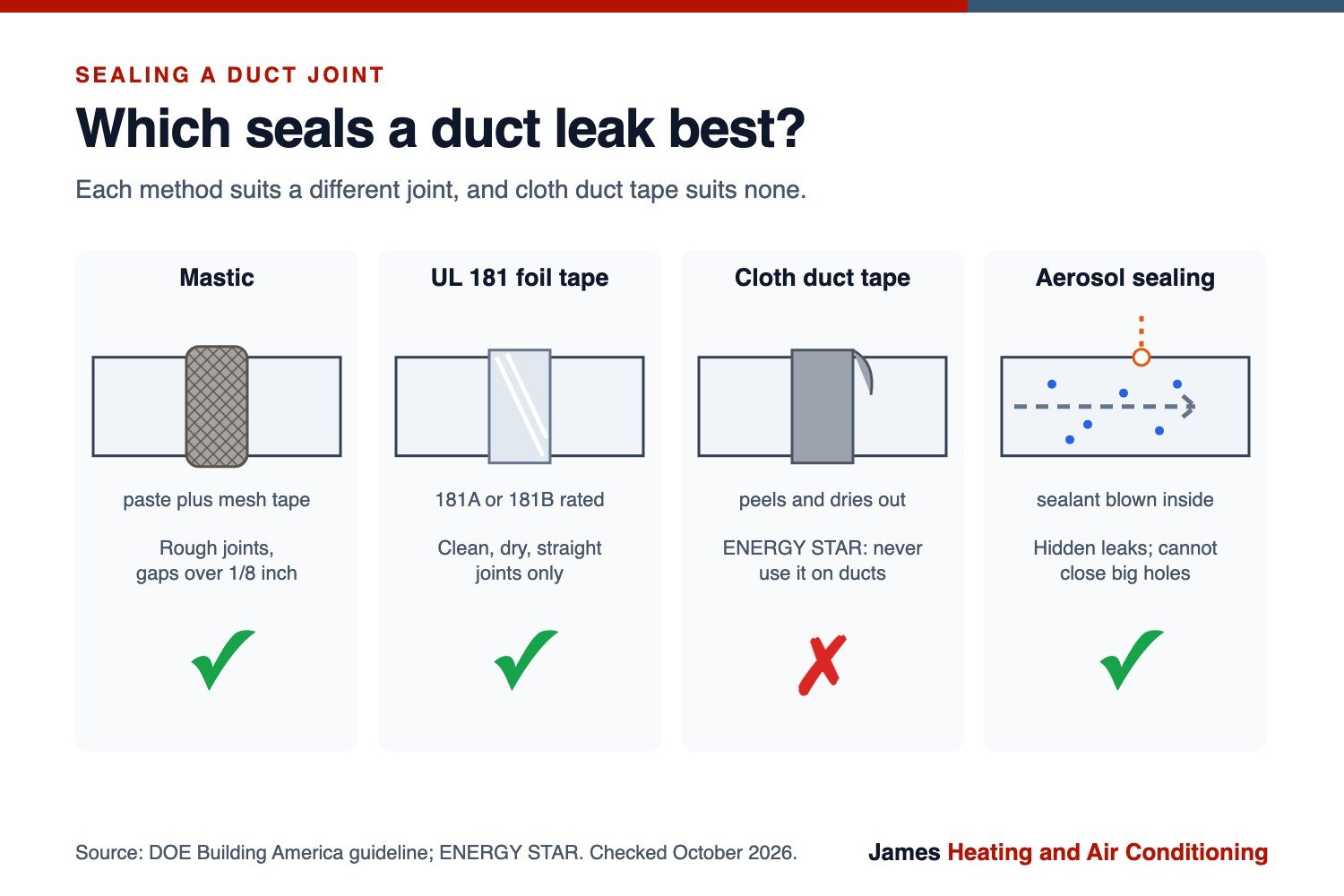
ENERGY STAR says to seal with mastic sealant or metal tape and never with duct tape, because it isn’t long-lasting. We seal reachable joints the way ENERGY STAR describes, and we don’t use cloth duct tape. The DOE guideline explains why the choice matters.
- Mastic is a water-based paste that dries into a semi-rigid, waterproof coating. It stays slightly elastic, and fibre mesh tape reinforces gaps wider than 1/8 inch. Many experts rate it above tape on rough joints.
- Foil tape rated UL 181A or 181B works on clean, dry, straight surfaces. Thin foil tapes can still fail over time.
- Aerosol sealing blows sealant particles through the pressurized duct system with the registers blocked. Lawrence Berkeley National Laboratory, which developed it, says the particles build up at leak edges until the leak closes and that a job takes four to eight hours. It can’t close large holes or disconnects, so those get fixed by hand first. We repair disconnects by hand either way.
So “Aeroseal versus mastic” is a question of access. Mastic and tape suit every run you can reach from the crawl space hatch, including each boot and plenum connection. Aerosol earns its cost when leaks hide in walls, floors or tight chases, and we’ll tell you if your ducts are that case. James Heating and Air Conditioning repairs and seals ductwork, and our technicians explain which method fits your ducts after they look at them.
Do crawl space ducts need insulation after sealing?
Yes. A tight duct that’s bare still loses heat to a cold crawl space.
The Building America checklist calls for accessible ducts in attics, crawl spaces, basements and garages to be insulated to at least R-8 for supply ducts and R-6 for return ducts. The DOE guideline quotes the 2009 energy code at R-8 in attics and R-6 elsewhere.
Order matters. We seal first, let the mastic set, then insulate, as the guideline directs. We check each run’s insulation while we’re under the floor. The flex duct guide adds that insulation must touch the duct wall without gaps and must not be squeezed by a draw band.
Will duct cleaning fix leaky ducts?
No. Cleaning removes dust and leaves the hole where it was, so a cold room and a high bill without debris call for sealing.
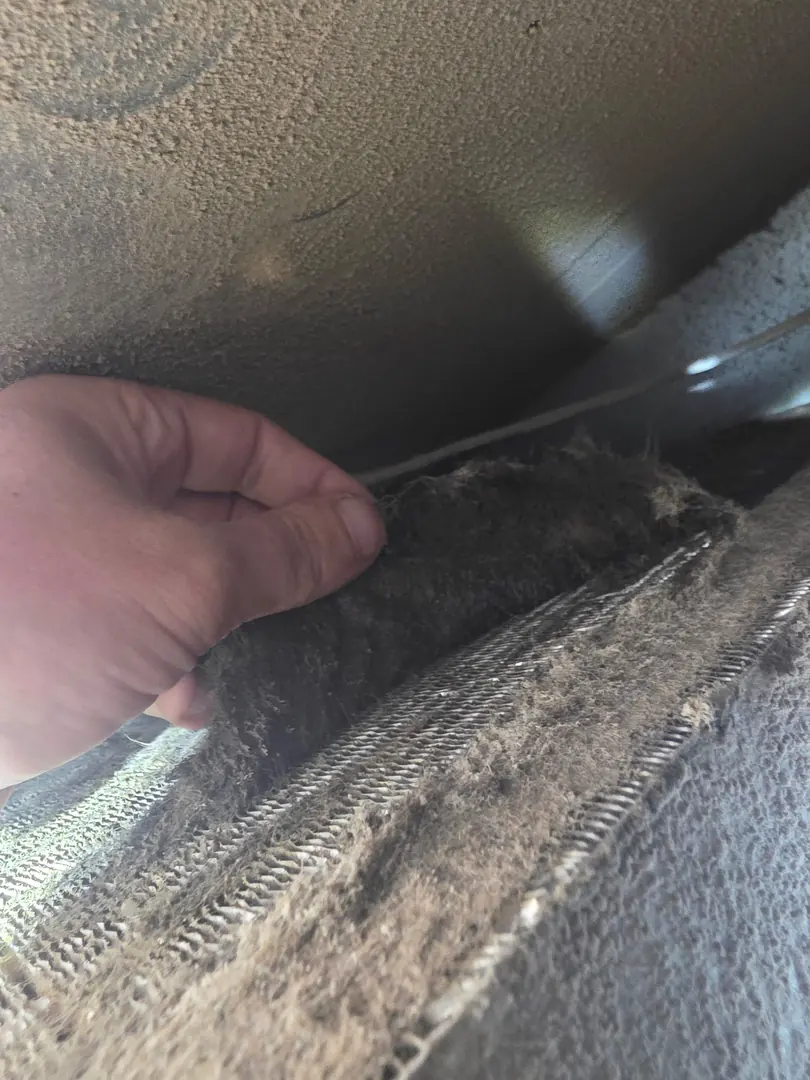
The EPA recommends duct cleaning for substantial mold, vermin or heavy dust and debris, not as a routine job. It adds that little evidence exists that cleaning only the ducts improves efficiency.
If a camera shows heavy debris or pests have been in your ducts, we clean them, and duct cleaning can follow a sealing job. We offer it as a separate service. Our weak airflow guide has a side-by-side comparison of sealing and cleaning.
How much does duct sealing cost?
National guides put duct repair at $200 to $1,000 and sealing at $300 to $3,800, depending on method and access.
Those are national guide ranges, not James prices. We quote in writing after we look at your ducts, and we quote the repair for your house, not an average.
| Job | National guide range | Source |
|---|---|---|
| Duct repair | $200 to $1,000 (average $600) | Fixr |
| Sealing air ducts | $1,000 to $3,000 | Fixr |
| Manual whole-house sealing (mastic, tape) | $300 to $1,800 (average $800) | PICKHVAC |
| Aerosol whole-house sealing | $800 to $3,800 (average $1,800) | PICKHVAC |
The two guides disagree, and PICKHVAC cites no data, so treat the spread as the honest answer. One disconnected run in your crawl space is a repair at the low end. Ducts hidden behind finished walls land at the high end.
Does EWEB or Energy Trust pay for duct sealing?
It depends on who bills your electricity, and EWEB is the only Eugene-area utility with a duct sealing rebate we could verify. EWEB funds it through two programs. Our Eugene office serves EWEB customers.
EWEB offers a $250 rebate for prescriptive duct sealing, per its insulation and air sealing page, but only when you do it with an attic or crawl space insulation project, in a single-family home with primary electric heat serving at least half the house. EWEB requires a carbon monoxide detector if your home has combustion appliances. EWEB also pays $250, or $500 on its income-based tier, for homes with electric heat and leaky ducts, per its ducted heat pump page. EWEB runs an energy line at 541-685-7088. Call before the work, because EWEB requires documentation before it pays. Our rebate guide by utility covers the heat pump and furnace programs too.
Energy Trust of Oregon covers only customers of investor-owned utilities: Portland General Electric, Pacific Power, NW Natural, Cascade Natural Gas and Avista. Our Salem office serves PGE and Pacific Power customers. Energy Trust covers duct testing, sealing and critical repair at no cost, per its live duct sealing and repair page, but for manufactured homes only, through a trade ally contractor, which Energy Trust requires for that offer. If you have a site-built home and PGE or Pacific Power service in the Salem area, ask Energy Trust before you book work, because its offers change.
SUB offers rebates for ducted heat pumps and insulation, per its rebates page, but we found no standalone duct sealing line, so ask SUB directly. Salem Electric runs its own programs in West Salem, so call them too. Federal 25C credits ended December 31, 2025, so no federal credit applies to sealing done now.
Frequently asked questions
Can I use duct tape to seal a leaky duct?
No. ENERGY STAR says never to use duct tape on ducts because it isn’t long-lasting. We fasten the joint mechanically, then seal it with mastic or UL 181 foil tape.
Is Aeroseal better than mastic?
Neither wins everywhere. Mastic and tape suit any duct you can reach and handle large gaps. Aerosol sealing suits leaks you can’t reach, and it can’t close big holes or disconnects.
Will sealing my ducts fix a cold room?
Often, if your cause is a leak or a disconnected run. Sealing won’t help when a duct is too small for the room. We check airflow at that register before and after the repair, and we size a replacement run to the room it feeds.
Why are my crawl space ducts sweating?
Moisture condenses on cold ducts in a damp crawl space. The EPA says sealing and insulating ducts in crawl spaces and attics limits condensation, and we check a wet crawl space floor before we seal anything.
Can leaky ducts make my house smell musty?
Yes, when the leak is on the return side. A return gap lets the blower pull damp crawl space air into the system, and the smell usually peaks when the blower starts. We inspect the return side first.
Call James Heating and Air Conditioning
If a cold room or a high bill points at your ducts, we trace the run, fix disconnects and seal the leaks. We cover Eugene, Springfield, Salem and Keizer. We repair, seal and recheck airflow before we leave. From our Eugene and Salem offices we serve Lane, Marion and Polk County homes. James Heating and Air Conditioning has served Oregon homes since 1983 under CCB #47396. See our HVAC diagnostics and repair and air ventilation services.
- Eugene, Springfield and nearby Lane County towns, call (541) 461-2101.
- Salem, Keizer and nearby Marion and Polk County towns, call (503) 581-9982.