






An air handler is the indoor cabinet of your heat pump or air conditioner. Its blower pulls house air across the evaporator coil and pushes it through your ducts, and most problems trace to airflow, water or power. Call (541) 461-2101 in Eugene or Springfield, or (503) 581-9982 in Salem or Keizer, any hour.
What does an air handler do?
An air handler moves your conditioned air: the blower pulls it through the return, across the evaporator coil and out the supply ducts.
The outdoor unit moves heat outside, and our technicians service the air handler that does the part you feel. Wikipedia describes the cabinet as a metal enclosure holding a blower, heating or cooling elements, filter racks and controls. In summer the coil cools and dries the air, and we clean it when dust builds up. A control board runs the sequence, and a heat pump air handler often holds electric heat strips too.
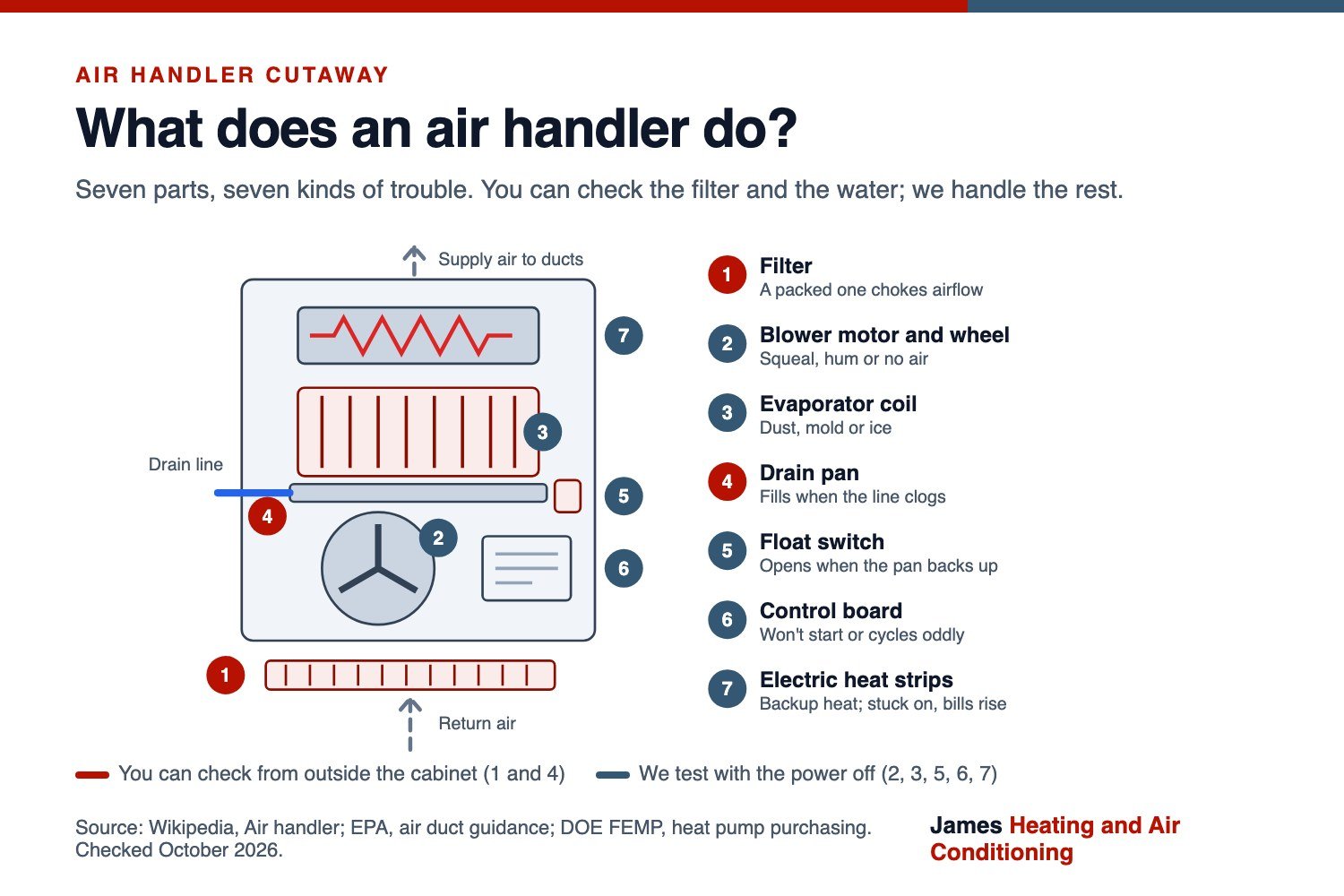
We open the cabinet and check these seven parts in order, because each one causes its own symptom:
- Filter. We pull it from its rack or return grille, since it sits outside the cabinet. A packed filter chokes the airflow.
- Blower motor and wheel. We test the capacitor and inspect the bearings. Worn bearings squeal, a dead capacitor hums, and a failed motor gives you no air.
- Evaporator coil. We inspect it for dust and ice. Dust past a weak filter dirties it, and low airflow or a refrigerant leak ices it.
- Drain pan. We clean the pan and the line, because the pan catches the water the coil pulls out of the air and a clogged line fills it.
- Float switch. It should shut the system off when the pan fills, so ask for it to be tested on a drain call. It cuts power when the pan backs up, so a quiet AC can mean a full pan.
- Control board. We check its connections and test its output. It sequences the blower, the strips and the signal to the outdoor unit.
- Electric heat strips. We inspect them in heat pump homes, where they serve as backup heat, and a stuck-on strip raises your bill.
So which cabinet do you have? That depends on whether a furnace sits in your house.
Is an air handler the same as a furnace?
No. A furnace burns fuel to make heat, while an air handler only moves air and adds cooling, and a heat pump home usually has the air handler.
In a gas furnace home, the furnace blower does the air handler’s job and the AC coil sits on top of the furnace. A heat pump home has a dedicated air handler that holds the coil, the blower and often electric strips, and we install and repair those cabinets. A ductless mini-split has no ducts, so each wall head carries its own blower and coil.
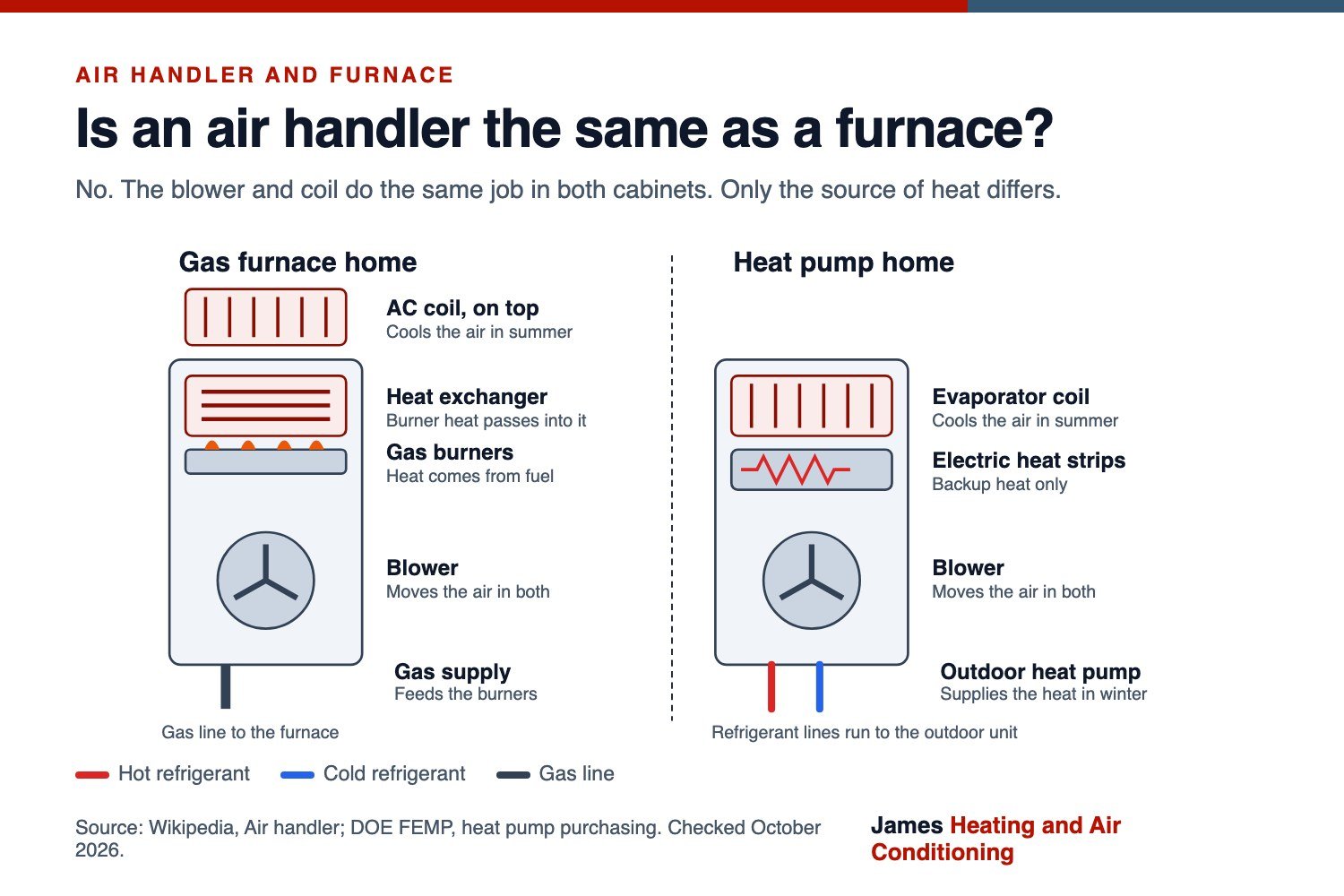
We service both, and the shared blower is why the two get confused. Weak airflow or blower noise can come from either cabinet, so we check which one you have before we chase a cause. The furnace explainer covers the gas side. Wherever yours sits decides what goes wrong, so that is next.
Where is my air handler, and why does that matter?
Your air handler most likely sits in a crawlspace, garage, utility closet or attic, and where it sits decides how fast you notice a leak.
A unit in a closet shows a leak quickly. One in a crawlspace or attic can overflow unseen, which is why the drain pan has a float switch that cuts power when water backs up. We inspect the pan and the switch on every crawlspace call. In Eugene and Salem homes we often find the cabinet beside the water heater, so a puddle there can come from either one, and we check both.
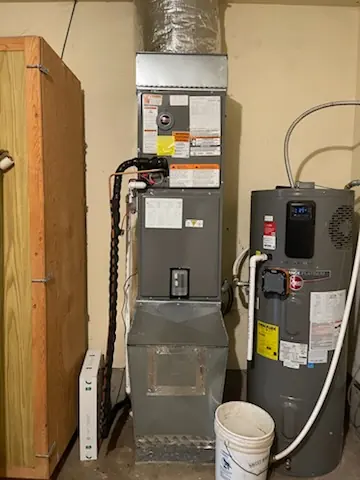
Once you know where it sits, the next question is what it is trying to tell you.
What are the signs of a bad air handler?
The signs of a bad air handler are weak airflow, ice on the coil, water at the unit, new blower noise or a blower that will not start.
If only a few rooms are weak, suspect the ducts, and the weak airflow post covers that. If every vent is weak, we start at the air handler. Our technicians test the blower and check the filter first. Follow the tree from what you notice to what to do.
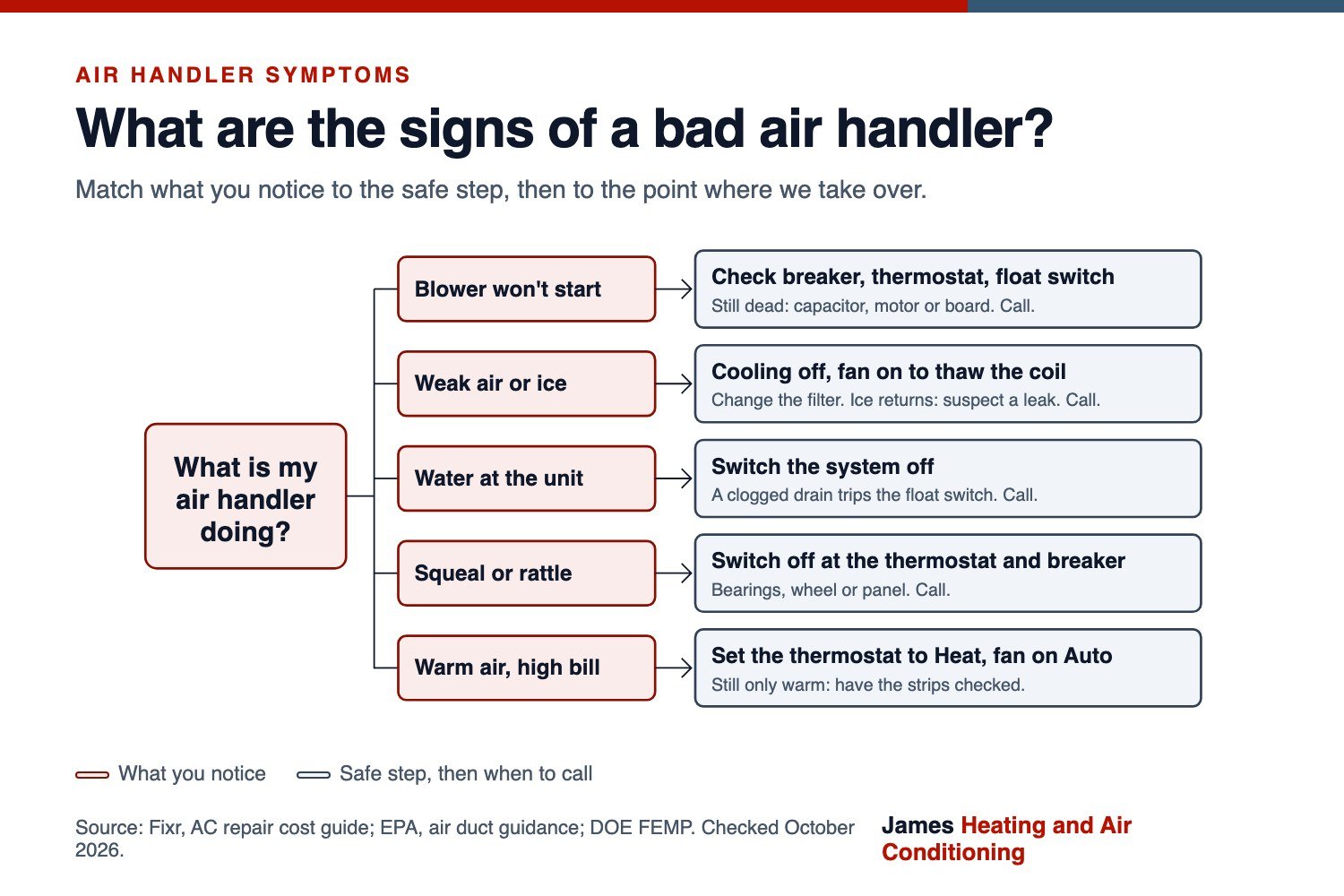
The table matches each symptom to its usual cause and sends you to the deeper post. We repair every part in it.
| Symptom | Usual cause | Go deeper | Repair cost (national guide) |
|---|---|---|---|
| Blower won’t run | Tripped breaker, failed capacitor or motor, bad board, tripped float switch | HVAC diagnostics and repair | Capacitor $100 to $400; blower motor repair $200 to $900 |
| Weak airflow | Clogged filter, iced coil, failing blower, duct leaks | Weak airflow from vents | Filter swap is a few dollars; motor as above |
| Water at the unit | Clogged condensate drain, overfull or cracked pan | Air conditioner leaking water | Drain line $75 to $250; condensate pump $100 to $500 |
| Frozen coil | Restricted airflow or low refrigerant from a leak | Frozen evaporator coil | Coil replacement, only if damaged, $400 to $2,700 |
| Noise | Worn bearings, loose wheel, failing motor, loose panel | Loud AC noises | Blower motor $200 to $900 repair, $300 to $2,000 replace |
| Dirty or moldy coil | Dust past a weak filter, standing water in the pan | Air filter schedule | Coil replacement $400 to $2,700 if cleaning won’t do |
| Failed control board | Power surge, moisture, aging relays | HVAC diagnostics and repair | Circuit board $100 to $700 |
| Tripped float switch | Clogged drain line backed water into the pan | Air conditioner leaking water | No part price listed; the drain line fix is $75 to $250 |
Costs are Fixr’s 2026 national ranges from its AC repair cost guide and include labor. Oregon prices differ, and we quote you a firm price after we inspect your system. A silent blower is the symptom people call about first,.
Why is my air handler not blowing air?
Your air handler is not blowing air most often because power is cut off: a tripped breaker, a thermostat setting or a float switch that opened after a drain backed up.
A failed capacitor or motor comes next, and we test the capacitor, the motor and the board in that order. Older units use a single-speed motor with a run capacitor, and newer ones use a variable-speed ECM motor with its own module. A dead capacitor gives you a hum and no spin, and it costs far less than a motor. A squeal or grind points to bearings, and a rattle may be a loose panel.
Leave the cabinet alone, though. A capacitor holds a charge after the power is off. Switch off at the thermostat and the breaker, and keep the panel closed.
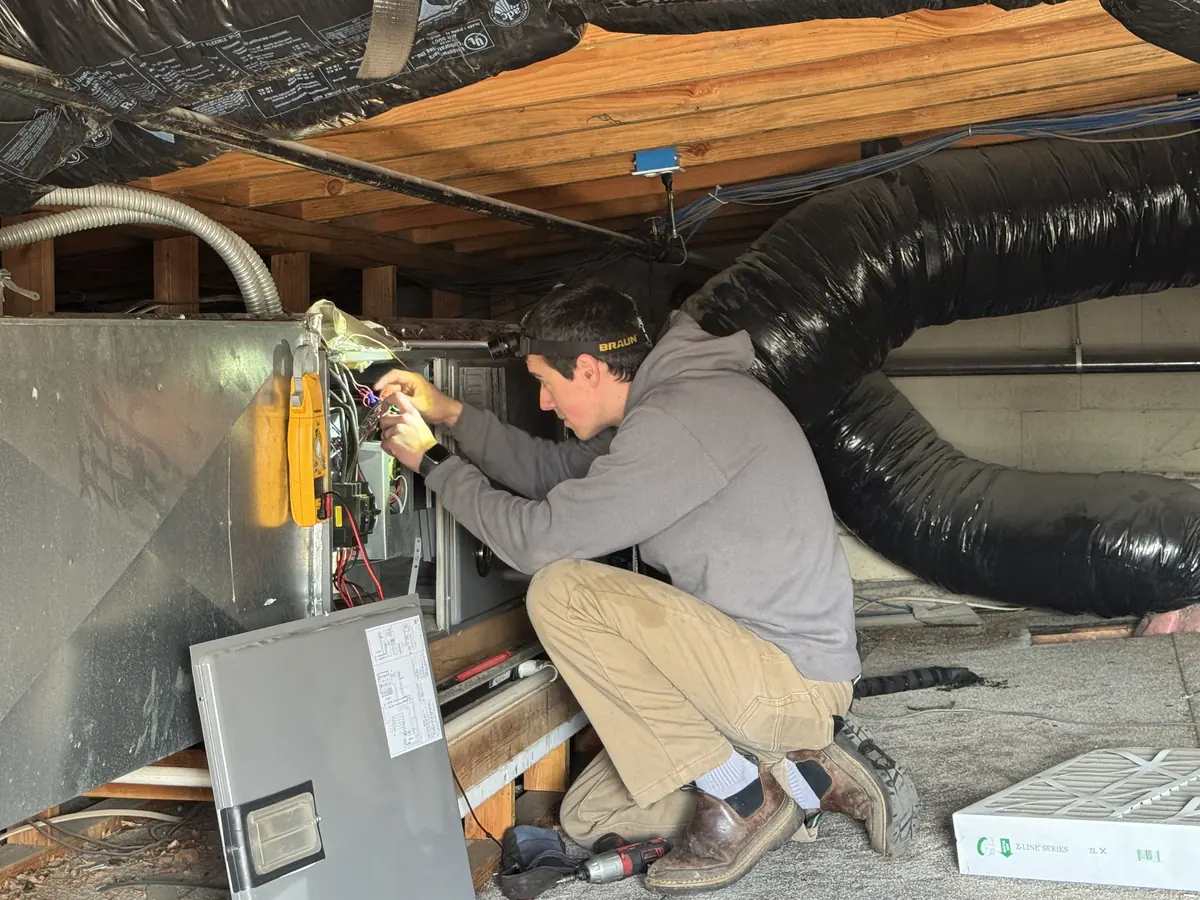
The control board sequences the blower, the strips and the signal to the outdoor unit. A failure looks like a blower that won’t start, odd cycling, or nothing at all. Loose connections and burned relays mimic a dead board, so we test the wiring before we replace the board. We check every connection and we test the relays one at a time. This is line-voltage work, and a wrong guess is expensive. We handle it with the power off. If the blower runs but you see water or ice, the cause is different.
Why is my air handler leaking water or freezing up?
Your air handler leaks or freezes when the coil’s water cannot drain or too little air crosses the coil, and both start with the filter, the drain or a leak.
Cooling pulls water out of the air. It runs from the coil into the pan and out the drain line. Algae and debris narrow the line, the pan fills, and the float switch opens the control circuit. You see an AC that quit, often with a puddle nearby. We clear the drain line, and a float switch should never be bypassed, because a bypassed switch wets ceilings. Our technicians clean the pan and flush the line too.
Ice on the coil means too little air crossing it or too little refrigerant. A dirty filter or failing blower starves the coil of air. Refrigerant isn’t consumed, so a low charge means a leak, and the EPA requires Section 608 certification to handle refrigerant under federal law. Switch cooling off and run the fan alone to thaw the coil. Never chip the ice. We check the airflow first, then we test for a refrigerant leak.
Dirt and mold are a moisture story. The EPA says to “pay particular attention to cooling coils” and to make sure the condensate pan drains, and that standing water or debris “indicates a problem requiring immediate attention.” Its duct cleaning guidance is narrow: clean ducts only as needed, such as for visible mold, vermin or heavy clogging. A musty smell at the air handler more often points to the coil or pan, so we inspect both and clean what we find. Heat pump cabinets add one more part to watch.
What do the electric heat strips in an air handler do?
The electric heat strips in a heat pump air handler are backup heat that switches on when the heat pump alone cannot keep up.
They are electric resistance elements, and the Department of Energy’s FEMP program says their “use should be kept to a minimum.” It also suggests a heat-pump thermostat that raises the temperature gradually, so the strips stay off. If your bill jumps and the vent air feels only warm, we check the strips and the outdoor unit together. We test each strip and we read the thermostat settings. Before you call, there are checks you can make yourself.
What can I check before I call?
You can make four checks without opening the cabinet: the thermostat, the breaker, the filter and the water.
- Thermostat. Confirm it is set to cool or heat and the fan is on Auto, with fresh batteries if it takes them.
- Breaker. Reset a tripped breaker once. If it trips again, stop.
- Filter. A packed filter chokes the blower. Wildfire smoke season loads one with ash faster than normal, so look sooner than the calendar says. We replace filters on the same visit. The air filter schedule covers timing.
- Water. Look for water at the unit or a wet pan. Wet means a drain problem, so leave it off.
Do not open the cabinet with the power on, bypass a float switch or add refrigerant. If the four checks don’t solve it, you are weighing a repair against a bigger bill.
Should I repair or replace my air handler?
Repair your air handler when the part costs under half of a replacement; replace it when one repair crosses that line or several parts are failing.
The U.S. Department of Energy’s Building America guide sets the half-the-cost rule. Most problems are repairs, and national guides put capacitors, drain lines and boards in the low hundreds of dollars. The math shifts when a motor and a coil are both going. Fixr lists air handler units at $1,000 to $3,500, averaging $1,700, and labor is extra. A coil alone can run $400 to $2,700.
Replacement also ties to the outdoor unit. New systems use R-454B or R-32 refrigerant, and we match the indoor coil to the outdoor unit. If you replace the outdoor unit, we usually replace the air handler with it. We quote both the repair and the replacement, so you can hold them against that line. Our trucks carry common capacitors and drain parts.
Frequently asked questions
What are the signs of a bad air handler?
Weak airflow from every vent, ice on the coil, water at the unit, new blower noise, or a blower that won’t start. If only a few rooms are weak, suspect the ducts. If the whole house is, start at the air handler.
Why is my air handler not blowing air?
Power is the usual reason: a tripped breaker, a thermostat setting, or a float switch that cut the circuit after a drain backed up. A failed capacitor or motor comes next.
Can I run my AC with the air handler off?
No. The blower moves air across the evaporator coil. Without it the coil gets too cold and freezes, and no cooled air reaches the house. We inspect the blower first when ice shows up.
Can duct problems look like air handler problems?
Yes. Leaking or blocked ducts weaken airflow in the same way a failing blower does. If only some rooms are weak, we test the ducts first.
How often should an air handler be serviced?
Once a year is the common schedule, and the tune-up post lists what a visit covers. We check the drain, the blower and the wiring, and we clean the coil when it needs it.
Call James Heating and Air Conditioning for air handler diagnosis
We have worked on Oregon heating and cooling systems since 1983, Oregon CCB #47396, and we answer 24 hours a day. In Salem, Keizer and the Willamette Valley, call (503) 581-9982. Lane County homes, including Eugene and Springfield, reach the Eugene office at (541) 461-2101. What a visit covers is on our HVAC diagnostics and repair page.