



A furnace is the part of your central heating system that makes heat and sends it through your ducts. It warms air with a gas flame or electric elements, and a blower pushes that air to each room. We service furnaces in Eugene at (541) 461-2101 and in Salem at (503) 581-9982.
What does a furnace do in your house?
A furnace heats the air in your house and pushes it through your ducts to every room. Return ducts pull cool air in, the furnace warms it, and supply ducts carry it back out.
Think of a furnace as a heater and a fan in one cabinet. A boiler heats water instead, and a heat pump moves heat rather than making it. If you have central air conditioning, the same blower and ducts carry cooled air in summer. The thermostat picks the mode, so the furnace does not control your AC. We service both, and the two share the fan and the ductwork. Our technicians service the furnace, the blower and the ducts as one system. We check the thermostat setting first, then we open the cabinet.
What are the parts of a furnace and what does each one do?
A gas furnace has eight main parts, and each one has a single job and its own way of failing.
| Part | What it does | What failure looks like |
|---|---|---|
| Thermostat | Tells the furnace when to start and stop | No heat, or heat that never shuts off |
| Inducer fan | Pulls exhaust out through the vent before the burners fire | No heat, furnace starts and quits |
| Igniter | Lights the gas at the burners | No heat, clicking or glowing with no flame |
| Burners | Burn gas to make heat | Uneven or yellow flame, soot |
| Flame sensor | Confirms a flame is present, or the gas valve shuts | Burners light, then go out in seconds |
| Heat exchanger | Moves heat from the flame to the air without mixing exhaust in | Cracks are a carbon monoxide risk |
| Blower | Pushes house air across the heat exchanger and into the ducts | Weak airflow, cold air, noise |
| Control board | Runs the sequence and watches the safety switches | Random no-heat faults, short cycling |
The filter slot sits on the return side, ahead of the blower. A clogged filter starves the furnace of air, and the high-limit switch shuts the burners down to stop overheating. We check the filter first on a no-heat call for that reason. Our technicians test the igniter and the flame sensor before we replace either one, and we clean a dirty flame sensor on the same visit. We replace the igniter, flame sensor or control board only when the test says it failed. Next, those parts at work.
How does a gas furnace heat your house?
A gas furnace heats your house by burning gas in a burner box, passing that heat into your air through a heat exchanger and blowing the warmed air into the ducts.
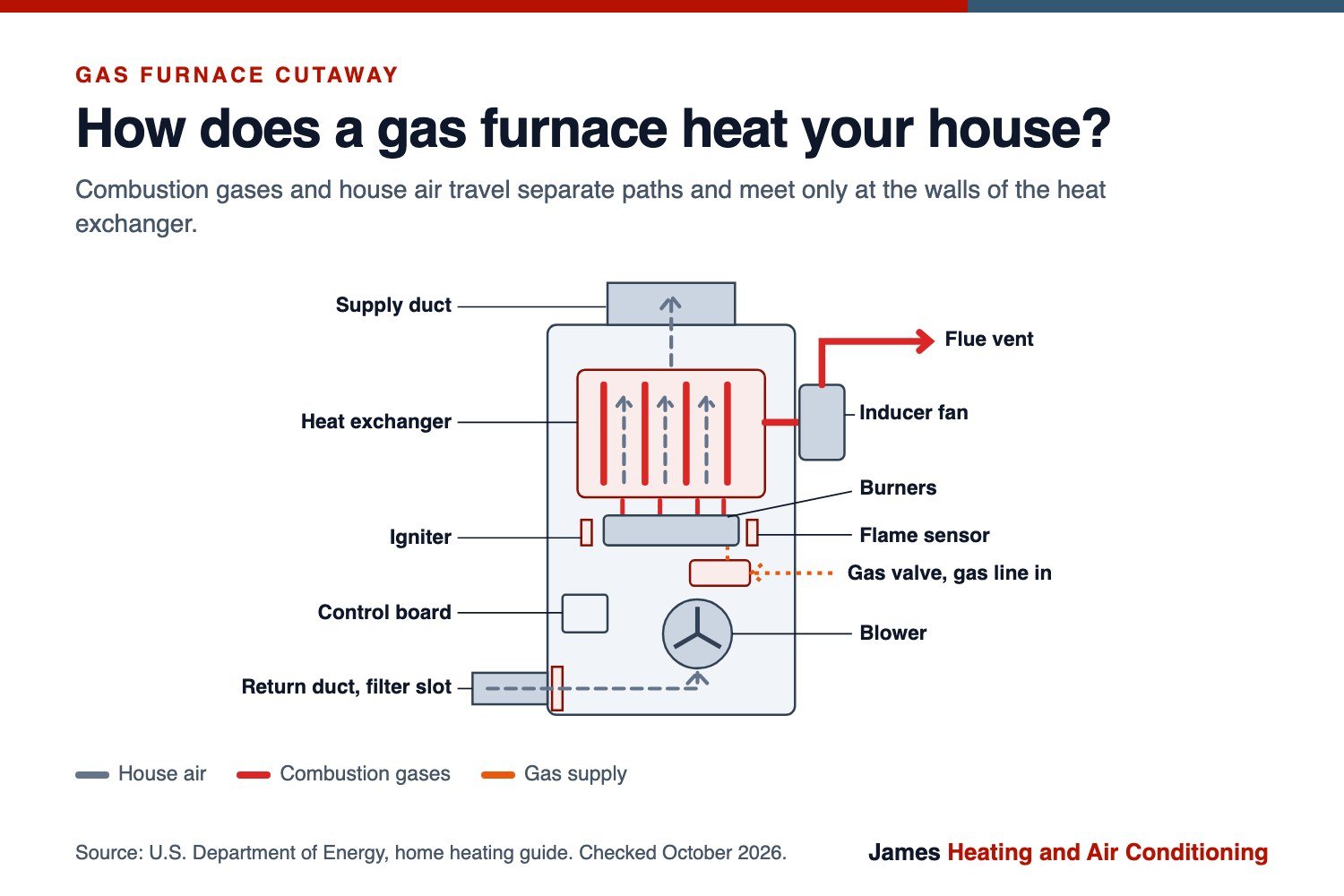
The drawing shows an upflow furnace, where air moves from the bottom of the cabinet to the top. The sequence never changes, and our technicians test it in this order on a no-heat call. The thermostat calls for heat, and the control board starts the inducer fan. When the sequence stalls, we test the step that failed to start before we touch anything else. The igniter heats up or sparks, the gas valve opens and the burners light. The flame sensor checks that the flame is real, and we check the flame at the burners during that step. Heat soaks into the heat exchanger, and after a short delay the blower pushes warm air into your ducts. When the room reaches the set temperature, the burners stop and the blower runs a little longer to clear the remaining heat.
Two paths run side by side and never mix. Exhaust travels from the burners through the heat exchanger tubes and out the flue vent. Your house air travels around those tubes, picks up heat from their walls and heads for the supply duct. We inspect the heat exchanger for cracks because a crack breaks that separation. Before the safety section, one more question about the power cord.
Does a gas furnace need electricity to run?
Yes, a gas furnace needs electricity to run. The inducer fan, igniter, blower and control board all run on power, so a gas furnace will not heat in a power outage.
Gas supplies the heat, and electricity runs everything else. If your furnace stays dead after the power returns, our technicians test the control board and the inducer first, and we test the igniter when the furnace has power but no flame. That leads to the bigger question: which fuel does your furnace use at all?
Is a furnace gas or electric?
A furnace is either gas or electric, and propane units burn fuel the same way gas units do. Which one you have often comes down to your address.
Gas and propane furnaces use a burner, a heat exchanger and a vent pipe to the outside. Electric furnaces skip all of that. Oregon’s Department of Energy reports that in Lane County, electricity is the primary heating fuel in 75% of homes, natural gas in 18% and wood in 5%. Primary electric heat includes heat pumps, baseboard heaters and electric furnaces, so 75% does not mean 75% electric furnaces. A Eugene or Springfield home is far more likely to run on electricity. NW Natural serves gas customers, so gas depends on whether it runs a line down your street. EWEB serves Eugene homes with electricity. We check the nameplate and the vent before we assume anything about your system. We replace a gas furnace with another gas furnace or with a heat pump, depending on your house. Next, what happens inside an electric cabinet.
How does an electric furnace make heat?
An electric furnace makes heat by running current through heating elements while a blower pushes house air across them. It has no flame, no flue and no combustion gases.
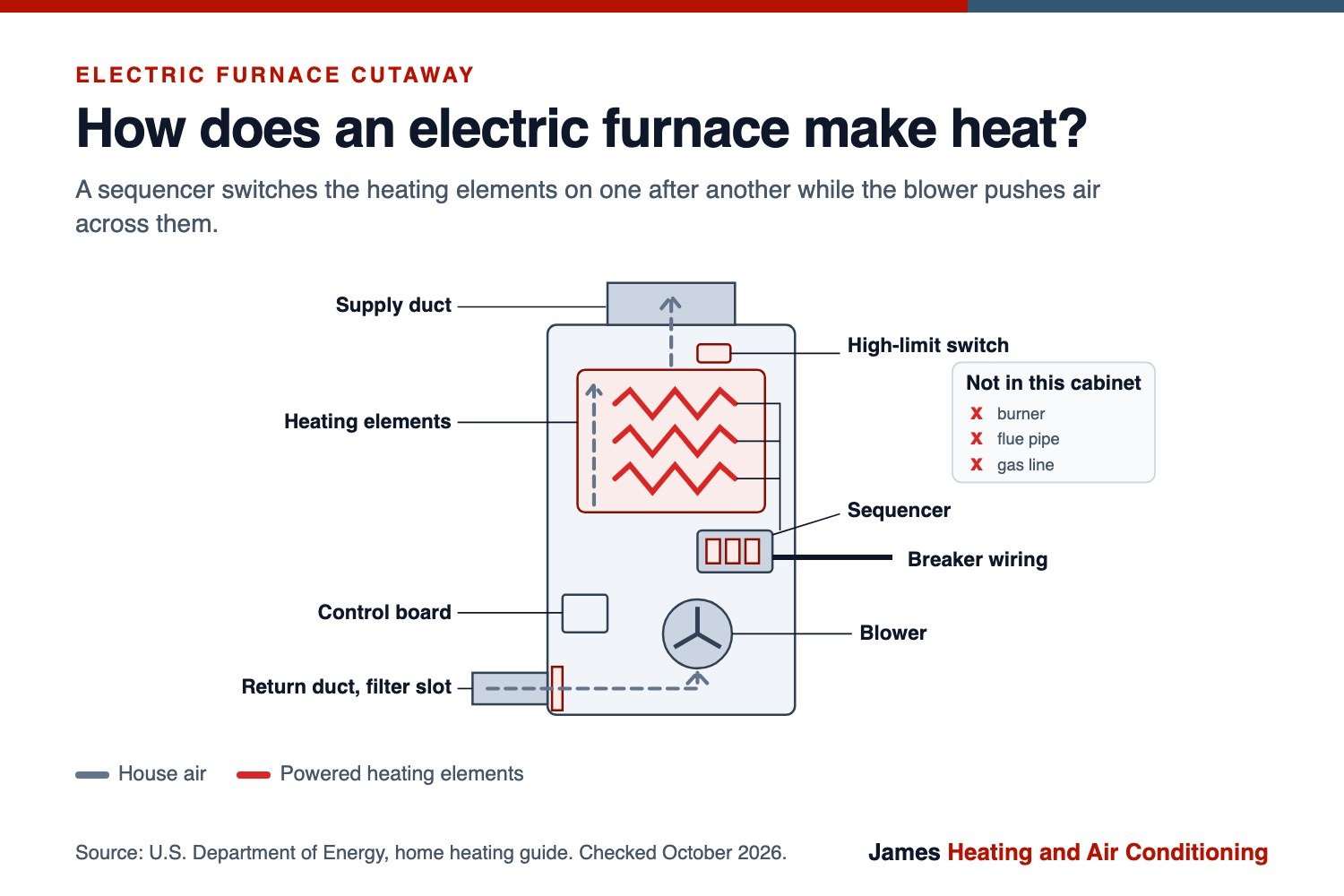
The sequencer sets an electric furnace apart. It switches the elements on one after another so they do not all draw power at once, and heavy wiring from your breaker panel feeds it. The control board runs the sequence, and the high-limit switch cuts the elements if the air gets too hot. We test the high-limit switch when the elements shut off early. A clogged filter trips that switch in an electric furnace the same way it trips one in a gas furnace, so we inspect the filter first. We check the breaker and the wiring next, and our technicians test the control board, the sequencer and each element with a meter. Your electric rate sets the running cost, which brings up the other all-electric option.
Is a furnace the same as a heat pump?
No, a furnace is not a heat pump. A furnace makes heat from fuel or electric elements, and a heat pump moves heat that already exists in outdoor air.
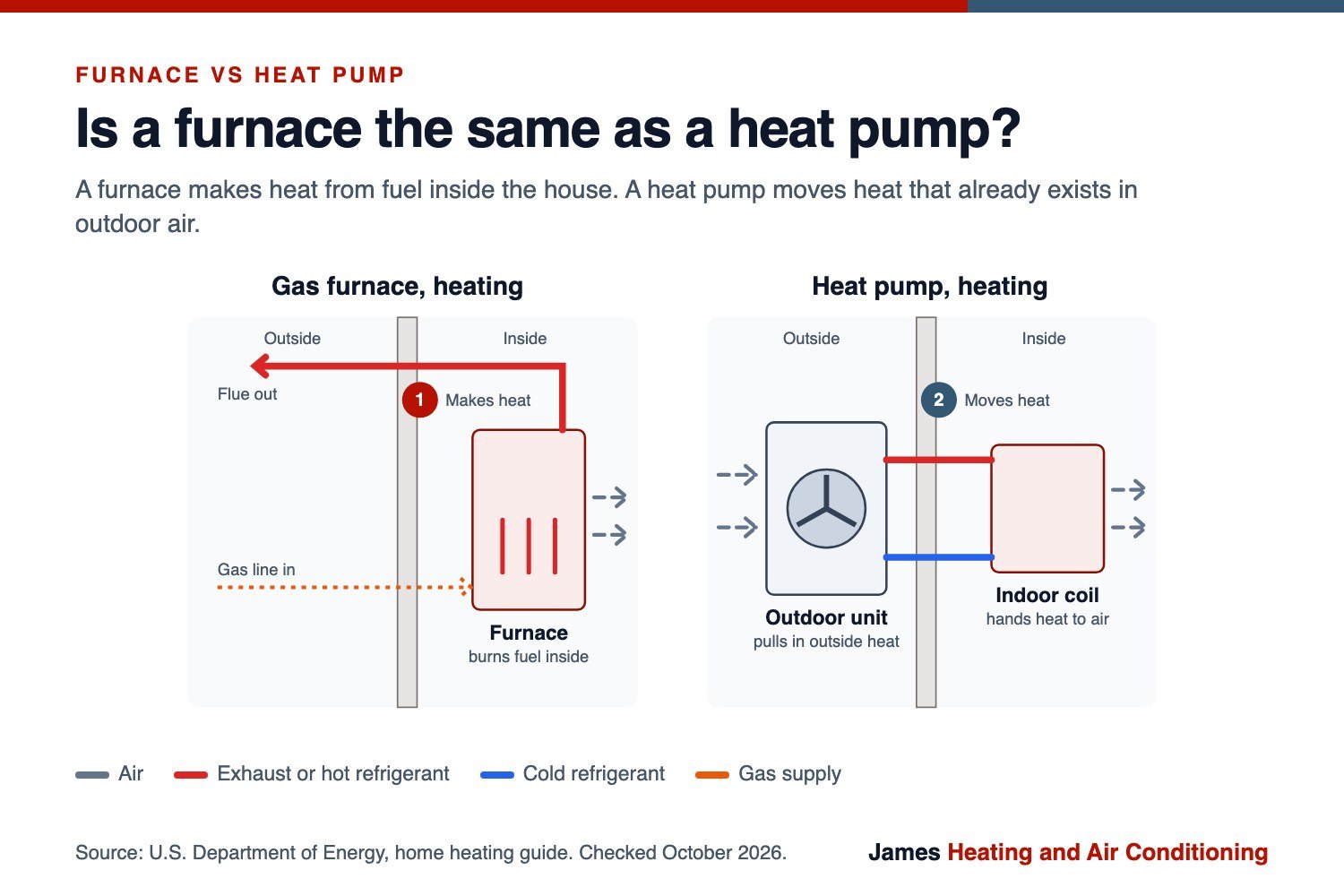
That difference explains the efficiency gap. The Department of Energy puts heat pump efficiency (COP) at roughly 2 to 4, which means two to four units of heat for each unit of electricity. A ducted heat pump can replace a furnace and an air conditioner with one system. We install ducted heat pumps, we quote one against a furnace after we see your house, and we install ductless heat pumps for homes with no ducts. The table compares all four common systems.
| Gas furnace | Electric furnace | Heat pump | Boiler | |
|---|---|---|---|---|
| Heat source | Gas or propane flame | Electric elements | Moves heat from outdoor air | Gas, oil or electric heating water |
| Vent pipe needed | Yes | No | No | Yes, if fuel-fired |
| Heats in a power outage | No | No | No | No |
| Also cools | No | No | Yes | No |
| Needs ductwork | Yes | Yes | Ducted or ductless | No, uses radiators or in-floor tubing |
Our post on what drives furnace replacement cost shows how those choices change a quote. For a gas furnace, the next question is how much of the fuel becomes heat.
What does AFUE mean on a furnace?
AFUE stands for Annual Fuel Utilization Efficiency, and it is the share of a gas furnace’s fuel that becomes heat for your house over a season. At 80 percent AFUE, 80 percent of the fuel becomes heat and 20 percent goes up the vent.
The U.S. Department of Energy’s home heating guide groups furnaces and boilers into old low-efficiency units at 56 to 70 percent, mid-efficiency at 80 to 83 percent and high-efficiency at 90 to 98.5 percent. The 90-plus units are condensing furnaces. They pull so much heat out of the exhaust that it cools and condenses, so they vent through PVC pipe and need a drain for the condensate. We install condensing furnaces with the PVC vent and the condensate drain they need. We check the AFUE on the label when we size a replacement, and we size it to your house, not to the old furnace.
Two rules matter right now. The federal minimum for a new non-weatherized gas furnace is 80 percent AFUE. The Department of Energy has also finalized a 95 percent standard with an effective date in late 2028, but that rule is tied up in litigation and a delay has been requested, so check energy.gov before you plan around it. ENERGY STAR certifies furnaces that carry higher AFUE and more efficient blower motors than standard models. Heat pumps use a different yardstick, HSPF2. With ratings covered, you can go find your own unit.
How can you tell which furnace you have?
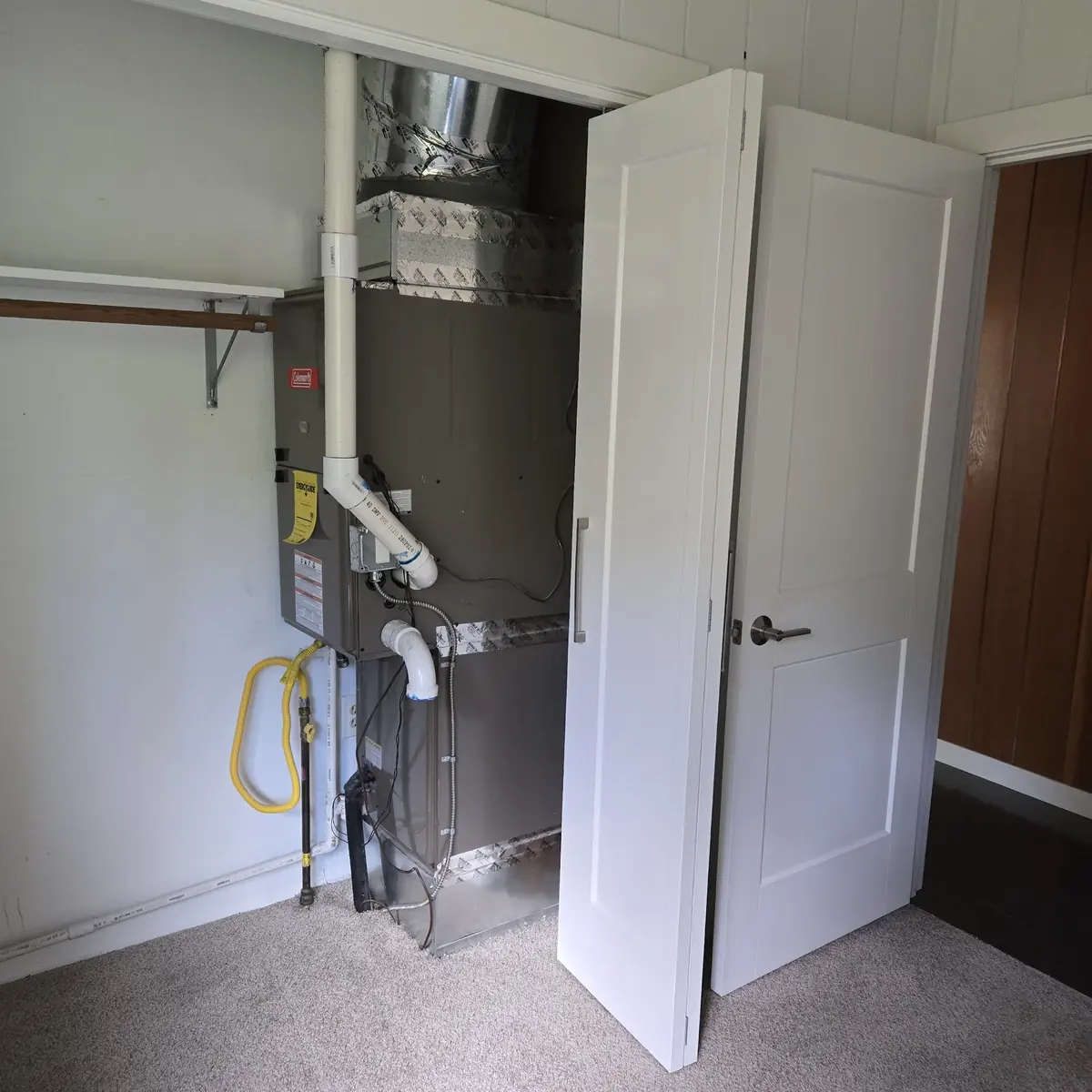
You can tell which furnace you have by reading the rating label on the cabinet and then looking at the plumbing and venting around it. We check four things in this order, and you can too. We trace the gas line and read the vent before we touch a part.
- Check the rating label. It gives the model and serial number, which together show the age and the fuel.
- Look for a gas line and a vent pipe. A gas line plus a metal or PVC vent means a gas furnace, and white PVC suggests a condensing model.
- Look for heavy wiring and no vent. That combination means an electric furnace, and we check the breaker panel too.
- Look outside for a fan unit. An outdoor unit with a fan, plus an indoor coil or air handler, means a heat pump. Radiators, baseboard pipes or in-floor tubing mean a boiler.
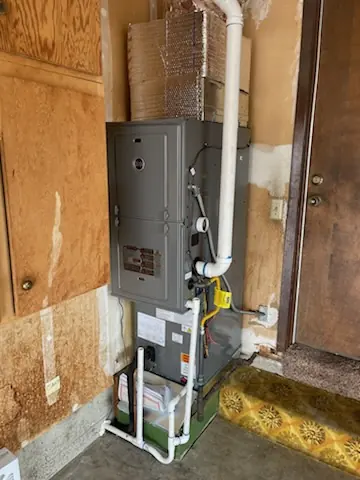
Furnaces sit in closets, garages, attics, crawlspaces and basements, usually near the main return duct. We service furnaces in all of those spots. Your utility bill shows which fuel serves you: NW Natural for gas, or EWEB, PGE, Pacific Power or Salem Electric for power. Once you know what you have, the last question is how it can hurt you.
Can a furnace leak carbon monoxide?
Yes, a furnace can leak carbon monoxide when the heat exchanger cracks or the vent clogs or leaks. Carbon monoxide has no smell, no color and no warning.
The EPA covers leaking furnaces and blocked or leaking flues among the common sources. A cracked heat exchanger is not visible from outside the cabinet, so we inspect it with the cabinet open.
- Install CO alarms. The Consumer Product Safety Commission recommends one on each level and outside each sleeping area, as the EPA notes.
- If a CO alarm sounds, get everyone outside and call 911. Do not go back in to look for the cause. We test the furnace after the fire department or utility clears the house.
- If you smell gas, leave first. Do not flip a switch or use a phone inside. From outside, call 911 and NW Natural at 800-882-3377.
- Have fuel-burning furnaces inspected every year. We check the heat exchanger, the vent and the burners on that visit, and we test for carbon monoxide at the registers. We also check that your CO alarms sit on each level and outside each sleeping area.
When should you call a technician about your furnace?
Call a technician for anything inside the cabinet. The filter, clear registers and the thermostat setting are yours, and a gas smell or CO alarm is an emergency that starts with leaving the house.
Our technicians repair furnaces that will not start, short cycle or blow cold air. We diagnose the stalled step before we replace a part, and we quote the repair before we start it. Know the signs a furnace needs repair, and check how long a furnace lasts before you pay for a big repair on an old one.
Frequently asked questions
Is a furnace the same thing as a heater?
A furnace is one kind of heater: the central kind that heats air and sends it through ducts. Space heaters and wood stoves heat one room without ducts.
What is the difference between a furnace and an HVAC system?
HVAC is the whole system, covering heating, ventilation and air conditioning. The furnace is the heating piece, and it shares the blower and ducts with the AC.
Does the furnace control the AC?
No. Your thermostat controls both. The furnace and the air conditioner share the blower and ducts, but each one runs only when the thermostat calls for its mode.
Where is a furnace located in a house?
In a closet, garage, attic, crawlspace or basement, usually near the main return duct.
Is a furnace an appliance?
Yes, it is a major fixed appliance, but unlike a range or dryer it is part of the home’s mechanical system. Oregon requires a mechanical permit for a furnace replacement, and we pull it as part of the job.
Call James if your furnace needs a look
A furnace that will not start, short cycles or blows cold air needs a technician. A CO alarm or gas odor needs 911 first. James Heating and Air Conditioning serves Eugene and Salem under Oregon CCB #47396 and has worked on heating systems since 1983. For furnace service in Eugene, Springfield and Lane County, call (541) 461-2101. In Salem, Keizer and Marion and Polk counties, call (503) 581-9982. We answer and dispatch emergency calls around the clock. See our furnace repair and installation page for what we service.