






An AC repair visit runs in five steps: a symptom walk-through, root-cause testing, a written quote, a repair-or-replace decision and a test run. We test for the cause before we quote a part, and you approve the price before work starts. In Salem and Marion County, call (503) 581-9982. We answer around the clock.
What happens during an AC repair visit, step by step?
An AC repair visit follows five steps, and each step hands its result to the next. You describe the symptoms, our technicians test for the cause, we quote the repair in writing, you decide, and our technicians run a full cooling cycle.
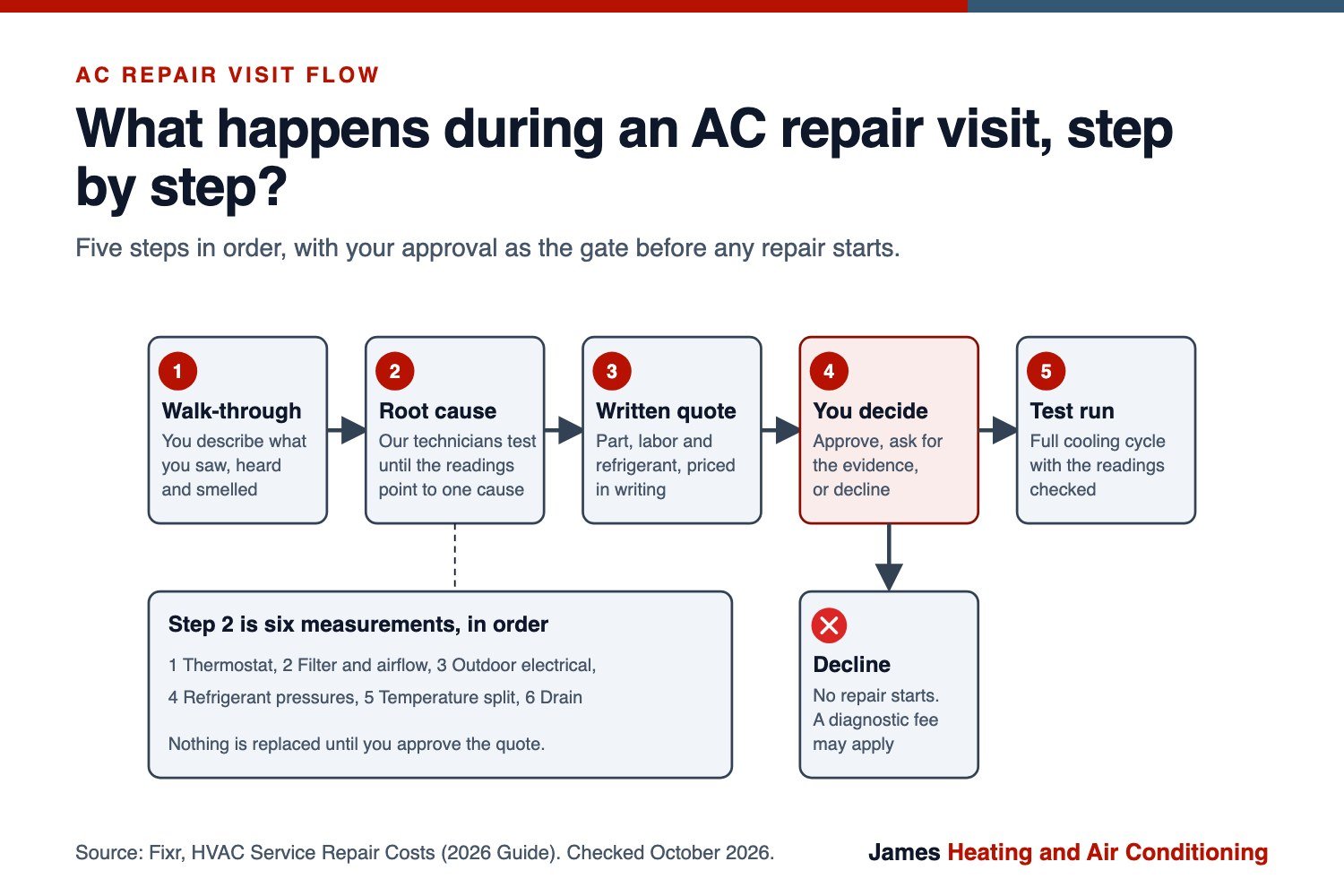
- Walk-through. Our technicians ask what you saw, heard and smelled, and when it started.
- Root cause. Our technicians test the system until the readings point to one failed part or one condition.
- Written quote. We quote the repair in writing before any work begins.
- Repair or replace. We quote a replacement as well when age, repair history or refrigerant type call for it, and you make the call.
- Test run. Our technicians run the system through a full cycle and check the readings.
A technician who jumps straight to a part has skipped the evidence. Your answers in step one speed up everything after it, so a few minutes of preparation pays off.
What should I do before the AC technician arrives?
Before the technician arrives, clear access to both units, write down your symptoms, photograph the model plate and secure your pets. Five minutes of preparation saves the technician from hunting for answers.
- Clear access. Move plants, toys and stored items away from the outdoor unit, and clear the path to the indoor unit or air handler.
- Symptom notes. Write down what happened, such as warm air, short cycling, ice, a noise, a smell or a tripped breaker, and add when it began.
- Brand and age. The model plate on the outdoor unit lists the brand, model and serial number. A phone photo works, and our technicians check warranty coverage with it.
- Pets secured. Gates, fences and open doors are part of the job.
- Thermostat behavior. Note the setting, whether the display is blank, and whether it clicks but nothing starts.
The warning signs your AC needs repair are worth a quick read, so your notes match what we check.
Should I be home during an AC repair?
Yes, for indoor work. An adult needs to give access and approve the quote. Outdoor-only work may not need you inside, but we replace nothing until you approve the price.
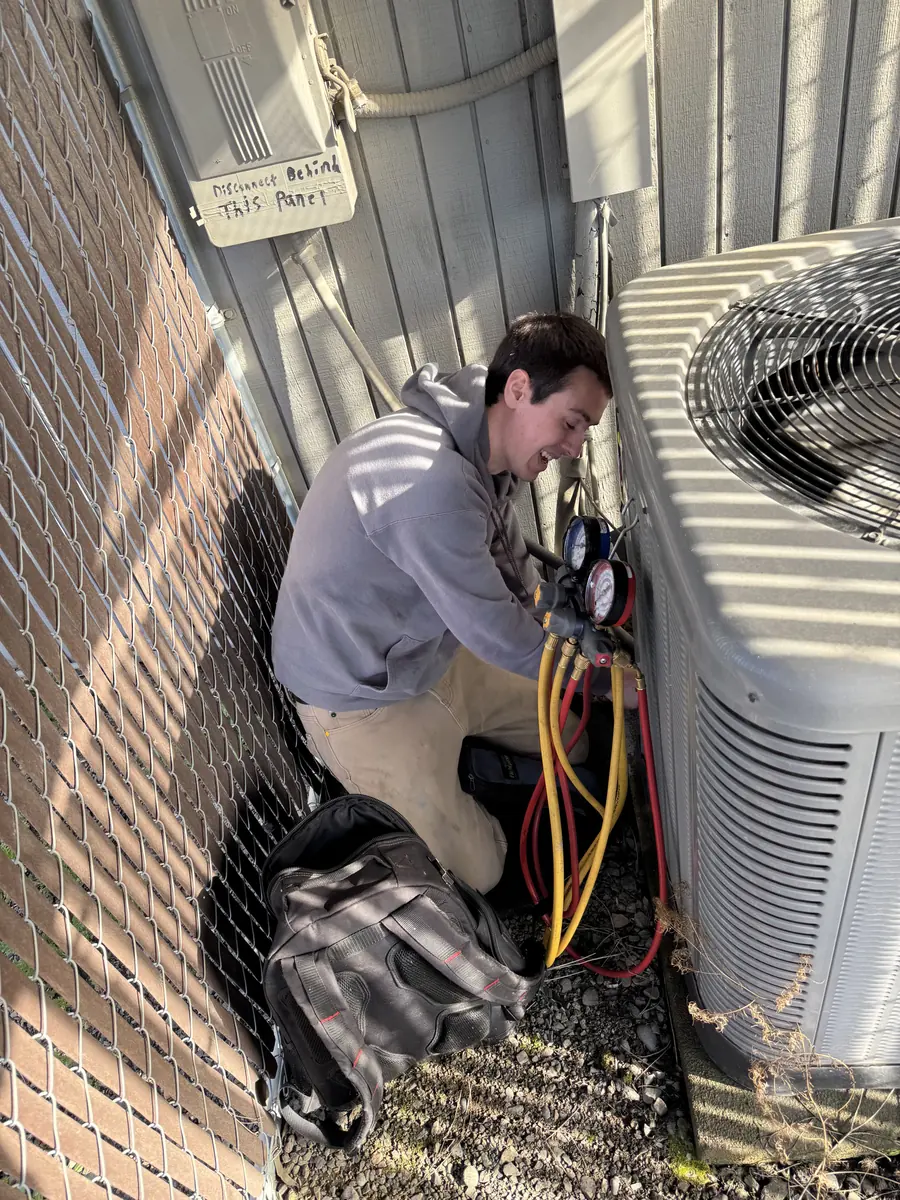
Tell the technician what you already tried. “It runs but never reaches the set temperature” points to different causes than “it hums and does nothing.” One-room problems suggest airflow or ducts, and whole-house failures suggest the outdoor unit, the thermostat or power. If you reset the breaker, say how many times. A unit that trips repeatedly has an electrical fault, so we test the connections before anyone resets it again.
What does an AC technician measure to find the problem?
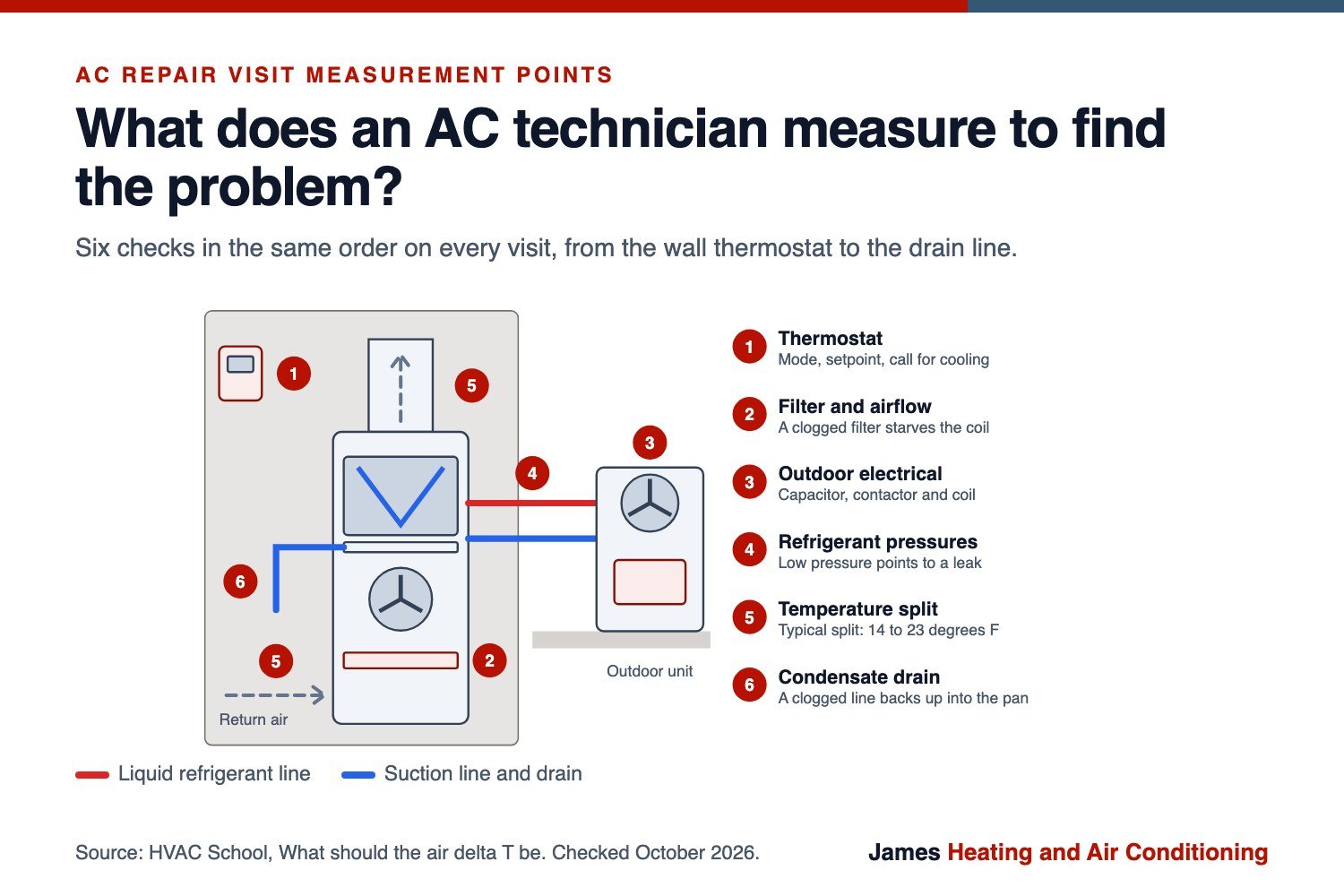
An AC technician measures six things in a fixed order: the thermostat, the filter, the outdoor electrical parts, the refrigerant pressures, the temperature split and the drain. Our technicians check the same chain every time, so the cause comes from readings and not from a hunch.
| Check | What it tells the technician |
|---|---|
| 1. Thermostat settings and wiring | Rules out a dead battery, wrong mode or a lost call for cooling |
| 2. Filter and airflow | A clogged filter or blocked coil cuts airflow, and low airflow can freeze the indoor coil |
| 3. Outdoor unit: capacitor, contactor and coil | A weak capacitor stops the compressor or fan from starting, a pitted contactor stops power reaching them, and cottonwood fluff or grass clippings block heat rejection |
| 4. Refrigerant pressures | Low pressure points to a leak, since refrigerant is not consumed like fuel |
| 5. Temperature split across the coil | Shows how much heat the system actually removes |
| 6. Condensate drain | A clogged line backs water up into the pan and can shut the system off |
We test the thermostat wiring first. We check the filter and airflow next, inspect the capacitor, contactor and coil at the outdoor unit, and read the refrigerant pressures. We check the temperature split and the drain last.
The temperature split is the difference between return air and supply air. HVAC School puts a typical split at 14 to 23 degrees Fahrenheit, and notes that airflow, humidity and capacity all move it. A split far outside that band, with a clean filter and a clean coil, sends us to the refrigerant side next. We check air temperature before and after the coil, not at the grilles, because ducts gain and lose heat.
Refrigerant deserves its own note. Topping off without finding the leak is a short-term fix. The EPA requires refrigerant to stay out of the air during service, and we recover it instead of venting it (EPA Section 608). Once the readings point to one cause, the next question is the price.
How much does an AC repair cost?
An AC repair costs $250 to $700 nationally, with a $375 average, according to Fixr’s AC repair cost guide. These are national ranges, not James prices. We quote after we inspect your system.
| Repair | National range |
|---|---|
| Clogged condensate drain line | $75 to $250 |
| Capacitor replacement | $100 to $400 |
| Refrigerant recharge | $100 to $600 |
| Blower motor repair | $200 to $900 |
| Evaporator coil replacement | $400 to $2,700 |
| Compressor replacement | $600 to $3,000 |
Many companies charge a diagnostic fee for the time spent finding the problem. Fixr puts that fee at $75 to $200, covering roughly 30 to 60 minutes of technician time, and says it is often waived or applied to the repair if you proceed. Ask when you book whether it is credited, and we answer fee questions on the same call. We quote the part, the labor and any refrigerant separately.
How long does an AC repair take?
It depends on the cause and on whether the part is on the truck. Fixr describes diagnosis as about 30 to 60 minutes of technician time, and the repair comes after that. Ask the dispatcher for an estimate when you call. A capacitor swap and a compressor replacement are very different jobs.
Should I repair or replace my AC?
Replace the system when the repair costs more than half of a new one. The U.S. Department of Energy’s Building America guide sets that half-the-cost rule, and Fixr gives the same 50% line.
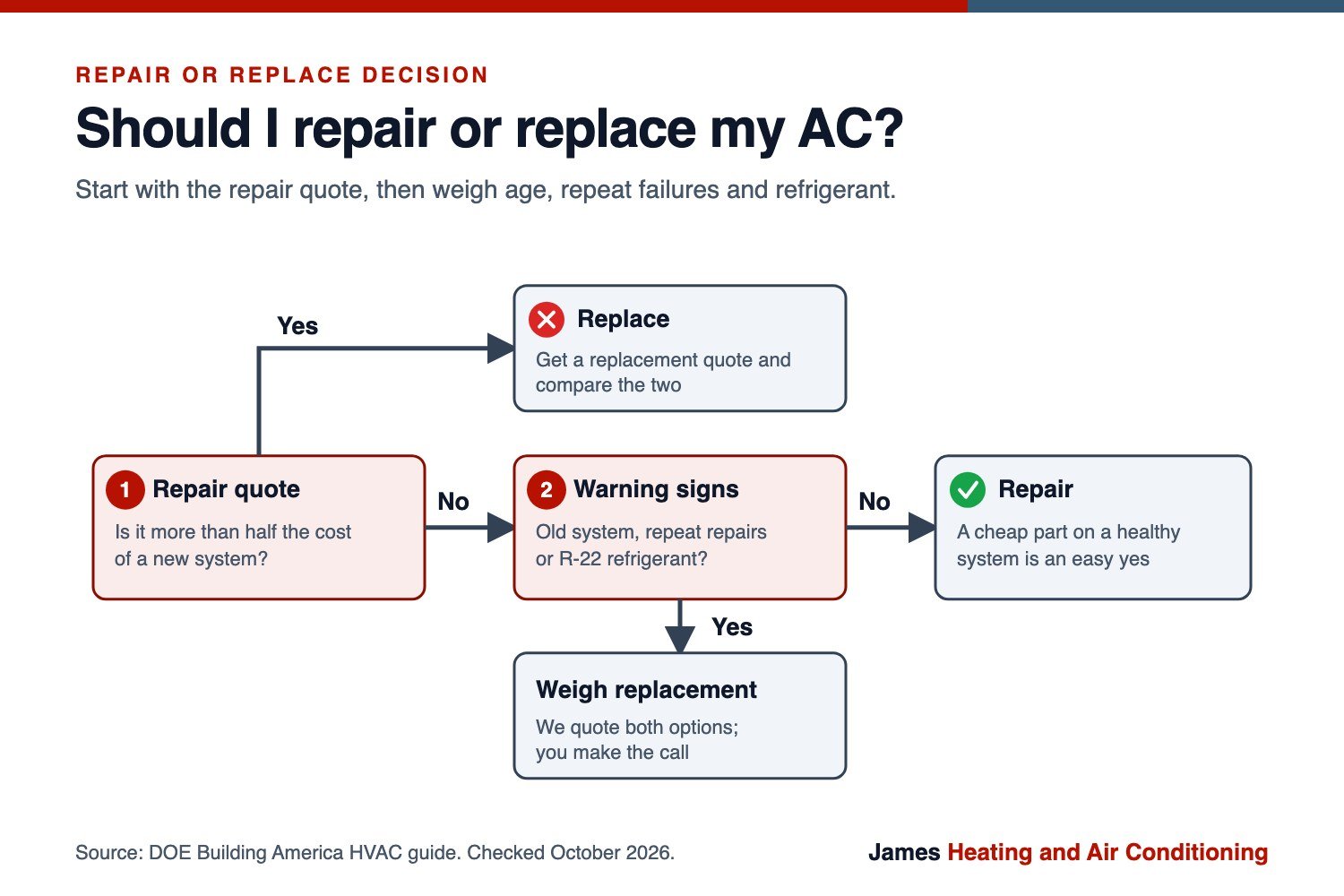
A cheap part on a healthy system is an easy yes. An expensive part on an old one is a harder call. We check the system’s age, how often it has failed and its refrigerant against that line, and we quote both options. R-22 production ended in 2020, and new equipment uses A2L refrigerants such as R-454B or R-32, so parts and recharges for an R-22 system get dearer every year.
Replacement is also a different job. Oregon requires a mechanical permit and inspection for a replacement, and our installers pull it. Repair visits do not need one. For the age question, read how long an air conditioner lasts.
How do I know if an AC repair quote is fair?
A fair quote follows a diagnosis, arrives in writing and comes with evidence you can see. We quote in writing before any repair starts. Most quotes are honest, and these patterns are worth a pause.
- A price with no diagnosis. “It’s probably the compressor” before any measurement.
- A verbal quote only. If it is not written, it can change.
- Pressure to decide now. A failed capacitor does not expire in an hour.
- A recharge sold as the whole fix. If the system leaked, the leak is the repair.
- No part shown, no reading shown. You are entitled to see the evidence.
- No license number. Oregon contractors carry a CCB number you can check at the CCB License Search. James is CCB #47396 and has been in business since 1983.
What happens at the end of an AC repair visit?
The visit ends with a full cooling cycle and a hand-off. Our technicians check the temperature split, test that the outdoor fan and compressor run normally, and tell you what was replaced. You keep the paperwork, because a warranty claim needs it.
Is AC repair covered by warranty?
Sometimes. Manufacturer warranties cover parts on registered equipment, but not always labor. We are a Ruud and Rheem dealer, and we check your model plate against the manufacturer’s registration. Warranty terms vary by maker and by model, so we check yours before we quote.
When should I call for an emergency visit instead of waiting?
Call right away for a burning smell or a breaker that trips again after a reset. Some failures justify a night call, and we dispatch technicians 24 hours a day, 7 days a week. If you are unsure, read when an AC problem is an emergency.
Common questions about AC repair visits
Do I need a permit for an AC repair in Oregon?
Repair visits do not. Oregon requires a mechanical permit and inspection for a replacement, and our installers pull it.
Will the diagnostic fee come off my repair?
Sometimes, but policies differ. Fixr says the fee is often waived or applied to the total repair cost, so ask when you book.
Can I check the breaker and filter before the technician comes?
Yes. Confirm the thermostat mode, replace a clogged filter and reset the breaker once. If it trips again, stop and tell the technician. Never open the unit or touch the refrigerant lines.
Can a technician just top off my refrigerant?
A technician can add refrigerant, but a system only loses it through a leak, so a recharge without a leak repair is temporary. Federal law forbids intentionally venting refrigerant during service.
Is it worth repairing an R-22 system?
It depends on the repair cost. R-22 production ended in 2020, so parts and recharges cost more each year. We compare the repair quote to half the price of a new system and quote both.
Book an AC repair visit in Salem
We cover AC repair in Salem and the Marion County towns around it, so call the Salem office at (503) 581-9982. We answer 24 hours a day, 7 days a week. The AC repair page lists the full service details. Have your model plate photo and symptom notes ready, and ask about the diagnostic fee when you book.