






Where your furnace or air handler sits decides which problems you get: moisture in a crawlspace, heat and ceiling leaks in an attic, fumes and bumpers in a garage, thin air in a closet. We check the warning signs for each spot. Call (541) 461-2101 in Eugene or (503) 581-9982 in Salem, any hour.
Where is my furnace or air handler, and what goes wrong there?
Your equipment sits in a crawlspace, attic, garage, closet or basement, and each spot invites its own failures, from damp ducts to starved burners.
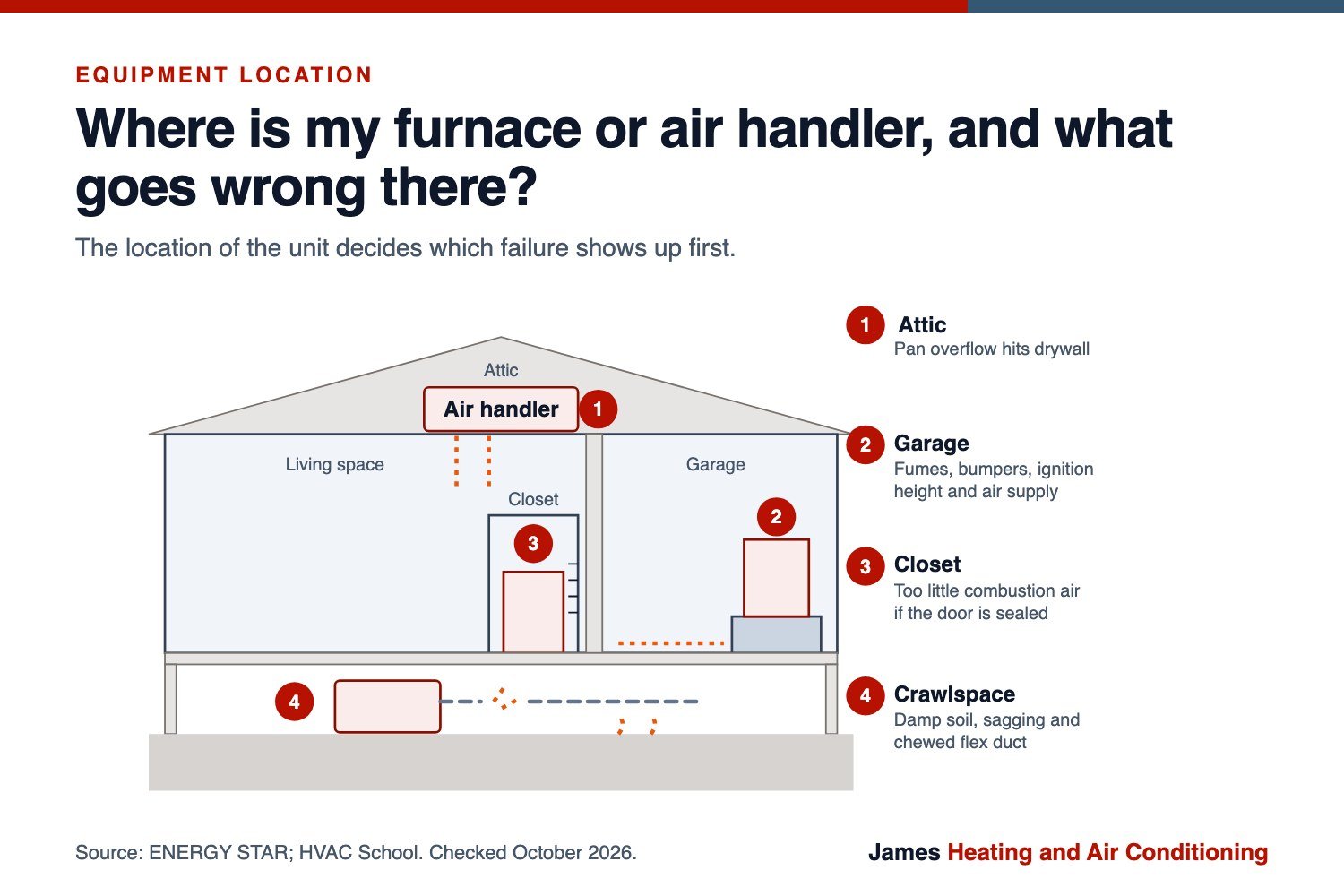
Oregon DOE’s county profile puts 67% of Lane County homes at built before 1990, so many of you live with equipment placed by older building habits. We inspect the location before we inspect the unit, because the space around the furnace explains half of what we find. The table shows which risks bite hardest where.
| Location | Moisture and drainage | Duct leaks and insulation | Access | Combustion air and CO (gas furnaces) | Pests | Sign you can see |
|---|---|---|---|---|---|---|
| Crawlspace | Damp soil; condensate line can sag or freeze-crack | High: flex duct sags, disconnects | Tight; techs crawl in | Needs a sealed or properly vented space | High: chewed duct, nesting | Cold floors, musty smell |
| Attic | Overflow pan stains ceilings | High: hot ducts lose cooled air | Narrow hatch, hot in summer | Rare for gas; check vent clearances | Moderate: insulation nests | Ceiling stain, uneven rooms |
| Garage | Condensate line exposed to cold | Moderate: short duct runs | Easy, if kept clear | Fumes, car impact, closed-door air | Moderate: stored items hide nests | Soot, scorch, rattling door |
| Basement | Floor drain, pump, flooding | Lower: ducts usually inside the house | Usually good | Tight rooms starve a furnace of air | Lower | Water at the base, rust |
| Closet or utility room | Drain line hides behind a door | Low | Cramped, filter access can be awkward | Highest risk if the door is louvered shut or sealed | Low | Hot closet, yellow flame |
James Heating and Air Conditioning services equipment in every one of these spots. Does yours live in the crawlspace? Start there. It carries the most risks.
Can a furnace be in a crawlspace?
Yes, a furnace or air handler can sit in a crawlspace when the unit is rated for it and the space stays dry, reachable and code-compliant.
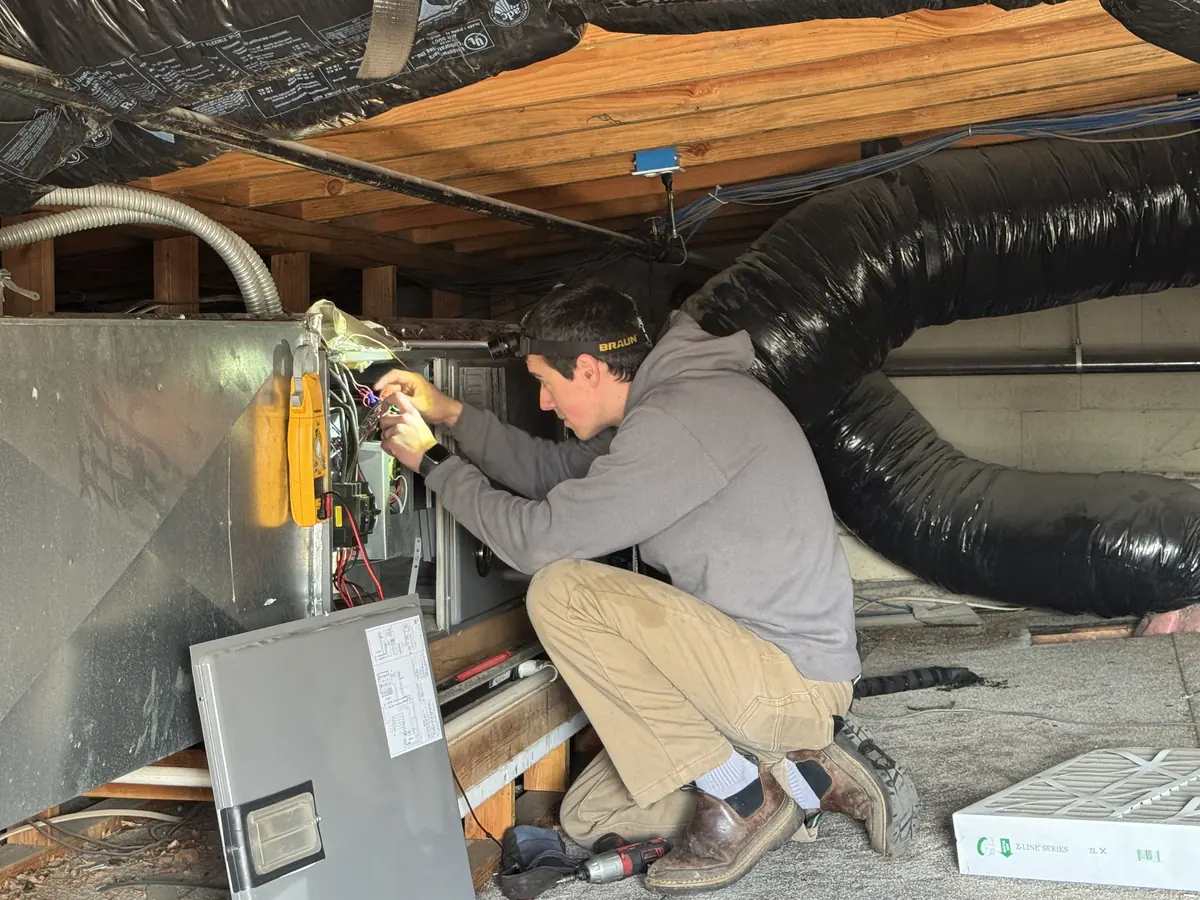
Soil gives off moisture, and a crawlspace is the closest your HVAC gets to the dirt. A ground vapor barrier slows that moisture. Without one, rust shows up on cabinets and fasteners, and a damp smell drifts upstairs. A gas furnace adds a second job, because it needs a sealed or properly vented space for its burners. We check yours against the maker’s instructions and your building department’s rules, since no source we opened gives a single venting rule for every house.
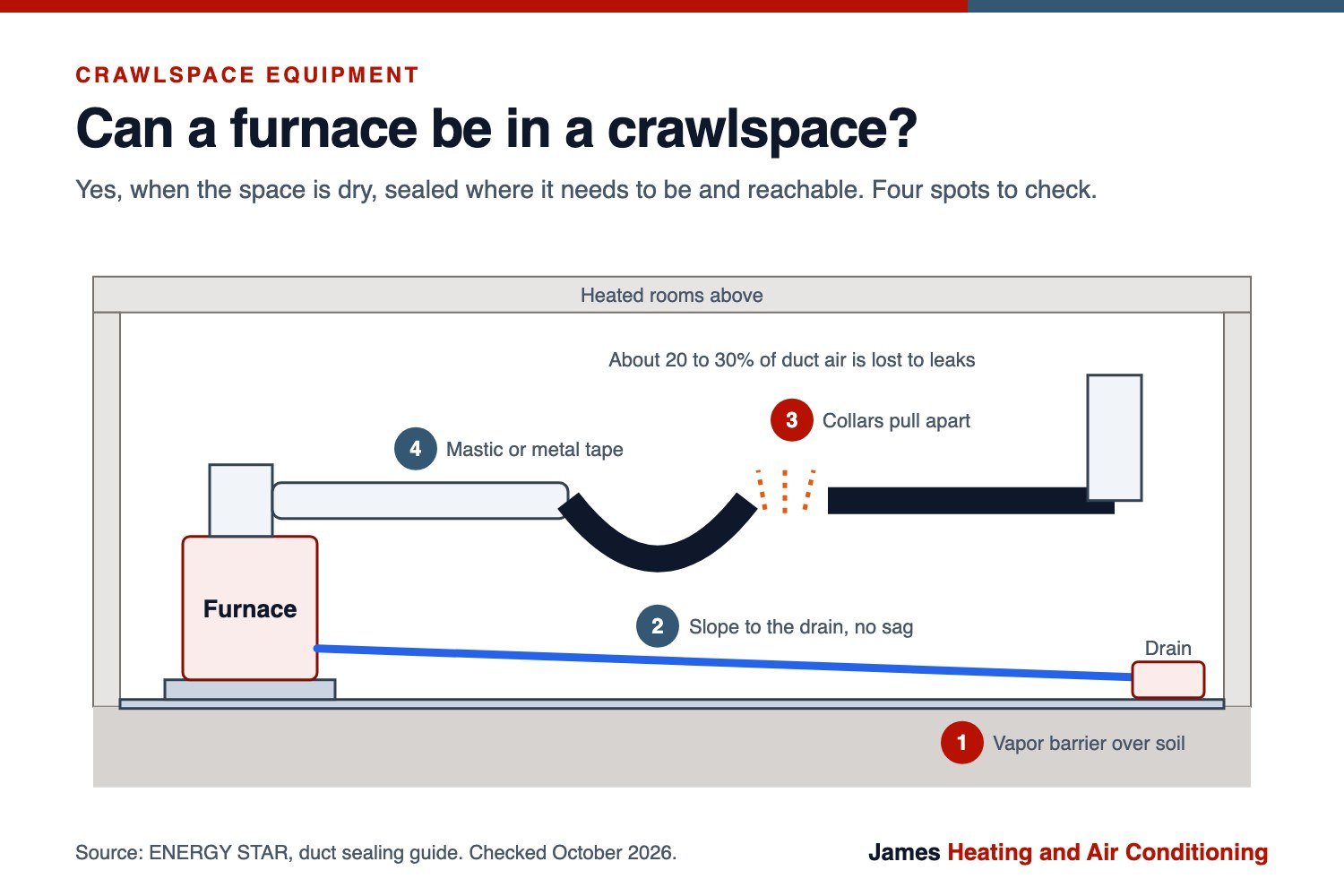
Ducts come next. Flex duct is light and easy to run, but it sags, kinks and pulls off its collars. Mice chew it. They nest in the wrap. We inspect the wrap for chew marks and nesting. ENERGY STAR lists ducts in an attic, crawlspace or garage as a warning sign and says about 20 to 30% of the air moving through the duct system is lost to leaks, holes and poor connections. In a crawlspace you are paying to heat the dirt. That’s waste.
Access gets underestimated. It shouldn’t. Our technicians inspect the blower, filter and drain, and they need a clear path to reach them. When a tech cannot get to those parts safely, checks get skipped. Clear the path to the hatch before we arrive.
Why is there water around my furnace or air handler?
Water around your furnace or air handler usually comes from the condensate drain, which clogs, sags or cracks and spills at the base of the unit.
A cooling coil, and a high-efficiency furnace, makes water, and the condensate line has to slope to a drain the whole way. In a crawlspace that line can sag or crack. In a garage it freezes. In a basement it can back up into a pump or floor drain. Found a puddle? Shut the system off, then call us. We inspect the line from the unit to the drain. We clean out a clogged trap and test the flow before we leave.
Water at the base of a basement unit, with rust on the cabinet, tells you moisture has been there a while. Rust takes time. It does not appear overnight. A fresh puddle with a clean cabinet points to a recent clog.
Is it OK to have an air handler in the attic?
Yes, an air handler can sit in an attic, but it needs a secondary drain pan, a float switch and insulated ducts to work safely over your ceiling.
We inspect attic duct insulation on a tune-up. A summer attic runs far hotter than the rooms below it, so ducts and the air handler work against that heat all afternoon. Uninsulated or leaky ducts hand your cooling back to the attic.
The bigger danger is water. The coil’s drain pan sits above your ceiling. If the line clogs, the pan overflows into the drywall. A float switch shuts the system off at a high water level, and it is cheap protection. We check the drain pan on an attic unit, and our technicians inspect the duct insulation beside it. We quote any drain repair after the visit. Check the ceiling below each season for a brown stain. Look early. See why an AC leaks water for the drain path.
Is it safe to have a gas furnace in the garage?
A gas furnace can sit in a garage when its burner is raised off the floor, shielded from vehicles and fed clean air.
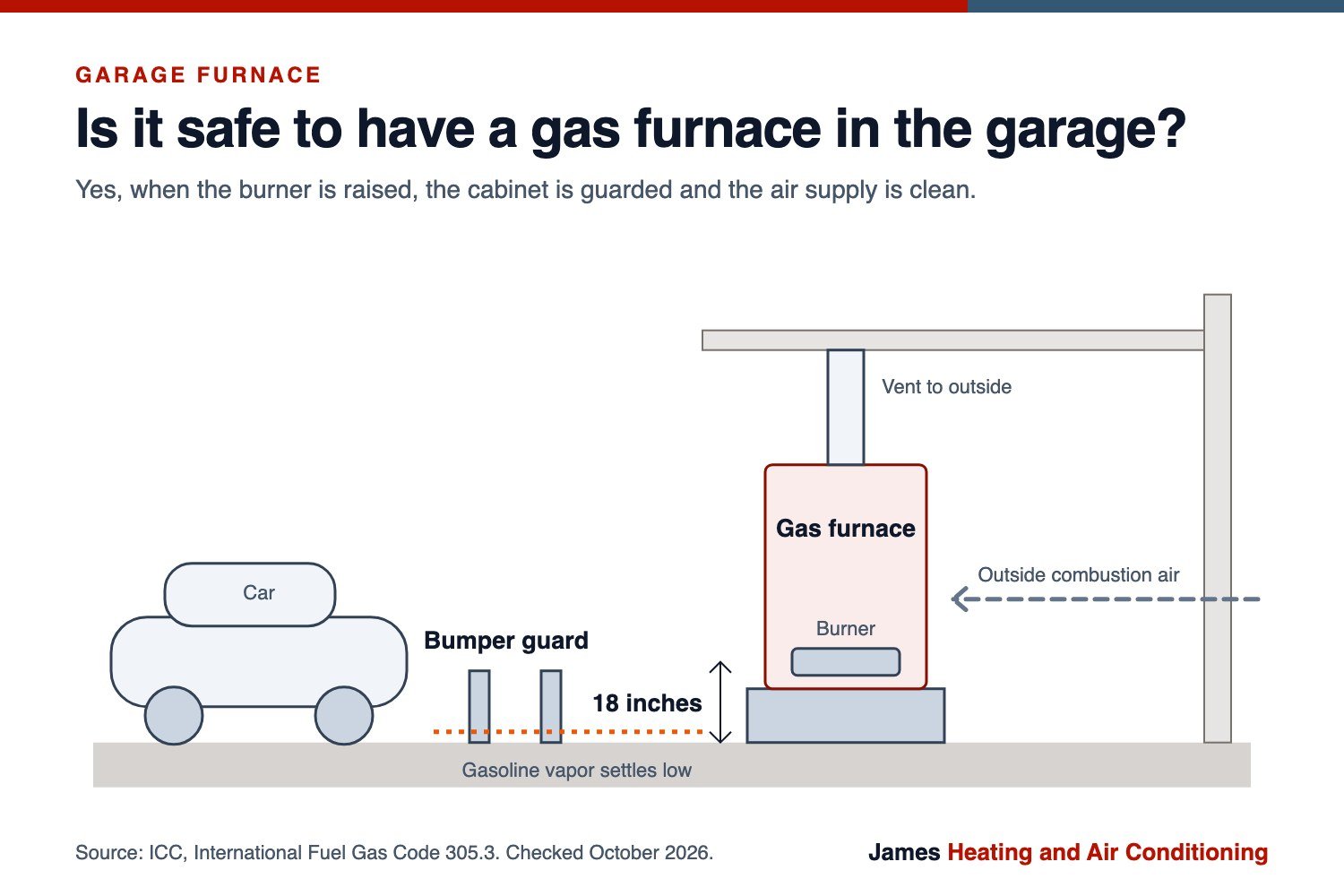
A garage is easy to reach. That’s its charm. We service gas furnaces in garages. It is also where gasoline, paint thinner and cleaning supplies live, and where a bumper can meet a furnace cabinet. The International Fuel Gas Code, section 305.3, calls for the ignition source of a gas appliance in a garage to sit at least 18 inches above the floor, because gasoline vapor settles low. A platform is one way to meet it. Your building department confirms which code edition applies to your address.
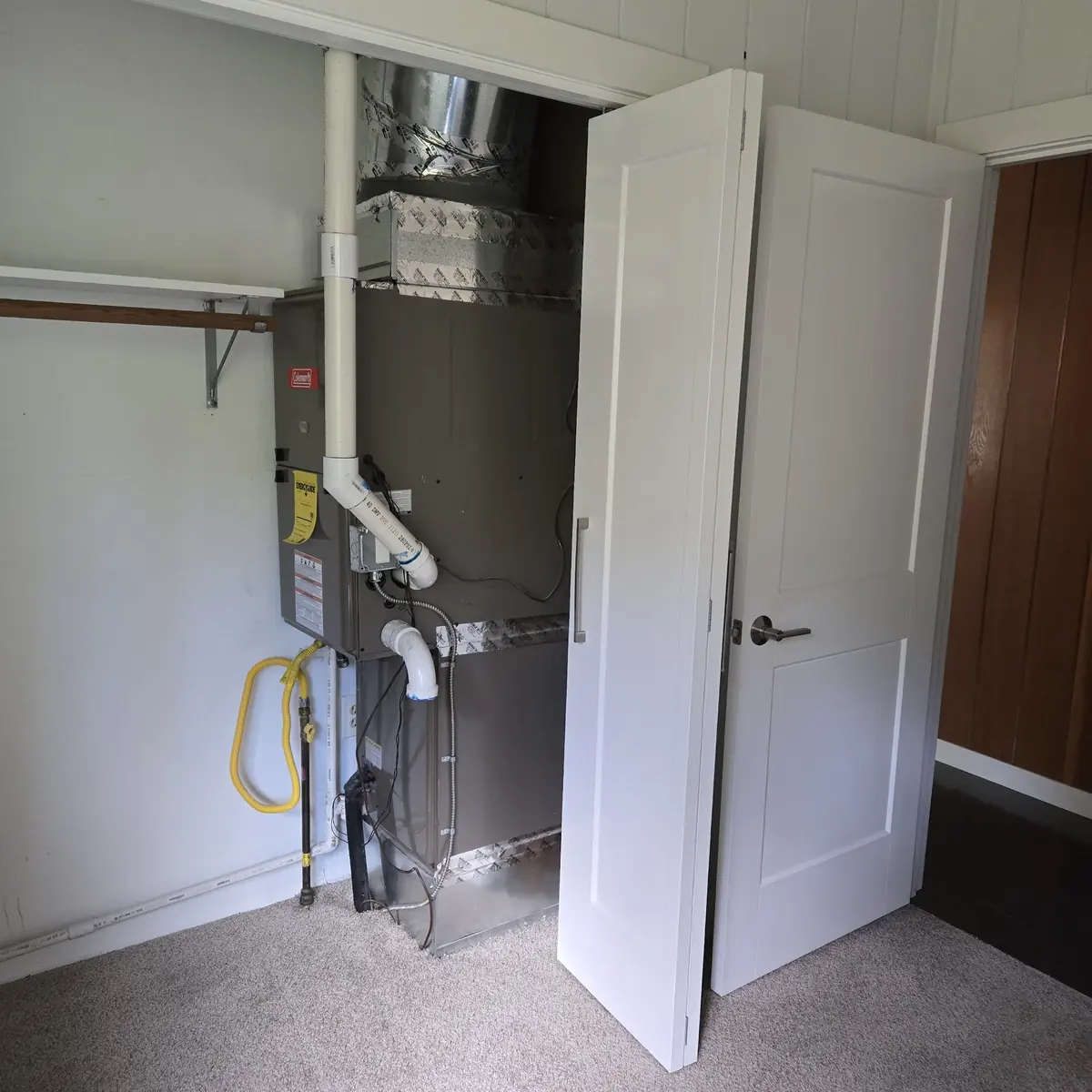
Combustion air is the other safety issue. A furnace burns room air. When the garage is sealed tight and a car or dryer competes for that air, burning gets poor and carbon monoxide can result. Never block a combustion air opening. Ever. We inspect the vent connection and the gas line for damage too. We check cabinet clearance, the vent and anything stored too close during a tune-up. We inspect the combustion air openings for blockage and check where the burner sits against the floor.
How much air does a furnace in a closet need?
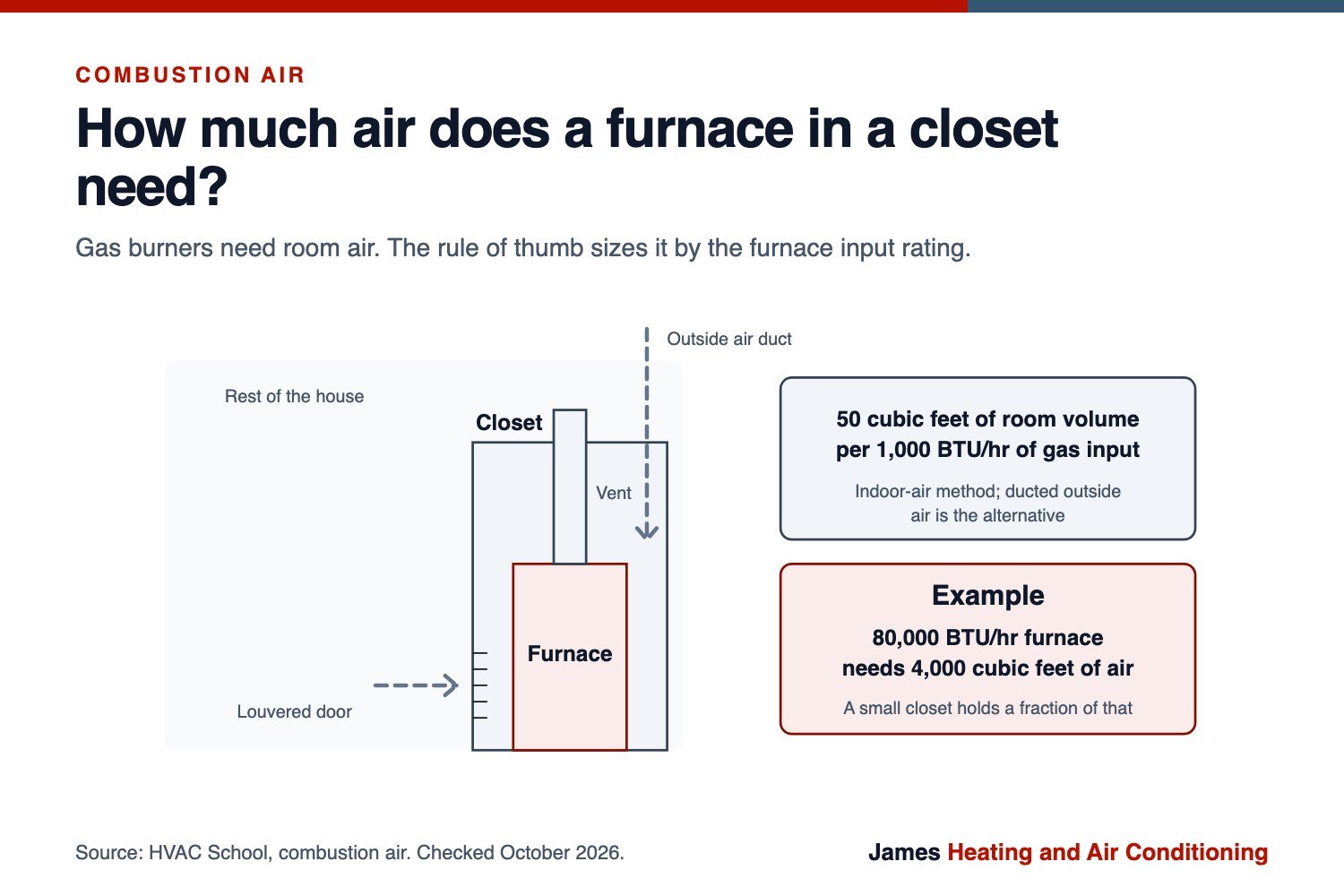
A gas furnace in a closet needs 50 cubic feet of room volume for every 1,000 BTU/hr of gas input, unless outside air is ducted in.
HVAC School summarizes the code indoor-air method as 50 cubic feet of room volume per 1,000 BTU/hr of gas input. Take an 80,000 BTU/hr furnace. It needs 4,000 cubic feet of air to draw from, and a small closet holds a fraction of that. The air has to come from the rest of the house through louvers or openings, or from outside through ducts.
A furnace starved of air burns poorly. The flame turns yellow, the closet runs hot and carbon monoxide can follow. Keep the door and any louvers the way the installer left them. We check the flue connection at the top of the furnace as well. If you want to change what is stored in the closet, call us first. We size the space against the furnace’s input rating and tell you what it needs. We check the door and any louvers on the same visit.
What should I watch if my furnace is in a basement?
Watch the floor drain, any condensate pump and the base of the unit, because a basement holds water and a tight furnace room holds too little air.
Basement ducts usually sit inside the heated house, so they lose less air than crawlspace or attic ducts. The risks shift to flooding, rust and the room’s size. A tight, closed furnace room carries the same combustion air question as a closet, so the 50 cubic feet rule applies there too. Our technicians check the pump, the drain and the cabinet for rust on a basement visit. We inspect the furnace room’s size against the same rule.
How do I know if my crawlspace ducts are leaking?
Leaky crawlspace ducts show up as sagging or disconnected runs, torn insulation wrap, cold floors above and one room that never matches the rest.
You can look from the hatch with a flashlight. We check each connection at the furnace plenum, and our technicians inspect each register boot. ENERGY STAR covers the fix, which is to insulate accessible ducts and seal joints with mastic or metal tape, not cloth duct tape, which dries out and peels. A duct pressure test confirms where the leak sits, and we check the visible runs first.
Weak airflow in one room and uneven comfort are what leaky ducts feel like. Our guides on weak airflow from vents and common air handler problems walk through the next checks. Duct cleaning is a separate question; the EPA covers it and suggests cleaning only for mold, vermin or heavy debris, so cleaning will not fix a leak.
Do I need a carbon monoxide alarm if my furnace is in a closed space?
Yes. Any gas furnace in a closet, garage, basement or crawlspace deserves a working carbon monoxide alarm near every sleeping area.
The CDC advises alarms near every sleeping area and replacing them per the maker’s instructions or every 5 years. The CDC also recommends yearly servicing of gas appliances. Symptoms look like the flu, with headache, dizziness and nausea. Flu that clears when you leave the house? Call us. We check the venting on every gas furnace we service.
If you smell gas, leave and call your gas utility. For everything else, ring us.
How often should a furnace in a crawlspace be serviced?
Service a crawlspace furnace once a year before heating season. The CDC recommends annual servicing for gas appliances, and hard-to-see equipment benefits most.
We check the parts that fail in each location during our HVAC inspection and maintenance visits:
- Crawlspace. Drain line slope, duct connections, moisture, signs of pests.
- Attic. Drain pan, float switch, duct insulation, hatch access.
- Garage. Cabinet clearance, vent, combustion air, anything stored too close.
- Basement or closet. Drain or pump, rust, air supply to the burners.
We inspect the heat exchanger, flame and venting on every gas furnace, whatever the location.
Frequently asked questions
What are the signs of moisture around crawlspace equipment?
Rust on cabinets and fasteners, a damp smell upstairs and water at the base of the unit. A ground vapor barrier slows the moisture, and we check the condensate line for sag.
Does an attic air handler need a float switch?
Yes. A float switch shuts the system off when the drain pan fills, before water reaches your ceiling, so it’s worth having it checked on each visit.
Can I block a combustion air opening to stop a draft?
No. A gas furnace burns room air, and a blocked opening starves it. Call us if the opening lets in cold air.
Will duct cleaning fix leaky crawlspace ducts?
No. Mastic or metal tape seals leaks. The EPA suggests duct cleaning only for mold, vermin or heavy debris.
What do I do if I smell gas near my furnace?
Leave the house and call your gas utility from outside. Don’t flip switches or use a phone inside.
Book a visit in Eugene or Salem
For Eugene, Springfield and the rest of Lane County, our number is (541) 461-2101. Salem, Keizer and Marion County homes reach our Salem office at (503) 581-9982. We answer emergency calls around the clock at both numbers. James Heating and Air Conditioning holds Oregon CCB #47396 and has served Oregon homes since 1983. We repair and service furnaces and air handlers wherever they sit. See our furnace repair and installation work or contact us online.