






An HVAC install in Eugene follows a fixed order: a home visit with a load calculation, a written quote, utility approval if a rebate applies, a permit, installation day, inspection and handoff. We run every step of that chain. Call (541) 461-2101 to book a visit in Eugene, Springfield or Lane County.
In what order does an HVAC install happen in Eugene?
An HVAC install in Eugene happens in this order: home visit, written quote, utility approval, permit, install day, inspection, then rebate paperwork. The crew’s day is only the middle of that chain, and two steps depend on the ones before them. Utility approval cannot come after the install, and the inspection cannot come before it. Order matters. A lot.
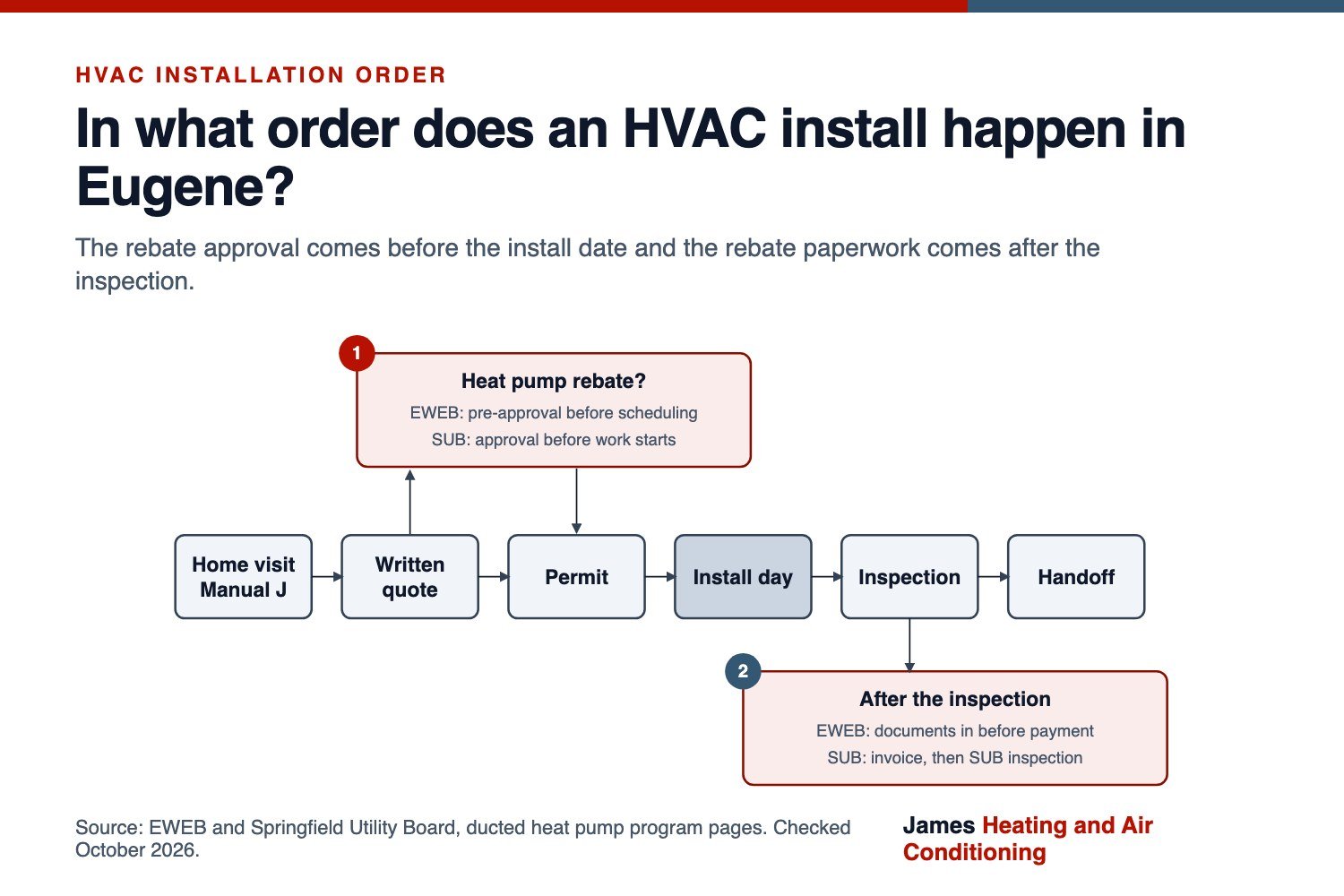
Each step below shows what happens and what you decide. Start with the visit. The first one happens in your house, before any quote.
What happens at the home visit before an HVAC install?
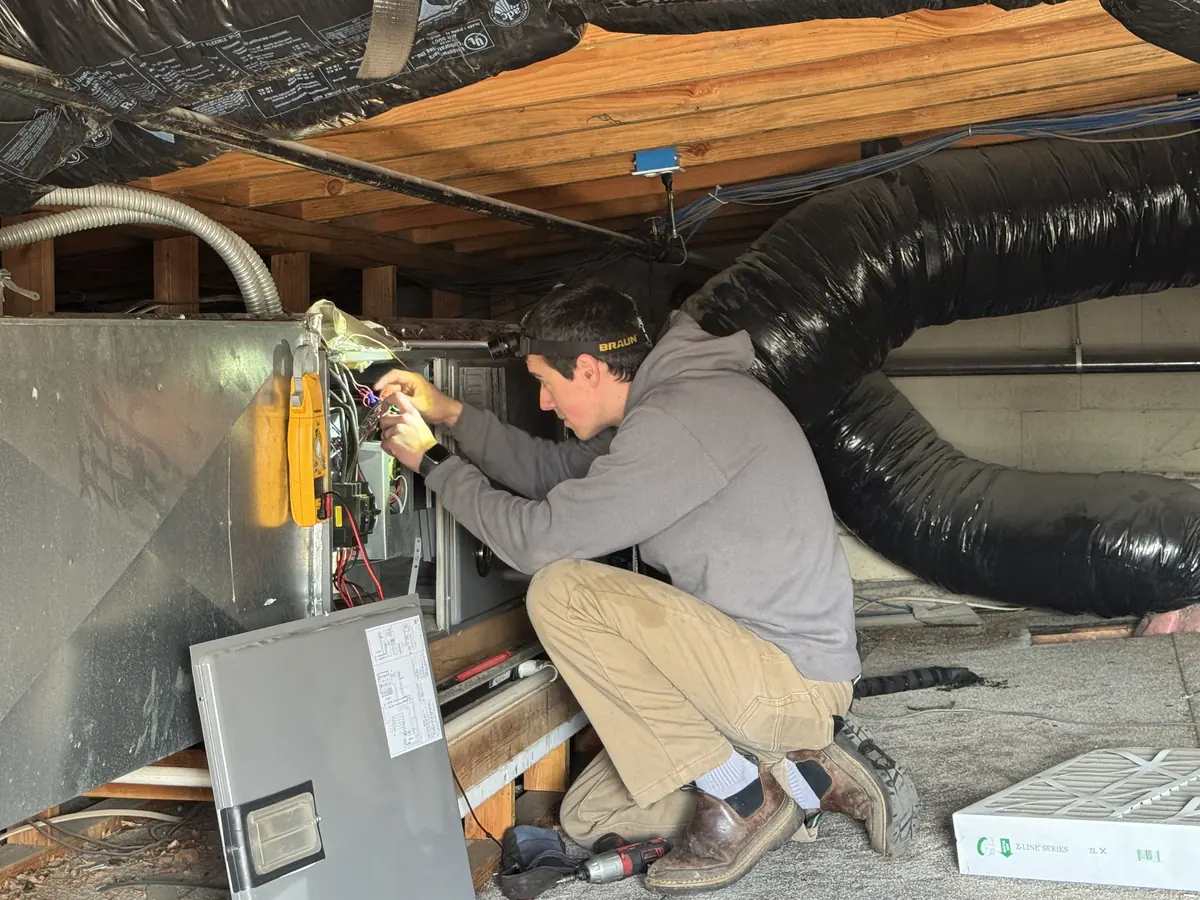
At the home visit, our technicians inspect your existing equipment, electrical panel, ducts and the spot where the new equipment will sit. In older Lane County homes that spot is often a crawlspace or attic, and access decides how the job goes.
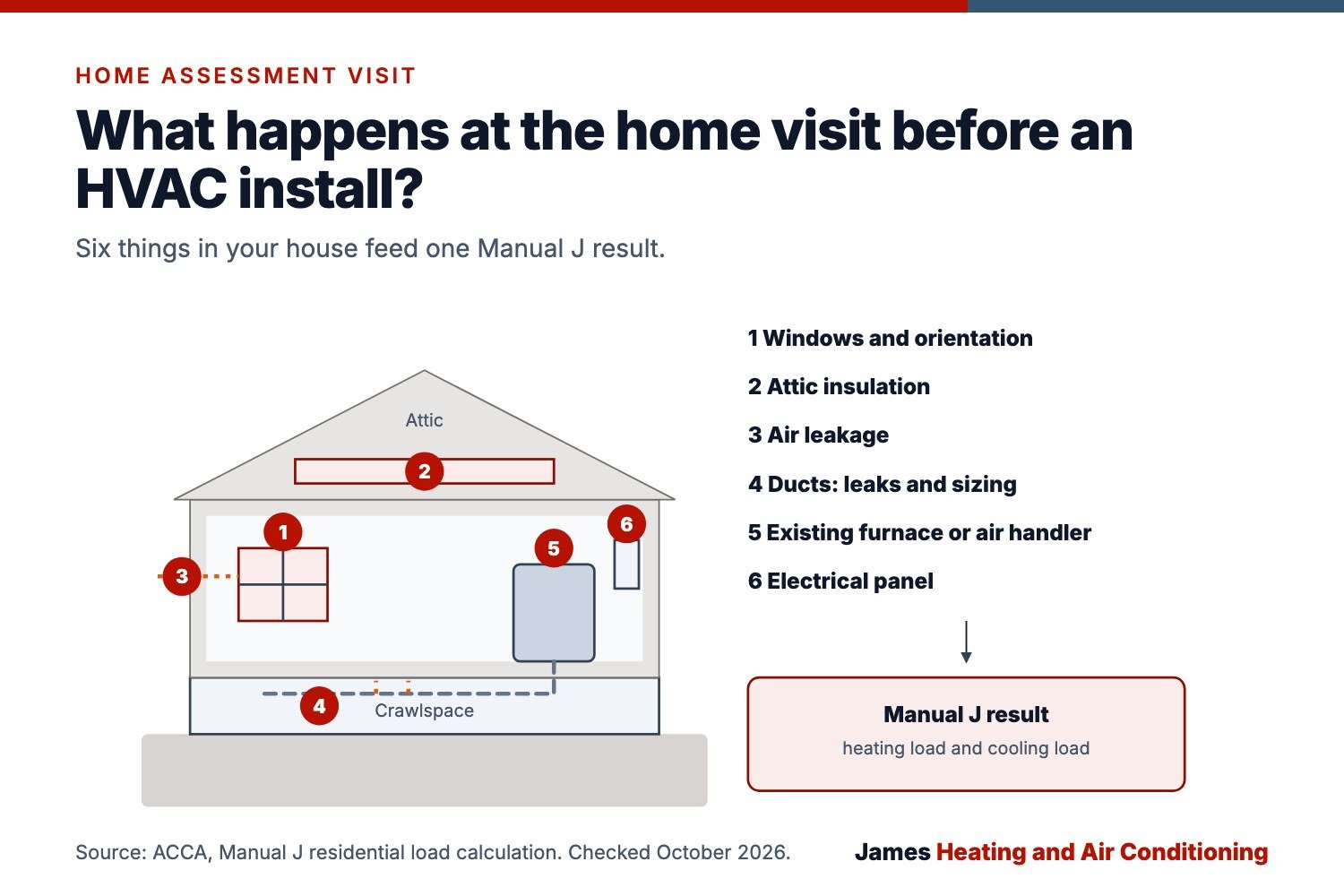
Then we size the system with a Manual J load calculation, the standard from ACCA. Manual J takes your home’s square footage, insulation, windows, orientation and air leakage and returns a heating load and a cooling load. A rule of thumb like “one ton per 500 square feet” skips all of that. It’s a guess. Oversized equipment short-cycles. Undersized equipment runs flat out on the coldest nights. Neither is cheap to live with.
What should a written HVAC quote include?
A written HVAC quote should list the equipment model numbers, what we are removing, what the permit covers and what the price leaves out. Read yours for gaps. Ask questions. We explain any line you question.
For price ranges, see what a new furnace costs, what a heat pump costs, and what sets the price of a new air conditioner. A firm number for your house comes after our visit.
Do I apply for the EWEB or SUB rebate before the install?
Yes. EWEB requires you to apply and receive pre-approval before scheduling installation, and SUB approves your project before work starts. Most Eugene homeowners miss this step. Don’t.
After the install, EWEB checks the contractor’s documents and may schedule a site visit. EWEB pays the rebate about four to six weeks after it approves the installation. The details are on the EWEB ducted heat pump page.
Springfield Utility Board works differently. SUB requires bids from contractors on its HVAC contractor list, and we are on it. SUB offers either a rebate or a loan, and you pick one on the application. You send SUB the chosen proposal with it and schedule the work after SUB approves. Afterward you send SUB the invoice with model numbers. SUB inspects the install, then SUB pays the rebate. See the SUB ducted heat pump page.
Incentive amounts change, so check the program page for the current figure. The federal 25C tax credit ended on December 31, 2025, and does not apply to installs this year. A gas furnace follows different incentive rules, so ask us which program applies before you sign.
Do I need a permit to replace a furnace or AC in Oregon?
Yes. Oregon requires a mechanical permit to replace a furnace, AC or heat pump, and we pull it as part of the job. Oregon BCD requires the permit on site for the inspector, and the permit expires if work does not start within 180 days of issue.
Your address decides which office issues it. The City of Eugene issues permits inside city limits. Outside them, Lane County or the city of Springfield issues the permit, depending on the address. A new circuit, which ductless systems often need, adds an electrical permit. Check the quote. The permit should be listed.
What happens on HVAC installation day?
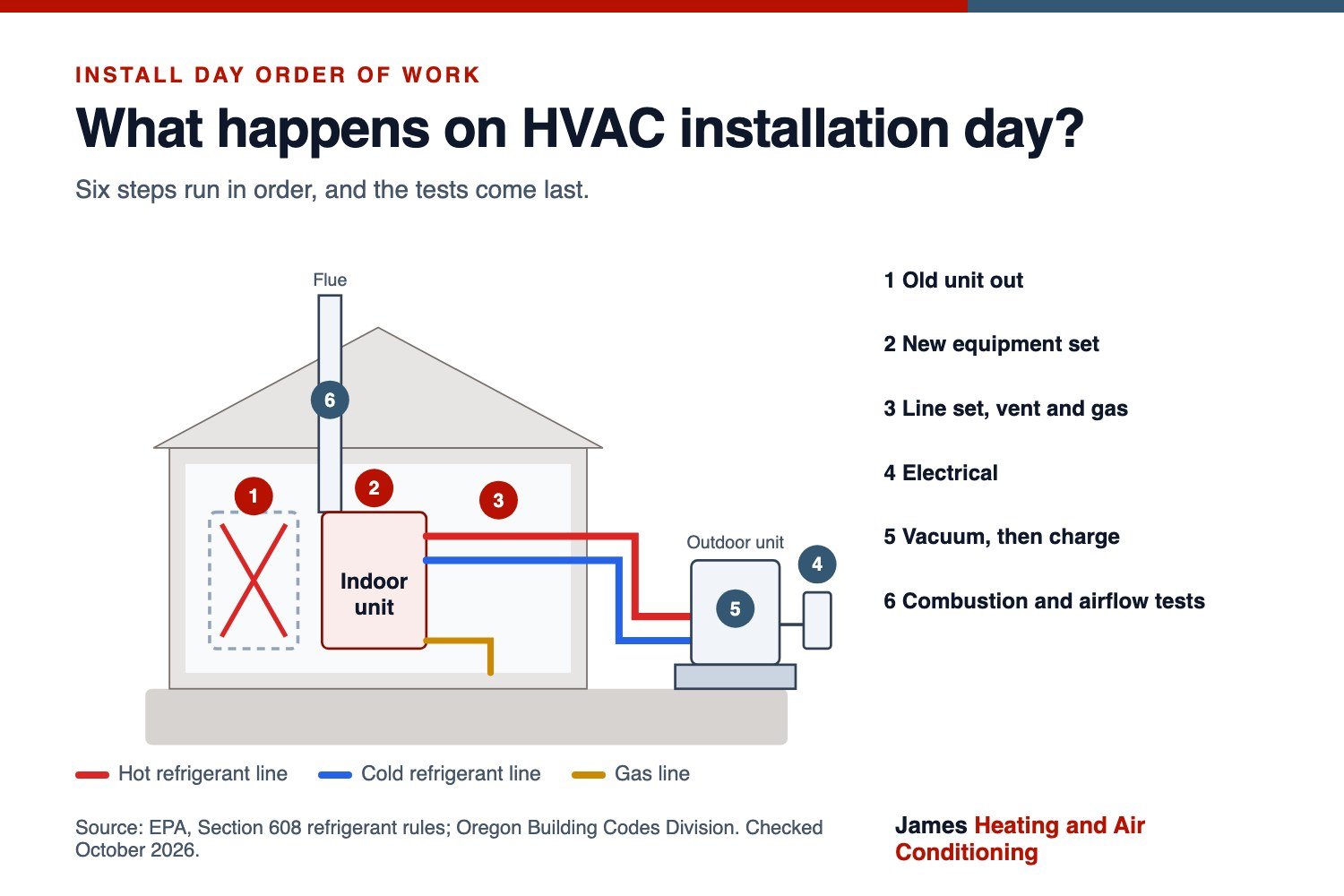
On installation day we remove the old equipment, set the new equipment, connect gas, venting, refrigerant and power, then test the system before we leave.
Old unit out and refrigerant recovered
The crew shuts off power at the breaker and, for gas, at the appliance valve. Our crews recover the existing refrigerant into a tank. It is never vented. The EPA requires Section 608 certification for every technician who handles refrigerant. Then the old furnace, coil or outdoor unit comes out.
New equipment set and line set connected
Our crews install the outdoor unit on a level pad and set the indoor furnace, coil or air handler in place. Copper line set runs between the two, and a brazing torch joins it while nitrogen flows through the line to keep the inside clean.
Equipment made since 2025 uses R-454B or R-32, both A2L refrigerants. Both refrigerants are mildly flammable, so recovery, ventilation and ignition sources need stricter handling than R-410A did.
Gas, venting and the combustion test
On a gas furnace, technicians connect the gas line, the flue or vent, and the condensate drain if it is a high-efficiency model. We test every gas joint for leaks. Every one.
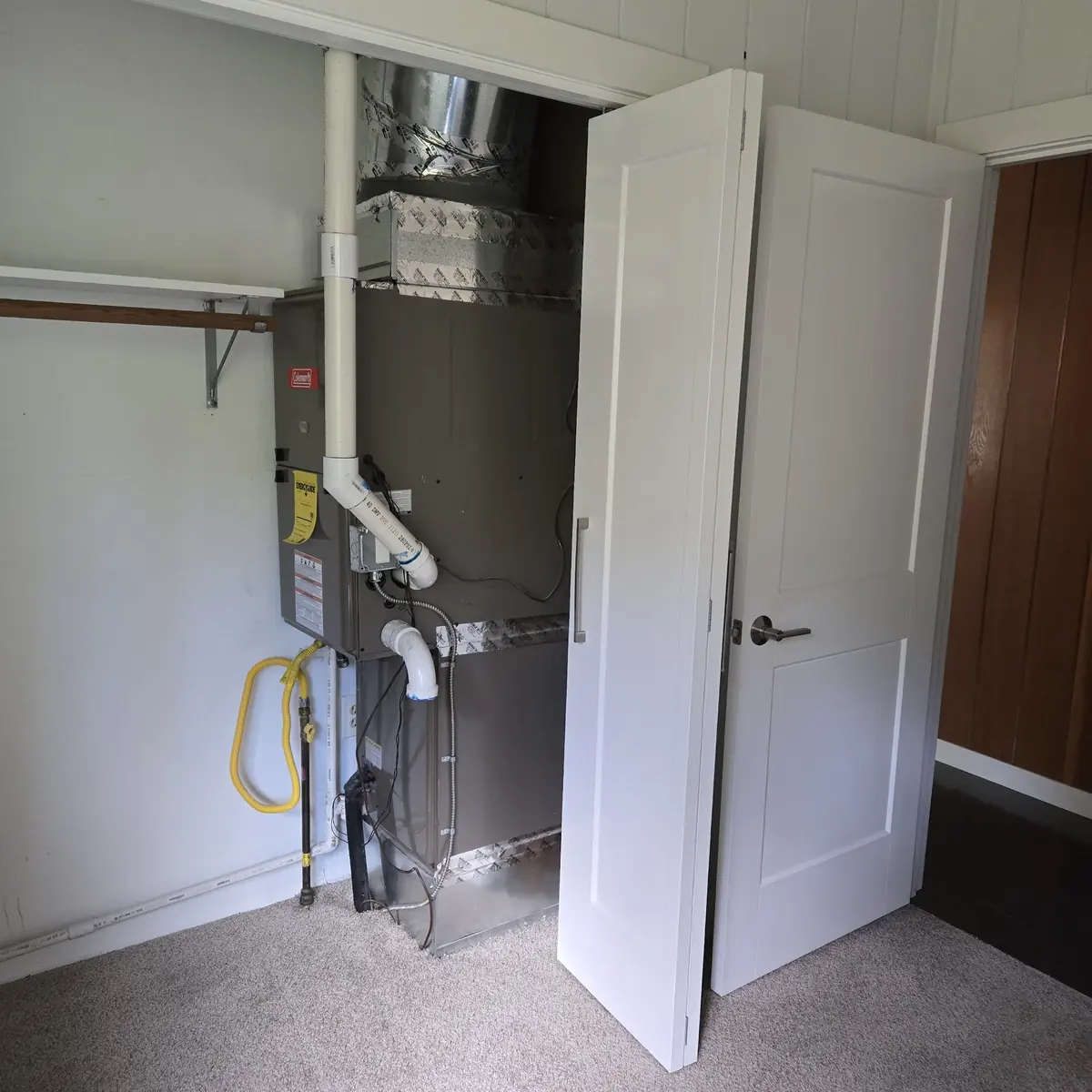
Before the crew leaves, a combustion analyzer measures flue gases, including carbon monoxide, and confirms the furnace burns the way its maker designed it to.
Ducts and electrical
The new unit connects to your existing duct system, and the ducts decide how much air it can move. Our technicians check that connection for leaks and sizing problems. Our technicians size the disconnect, wiring and breaker to the new equipment’s nameplate, not the old unit’s.
Evacuation, charge and commissioning
Before refrigerant enters the line set, a vacuum pump pulls out air and moisture. A micron gauge shows when the line is dry. Dry lines matter. Skip this and you pay later. Moisture left inside turns to acid over time and attacks the compressor.
Then our technicians check the charge against the manufacturer’s specification with temperatures and pressures. We test airflow and static pressure at the air handler too, because a perfect charge cannot fix choked ducts. Last, we set up your thermostat and run the system through a full heating or cooling cycle. Then we walk you through it.
How long does an HVAC install take for each system?
An install’s length depends on the system, access to your equipment and duct changes, so we give you a schedule after we see your equipment. Your heat or cooling stays off from the moment we disconnect the old unit until the new one starts.
| System | What is replaced | Access it needs | Permit |
|---|---|---|---|
| Furnace swap | Furnace, flue or vent connection, filter housing | Closet, attic or crawlspace; gas shutoff | Mechanical |
| AC or heat pump swap | Outdoor unit, indoor coil or air handler, line set | Outdoor pad area; indoor unit location | Mechanical |
| Ductless | Outdoor unit, indoor heads, line set through the wall | Wall locations; electrical panel | Mechanical, plus electrical if a new circuit is added |
| Install with duct changes | Equipment plus trunk or branch ducts | Attic or crawlspace access | Mechanical |
What should I do to prepare for HVAC installation day?
Clear a path to your indoor unit, your outdoor pad and your electrical panel before the crew arrives. Five items cover it:
- A path to the indoor unit, with stored items moved out of the closet, attic hatch or crawlspace entry.
- Two or three feet of open space around the outdoor pad.
- Clear access to the electrical panel, where we check the breaker before we start.
- Pets in a room away from open doors.
- Driveway room for the truck.
What happens after the crew leaves?
After the crew leaves, the permit holder requests the inspection, and any utility rebate paperwork goes in. The City of Eugene or Lane County inspects the work, depending on your address. The inspector may need to see the equipment in place, so the crew leaves it accessible.
Before we drive off, ask us for a walkthrough. You should leave with the model and serial numbers, the filter size and location, a thermostat walkthrough, and confirmation that the equipment is registered with the manufacturer so the warranty starts on the right date. We install Ruud and Rheem equipment. A first preventative maintenance visit makes sense before the opposite season starts.
Frequently asked questions
Do I need to be home during an HVAC install?
An adult should be there at the start and for the final walkthrough. We need access to the indoor unit and the electrical panel, and the walkthrough is where we explain your thermostat, filter and warranty.
Who pulls the permit, me or the contractor?
Oregon requires the person doing the work, homeowner or contractor, to hold the permit. We pull it on our installs, and a new circuit adds an electrical permit.
Can I keep my existing ducts?
Often, yes. Our technicians check them for leaks and sizing, and gauges measure static pressure after startup. Ducts that restrict airflow keep the new equipment below its rating.
How long will my heat or cooling be off?
From the moment we disconnect the old unit until the new one starts. We lay out the schedule once we have seen where your equipment sits.
Do I apply for the utility rebate before or after the install?
Before. EWEB requires pre-approval before scheduling. SUB approves the project before work starts.
Call James Heating and Air Conditioning
A load calculation and a written quote are where your install starts. Call (541) 461-2101 for Eugene, Springfield and Lane County, or read about HVAC system installation. Oregon CCB #47396, serving the area since 1983.