






A mini split is a ductless heat pump: one outdoor unit joined by a refrigerant line to one or more indoor heads, with no ducts between them, and it heats and cools. We install these systems across Lane and Marion counties. Call (541) 461-2101 in Eugene and Springfield or (503) 581-9982 in Salem and Keizer.
Is a mini split a heat pump that heats and cools?
Yes, almost every inverter-driven mini split sold for homes is a heat pump, so it heats and cools. Cooling-only models exist, but they are the exception.
“Mini split,” “ductless heat pump” and “ductless AC” name the same family of equipment. The “split” means the system is divided in two, with the compressor outside and the air handling inside. The “mini” means each indoor head is small and serves one room or zone. We install the indoor heads and the outdoor unit as one matched system.
A heat pump does not burn fuel to make heat. It moves heat. In winter the outdoor coil pulls heat out of outdoor air, and the refrigerant carries it through the line set to the indoor head. In summer a reversing valve flips the flow, the indoor coil absorbs heat from your room, and the outdoor coil dumps it outside. That is air conditioning, and it is why one system handles both seasons. We run the line set through one small hole in the wall, so the same tubing carries heat in both directions.
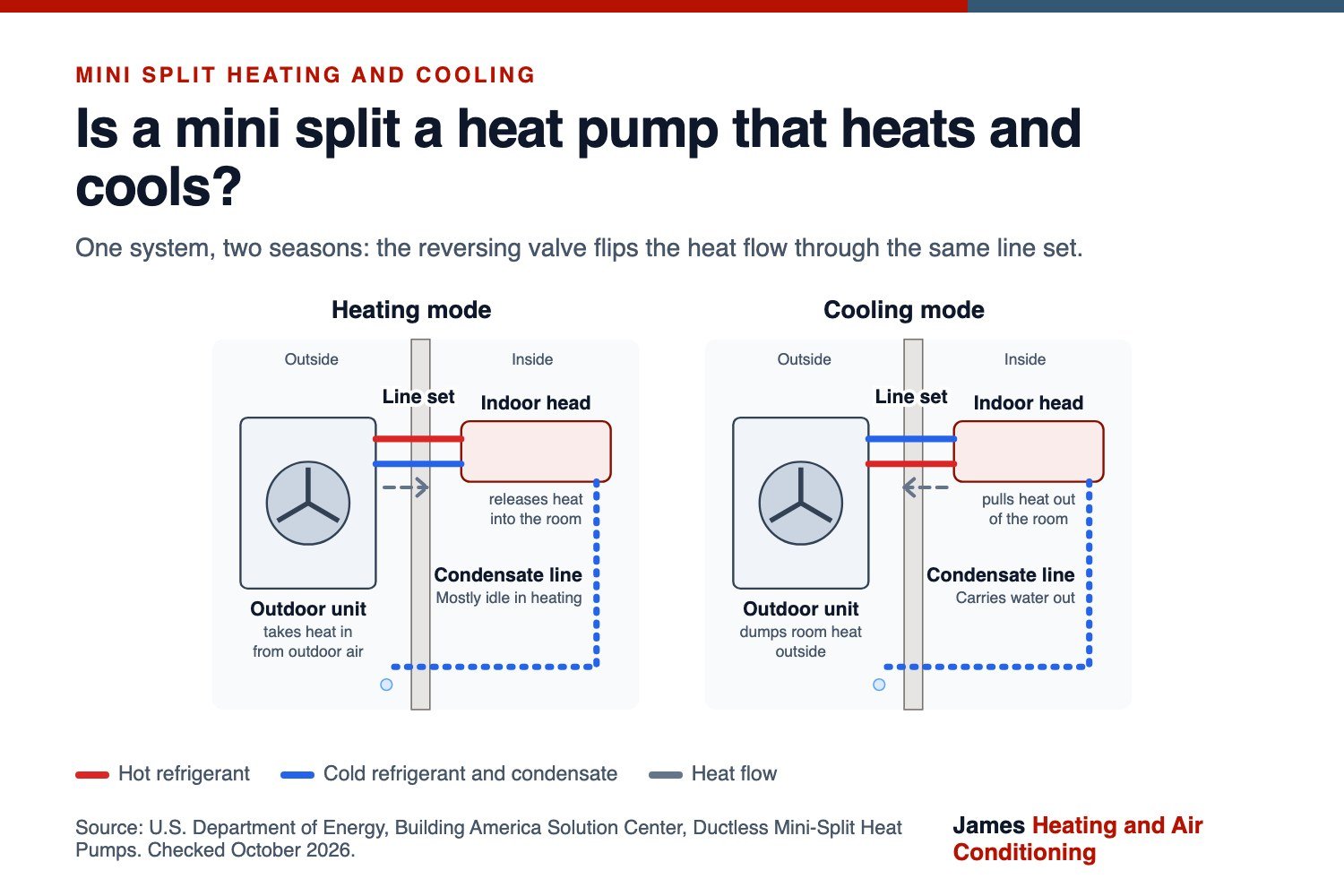
The compressor in a ductless system is usually an inverter type that changes speed to match demand, rather than switching fully on and off, according to the U.S. Department of Energy’s Building America guide to ductless heat pumps.
What are the parts of a mini split, and which one is loud?
A mini split has four working parts: the outdoor unit, the line set, the indoor head and the control. The compressor is the loud one, and it sits outside.
The outdoor unit holds the compressor, a fan and the outdoor coil. The line set is a bundle of refrigerant tubing, power wiring and a condensate drain, and it runs through a small hole in the wall. The indoor head carries its own fan, coil and washable filter. A remote or wall control sets the temperature for that head alone.
The indoor head blows air, so it is not silent. We recommend you plan the outdoor unit’s spot away from bedroom windows, because the compressor is the part you will hear. The line-set route and wall penetration decide how clean the install looks. Our technicians check that route and the wall before we quote, and we mark the outdoor unit’s spot with you.
What kinds of indoor units can a mini split have?
A mini split can have wall-mounted, floor console or ceiling cassette indoor units, and each style trades looks against placement. The DOE guide says indoor units are usually hung on a wall or installed in the ceiling, and floor consoles are also available.
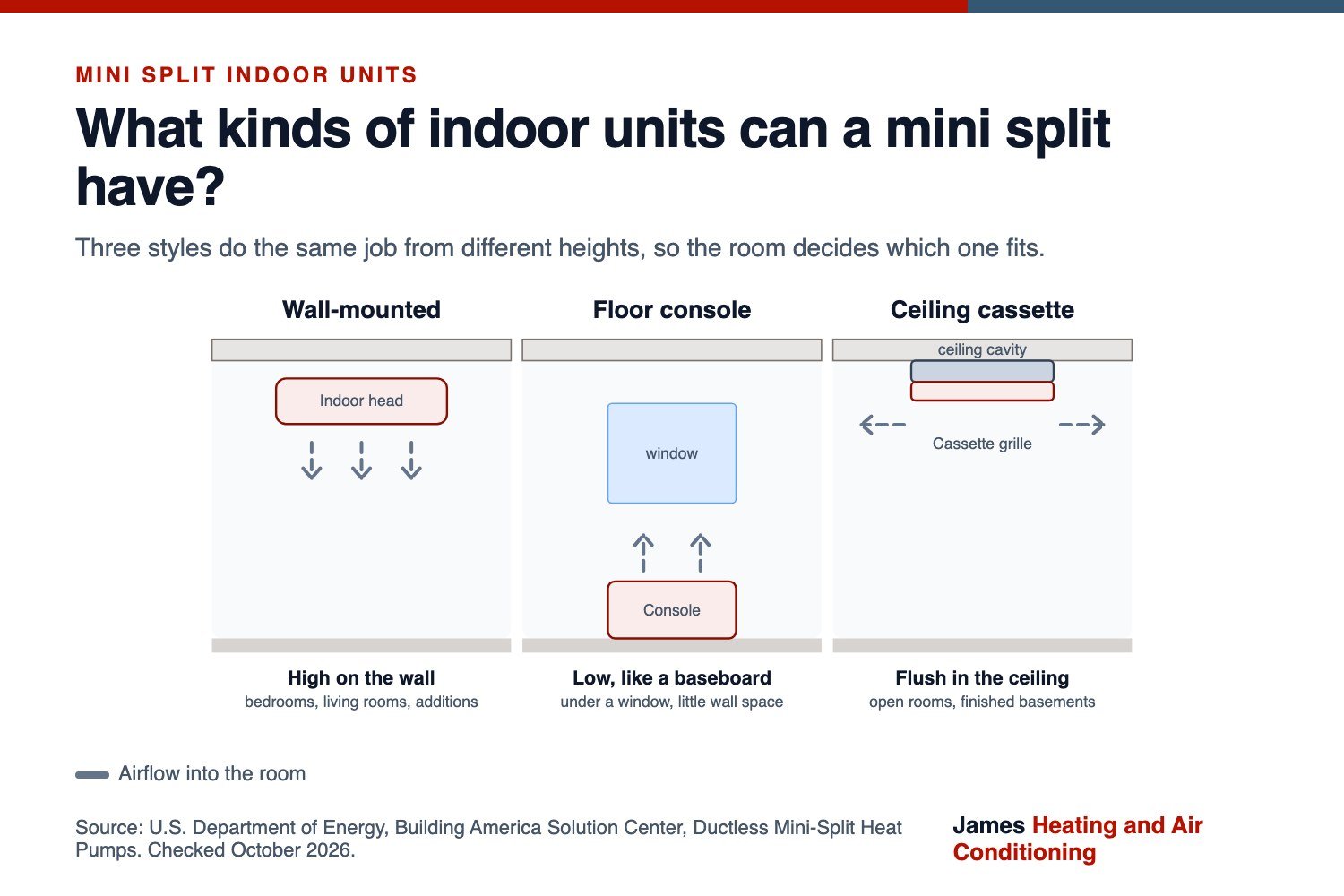
| Indoor unit | Where it fits | Trade-off |
|---|---|---|
| Wall-mounted | Bedrooms, living rooms, additions | Most common and simplest to install; visible high on the wall |
| Floor console | Rooms with little wall space, under a window, older homes with baseboard heaters | Sits low like a baseboard unit; takes floor space |
| Ceiling cassette | Open rooms, finished basements, rooms where wall space is precious | Only the grille shows, but needs ceiling cavity access |
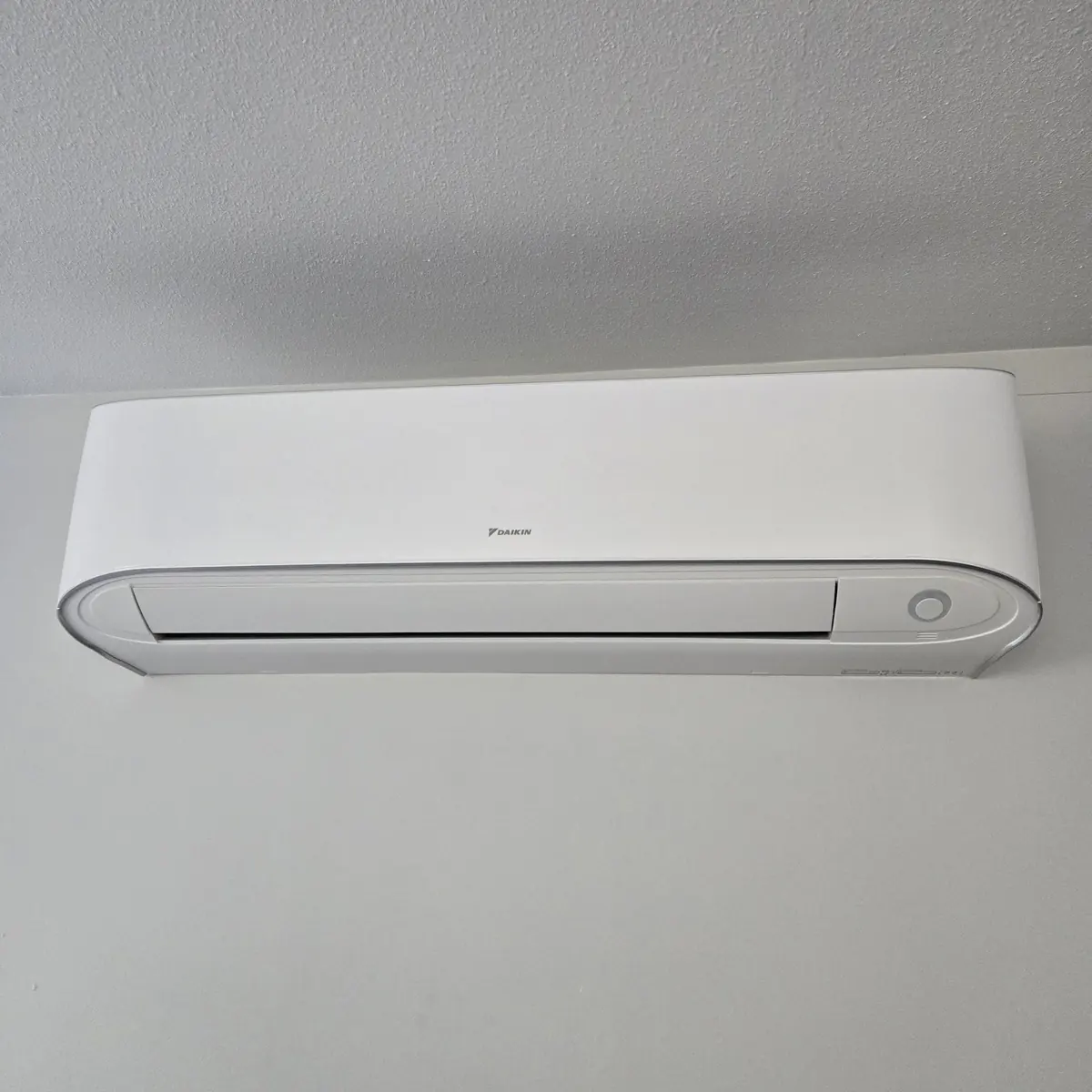
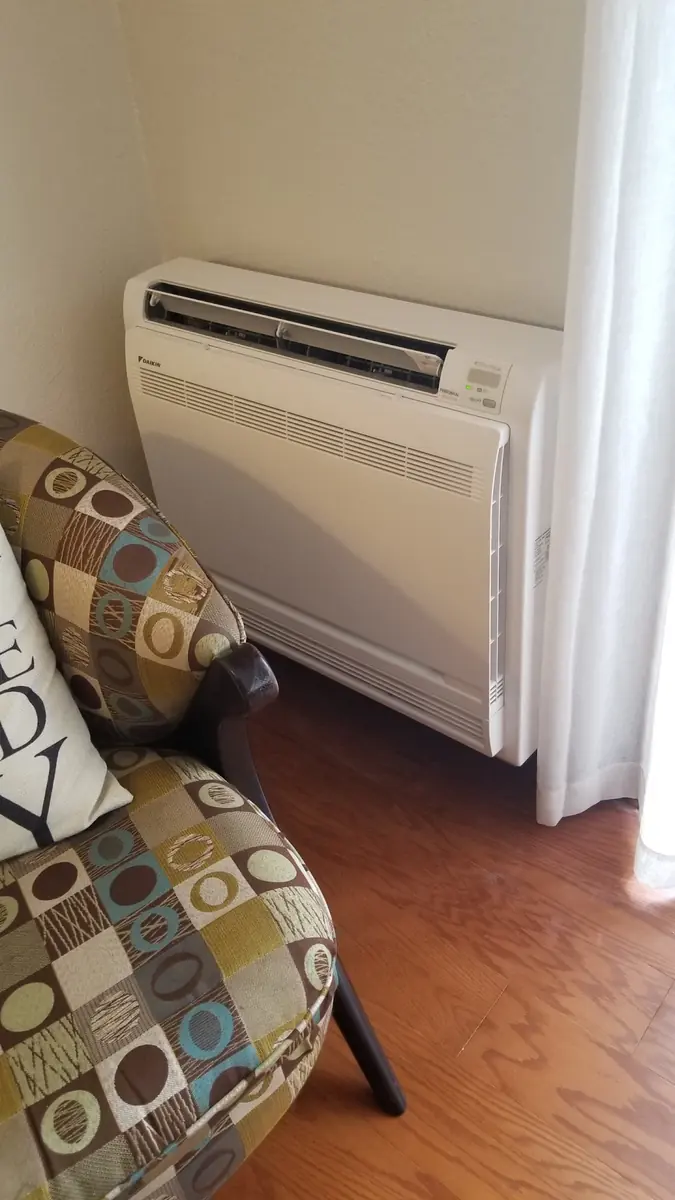
We install wall-mounted heads in bedrooms, living rooms and additions. Floor consoles go under windows in older homes with baseboard heaters, and we place those where the heater used to sit. We install ceiling cassettes only where the ceiling cavity gives access. Matching the style to the room is the first decision, and how many heads you need is the next one.
How many rooms can one mini split outdoor unit serve?
One outdoor unit can serve one room on a single-zone system or several rooms on a multi-zone system, and the outdoor unit’s spec sheet sets the limit. Fixr prices systems up to five zones, and EWEB covers up to five heads in its loan.
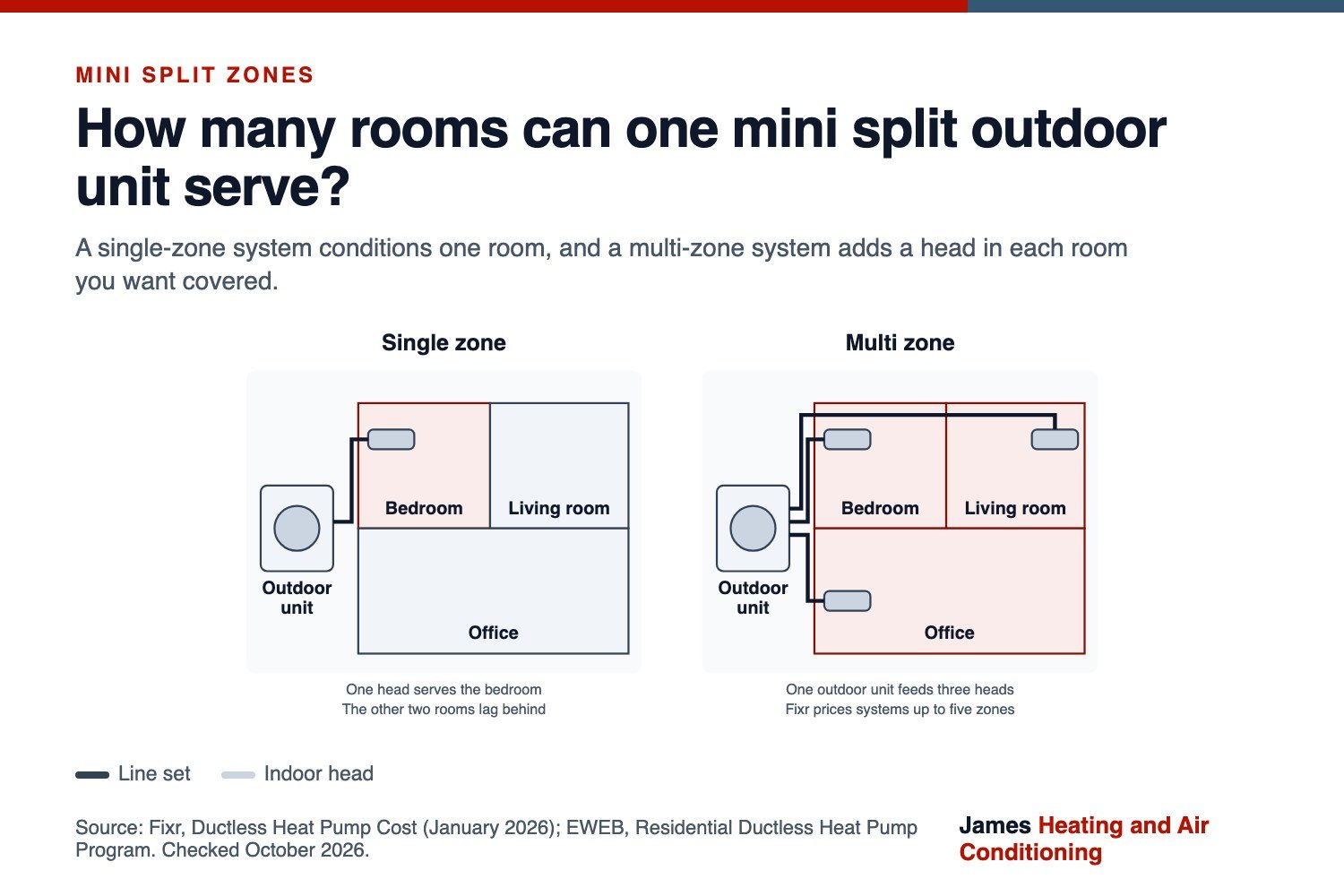
One head per room is not always right. A room without a head can lag behind, and covering a whole house takes several heads. Your home’s heating and cooling load decides the count, and sizing should come from a Manual J load calculation, the ACCA standard, not a square-foot rule. We check the rooms, the panel and the line-set route before we quote a head count. Every added head raises the price, as the cost table below shows.
What are the pros and cons of a mini split?
A mini split saves duct losses and lets you condition one room at a time, but it costs more per room than ducting into a house with good ducts. Nothing here is a reason to skip ductless. It is a reason to match it to the house.
| Pro | Con |
|---|---|
| No ducts to build, seal or insulate. The DOE guide says duct losses can top 30% of heating and cooling energy when ducts run through an attic, crawlspace or garage. | Higher cost per room than ducting into a house that already has good ducts. |
| Each head runs on its own, so you heat or cool only the rooms in use. | A room with no head can lag behind. Covering a whole house takes several heads. |
| Inverter compressors adjust output instead of cycling hard. | DOE notes ductless units tend to dehumidify less and filter less than a ducted system with a good MERV filter. |
| One system gives you heat and air conditioning. | Indoor heads show on the wall, ceiling or floor. |
| Fits additions, garages, bonus rooms and sunrooms with no new ductwork. | Washable filters on every head need regular cleaning. |
A hot upstairs bedroom is a common reason to add one head to a house that otherwise keeps its ducts, and we install that single head without touching the ducts. See uneven cooling in a house for the other causes to rule out first. For a whole-house comparison, read mini split vs central air.
Which homes in Eugene, Springfield and Salem suit a mini split?
Homes with electric baseboards, wall heaters or an electric furnace, plus additions and rooms without ducts, suit a mini split best. Many older Eugene, Springfield and Salem homes heat that way, and ductless was built for exactly that swap.
SUB rates a ductless heat pump 2 to 3 times more efficient than electric resistance heating, and Salem Electric rates heat pumps at up to 3 times the efficiency of electric forced-air and zonal heat. Run that as arithmetic. Baseboard gives one unit of heat for each unit of electricity. A heat pump at 2 to 3 units for each one means the same heat takes one-half to one-third the electricity. No utility publishes a dollar figure for your house, because the bill depends on the home, your rate and how much of the baseboard heat you keep using. EWEB goes further and rates a ductless heat pump cheaper to install and operate than any other heating system.
There is a catch. Energy Trust of Oregon’s 2022 evaluation of ductless heat pump controls described earlier retrofit results as somewhat disappointing in homes where people kept leaning on baseboards or an electric furnace as secondary heat. The savings arrive only if the heat pump does the heating and you keep the old heaters turned down.
Additions, finished garages, converted attics, bonus rooms, sunrooms and home offices are the other natural fits, because running new duct there is the expensive part. We serve Junction City, Veneta and the rest of western Lane County, where older houses without ducts are common, and we install ductless in those homes. Once you know a mini split fits, the next question is what it costs.
How much does a mini split cost?
A mini split costs $2,000 to $5,000 installed for one head and climbs to $9,000 to $16,500 for five. Fixr’s January 2026 ductless guide prices it by zone count. The figures are national guides, not James prices. We quote a firm number after we look at the home.
| Zones (indoor heads) | Installed range, Fixr 2026 |
|---|---|
| 1 | $2,000 to $5,000 |
| 2 | $3,000 to $8,000 |
| 3 | $5,000 to $11,000 |
| 4 | $7,000 to $14,000 |
| 5 | $9,000 to $16,500 |
Heads and line length move the price more than the unit does. Fixr lists labor at $300 to $2,000 on a single zone, 15% to 25% of the total. Add-ons run separately. A 200-amp service upgrade is $1,300 to $3,000 and a subpanel $400 to $2,000. Long line-set runs and wall penetrations add labor, and we quote both. For ducted pricing and the full cost picture, see what a heat pump costs. The federal 25C tax credit ended December 31, 2025, so a utility rebate is the main offset.
Which rebate pays for a mini split in Lane and Marion counties?
The rebate comes from your electric utility, so who sends your bill decides the program. Energy Trust of Oregon serves only PGE, Pacific Power, NW Natural, Cascade and Avista customers. EWEB serves Eugene, SUB serves Springfield and Salem Electric serves West Salem, and each runs its own program. EWEB pays the rebate only after pre-approval, SUB requires a contractor from its list, and Salem Electric requires an application within 6 months. The amounts below come from each utility’s published program terms, and programs change, so confirm yours before you buy.
| Utility | Ductless amount | The rule that most often disqualifies |
|---|---|---|
| EWEB | $800 rebate, or 0% loan up to $6,000 for one head plus $2,000 per extra head, maximum 5. Income-based owner-occupied, electrically heated home: $4,500 rebate | Apply and get pre-approval before scheduling the install. Rebate and loan cannot be combined on the standard track |
| SUB | $800 rebate, or 0% loan up to $4,000 | Home must now heat with electric forced air or zonal electric, and must never have had a heat pump. Contractor must be on SUB’s list |
| Salem Electric | $900 (HSPF2 7.6 minimum) with existing electric heat; $500 (HSPF2 9.3 minimum) for homes with an existing heat pump, manufactured homes or non-electric heat | Apply within 6 months of installation. The program keeps a heat pump contractor list, so ask before you sign |
| Energy Trust | $800, owner-occupied single-family home | PGE and Pacific Power customers only. Must replace electric resistance heat in the main living space, HSPF2 8.10 or greater |
Salem Electric pays $900 when the home has electric heat, and SUB pays $800. Programs change, and funds run out. Confirm the amount with the utility before you buy. Tell us which utility serves your address, and we send you to the right form.
How do I maintain a mini split?
You maintain a mini split by cleaning the washable filters about every two weeks, keeping the outdoor unit clear and booking a yearly service. The DOE guide says to vacuum or wash the mesh filters on most ductless heads on that two-week schedule.
Keep leaves and debris off the outdoor unit. Once a year, our technicians clean the coils. We check the condensate drain, and we test the refrigerant circuit. Our preventative maintenance visit covers that.
Frequently asked questions
Do mini splits work in cold weather?
Yes. The DOE guide says some cold-climate models still heat at an outdoor temperature of -15 degrees F, and the valley’s winters are far milder than that. Ask for the low-temperature heating capacity of the exact model, because it varies. We check that figure with you before we quote the model.
Are mini splits noisy?
They are quiet compared with a window unit, but not silent. The indoor head has its own blower fan. The compressor, the loudest part, sits outdoors, so placement of the outdoor unit away from bedroom windows matters. We place the outdoor unit away from bedroom windows whenever the lot allows.
Do mini splits need ductwork?
No. A mini split moves heat through a refrigerant line set, and each indoor head blows conditioned air straight into its own room. That is why it fits additions, garages and older homes with no ducts, and we install it in all three.
Do I need a permit to install a mini split?
Yes. Oregon requires a mechanical permit and inspection for heat pump work, and a new circuit needs an electrical permit. We pull them as part of the job, because the licensed installer is responsible for them.
Can a mini split heat a whole house?
Sometimes. A multi-zone system with a head in each main space can, if the house is well insulated and the load calculation supports it. We install a head in each main space when the load supports it. If the house already has sound ducts, a ducted heat pump often costs less for whole-house coverage. We install both ductless and ducted heat pumps, so we quote whichever fits your house.
Is a mini split cheaper than central air?
For one room or an addition, usually yes. For a whole house with good ducts, central air or a ducted heat pump usually costs less. Our mini split vs central air comparison walks through the numbers.
Get a ductless quote for your home
Our technicians look at your rooms, your electrical panel and the line-set route, then we quote one price. Our Eugene office answers Lane County calls at (541) 461-2101, and our Salem office covers Marion and Polk counties at (503) 581-9982. Start with our ductless heat pump installation page, or see mini split installation in Salem.