





The fastest indoor air upgrade is a clean filter and one HEPA air cleaner in the room where you spend the most time. Bigger jobs follow from there, such as a higher-rated furnace filter, a ventilator for a tight house, humidity control for a damp winter, or a smoke plan for the August and September fire season. Call (541) 461-2101 in Eugene or (503) 581-9982 in Salem, and we check what your air actually needs.
Which indoor air quality services clean the air fastest?
Source control, ventilation and filtration are the three basic strategies, and the first one is usually the most effective. EPA’s guide to improving indoor air quality names these three strategies and says the most effective one is usually to eliminate individual sources of pollution.
Ventilation comes second. Bathroom and kitchen fans that exhaust outdoors remove contaminants from the room where the fan sits. Filtration finishes the job, because EPA’s air cleaner guide says no air cleaner or filter will eliminate all of the pollutants in your home. We check your exhaust fans and your filter before we quote anything bigger. A service visit makes sense when a fan and a clean filter are not enough, and the next sections show which upgrade fits which problem.
Which MERV rating should I use?
Use MERV 13 if your system can take it, and MERV 8 if it cannot. The EPA rates every MERV filter by the particle sizes it captures, and those figures explain why we stop at MERV 13 in most houses. We size the filter to your slot, not the slot to the filter.
| Filter | Captures (EPA minimums) | Airflow trade-off |
|---|---|---|
| MERV 1 to 4 | Under 20% of 3 to 10 micron particles (lint, large dust) | Lowest resistance; protects the equipment, not your lungs |
| MERV 8 | At least 70% of 3 to 10 micron, 20% of 1 to 3 micron | Common upgrade; most blowers handle it |
| MERV 11 | At least 20% of 0.3 to 1 micron, 65% of 1 to 3 micron | Mid-range; smoke particles start to be caught |
| MERV 13 | At least 50% of 0.3 to 1 micron, 85% of 1 to 3, 90% of 3 to 10 | EPA’s recommended floor if your system can take it |
| MERV 14 to 16 | At least 75% to 95% of 0.3 to 1 micron | Highest resistance; many home blowers cannot move enough air |
| HEPA | At least 99.97% of 0.3 micron particles | Not rated on MERV; used in portable units, not the furnace slot |
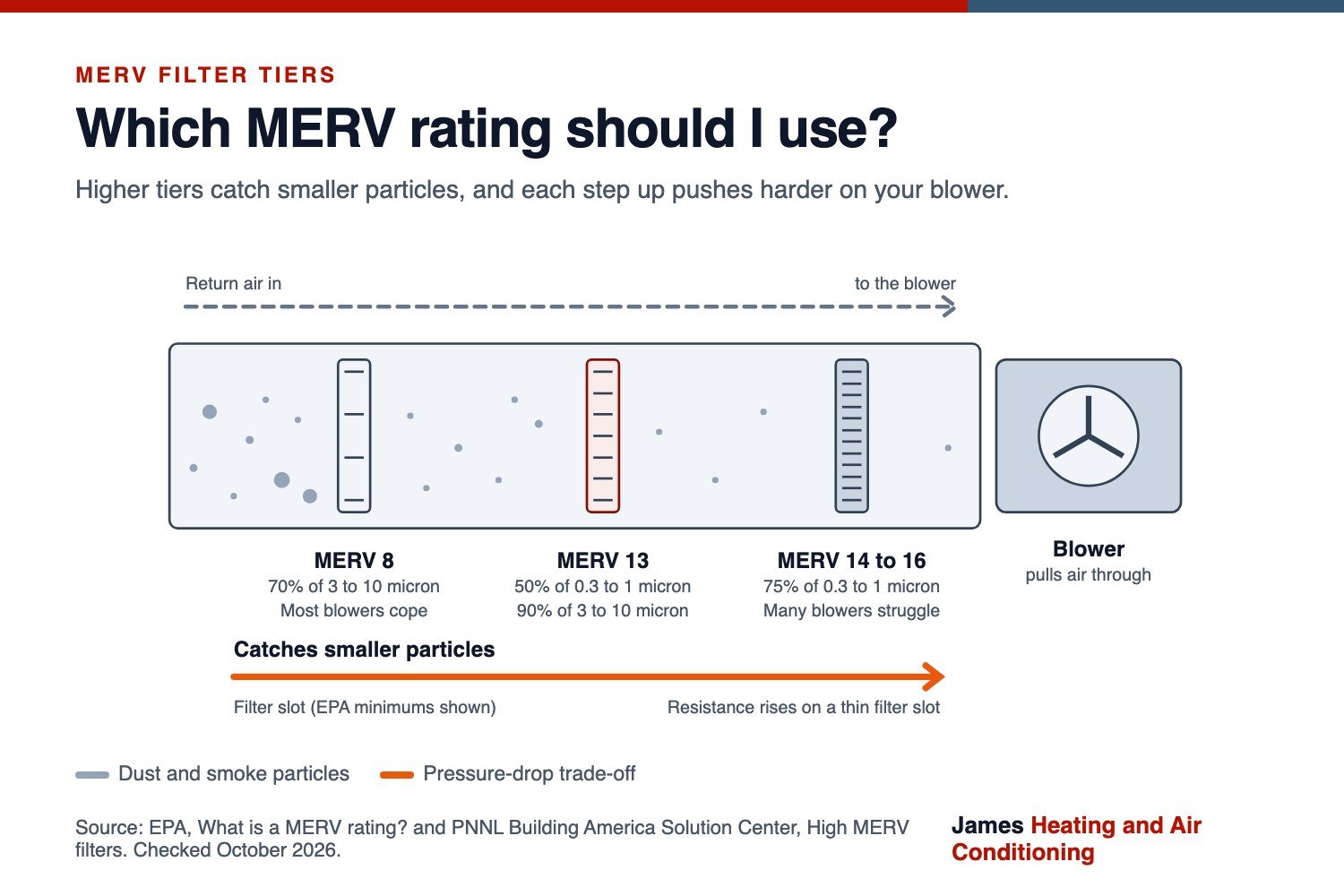
The table comes from EPA, What is a MERV rating?, and EPA advises choosing a filter rated at least MERV 13, or as high as your system’s fan and filter slot can accommodate. Our filter change schedule covers how often each type needs replacing.
Can my HVAC system handle a MERV 13 filter?
Often yes, but not always in the slot you have now. A thin one-inch MERV 13 can choke a return that was sized for a cheap fiberglass filter, and your blower pays for it. We check the slot depth before we recommend any rating.
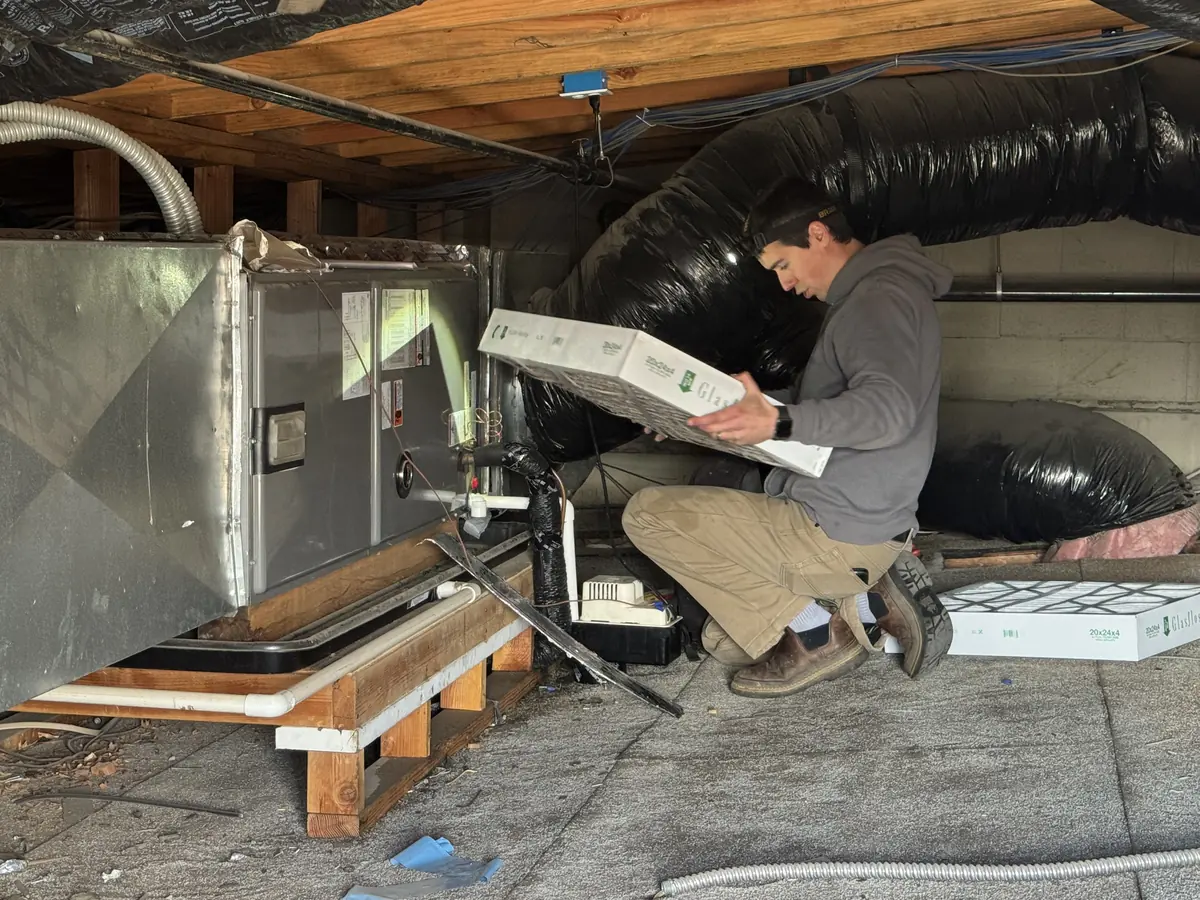
Pacific Northwest National Laboratory’s Building America guidance says a high rating does not by itself mean high resistance, because pleat depth and filter area do most of the work. It also warns that too much static pressure can freeze an AC coil or overheat a furnace. So the fix is rarely “buy the highest number.” We replace a thin one-inch filter with a deeper one when your return has the room, and a media filter cabinet gives the air even more surface to pass through. We test static pressure afterward to confirm your blower still moves the air it should, and we quote the cabinet only after we check the return.
Do I need a ventilator in a tight house?
You need one if cooking moisture, cleaning products and the carbon dioxide from your household have nowhere to go. A well-sealed house keeps heat in and keeps stale air in.
An energy recovery ventilator (ERV) or heat recovery ventilator (HRV) fixes that. It pulls outdoor air in, passes it across the outgoing air, and moves most of the heat from one stream to the other, so you do not throw away the warmth you paid for.
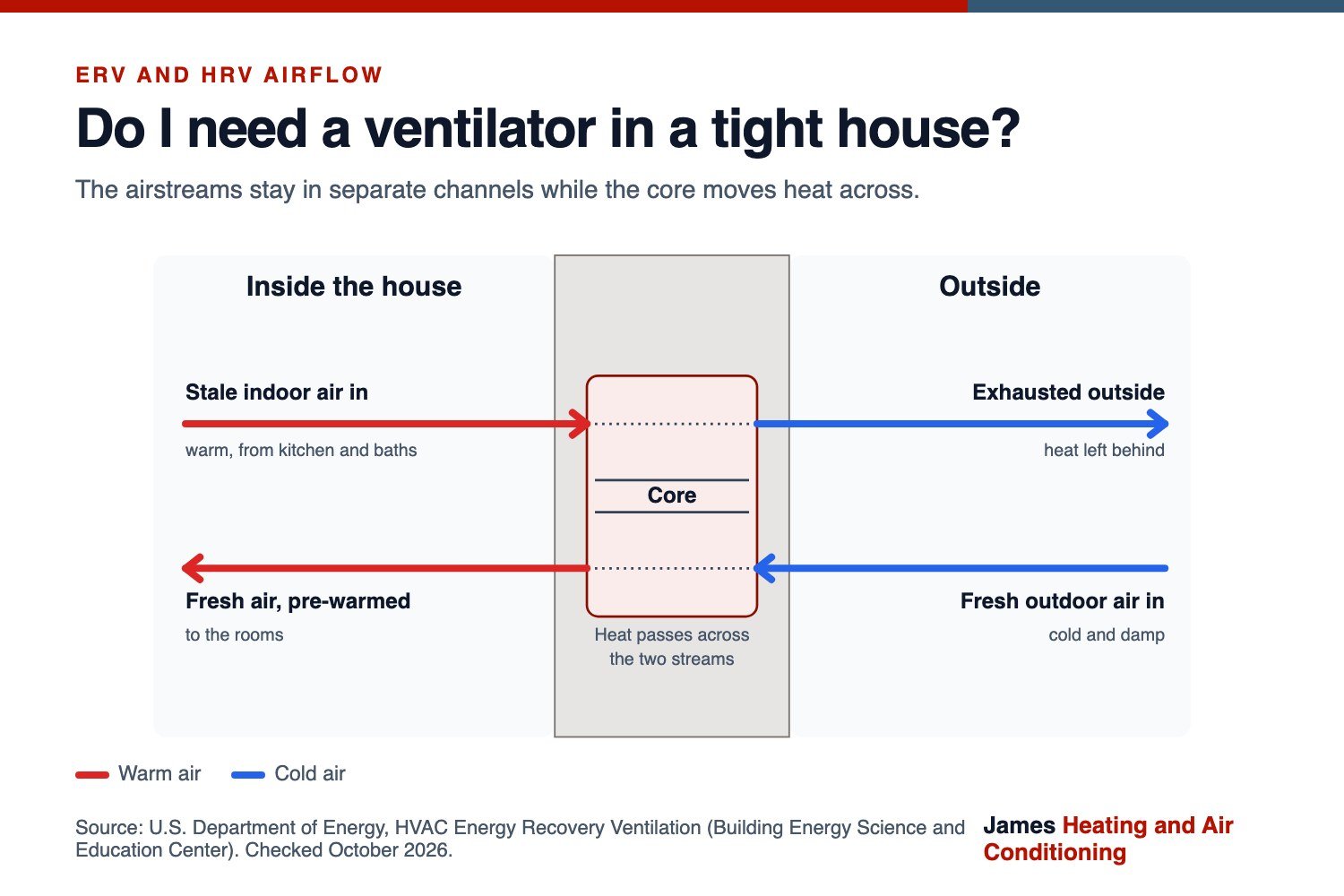
For Willamette Valley homes this is a winter job. Cold, damp outside air arrives slowly and pre-warmed through a ventilator, instead of through a cracked window. We size the ventilator to your house so it does not pull in more cold air than the house needs. We install and repair ventilators in both the Eugene and Salem areas, and our air ventilation services page lists what we cover.
One catch on smoke days. A ventilator pulls in outside air, so during a heavy smoke event it needs a good filter on the intake or should be switched off. Our technicians check the intake filter on any ventilator we service, and we tell you how your unit behaves when the AQI climbs.
What humidity level is best for my home?
Keep indoor relative humidity between 30 and 50 percent, and never above 60 percent. EPA’s mold guidance sets that band, and water on window glass or cold pipes tells you that you are above it. We check your indoor humidity with a hygrometer at the visit.
The Willamette Valley gives you two humidity problems, and they run in opposite seasons. Winters are wet outside, and showers, cooking and drying laundry push a closed-up house toward condensation and mold on north walls, closets and window frames. Summers are dry, so a house can drop low enough for static shocks and dry throats once your AC is running.
The fixes differ too. Bath and range fans vented outdoors, a crawlspace vapor barrier and a working condensate drain cost little. If your house still sits above the band, a whole-home dehumidifier tied to the ductwork is the next step, and a ventilator helps in winter by swapping damp indoor air for outdoor air. We check the bath fans, the crawlspace vapor barrier and the condensate drain before we quote a dehumidifier, and we size any recommendation to your house.
How do I set up my HVAC for wildfire smoke?
Close the fresh-air intake, put your best filter in the return, and run a HEPA unit in one clean room. Wildfire smoke is mostly fine particles, the size range where a MERV 13 starts to work and a basic filter does very little.
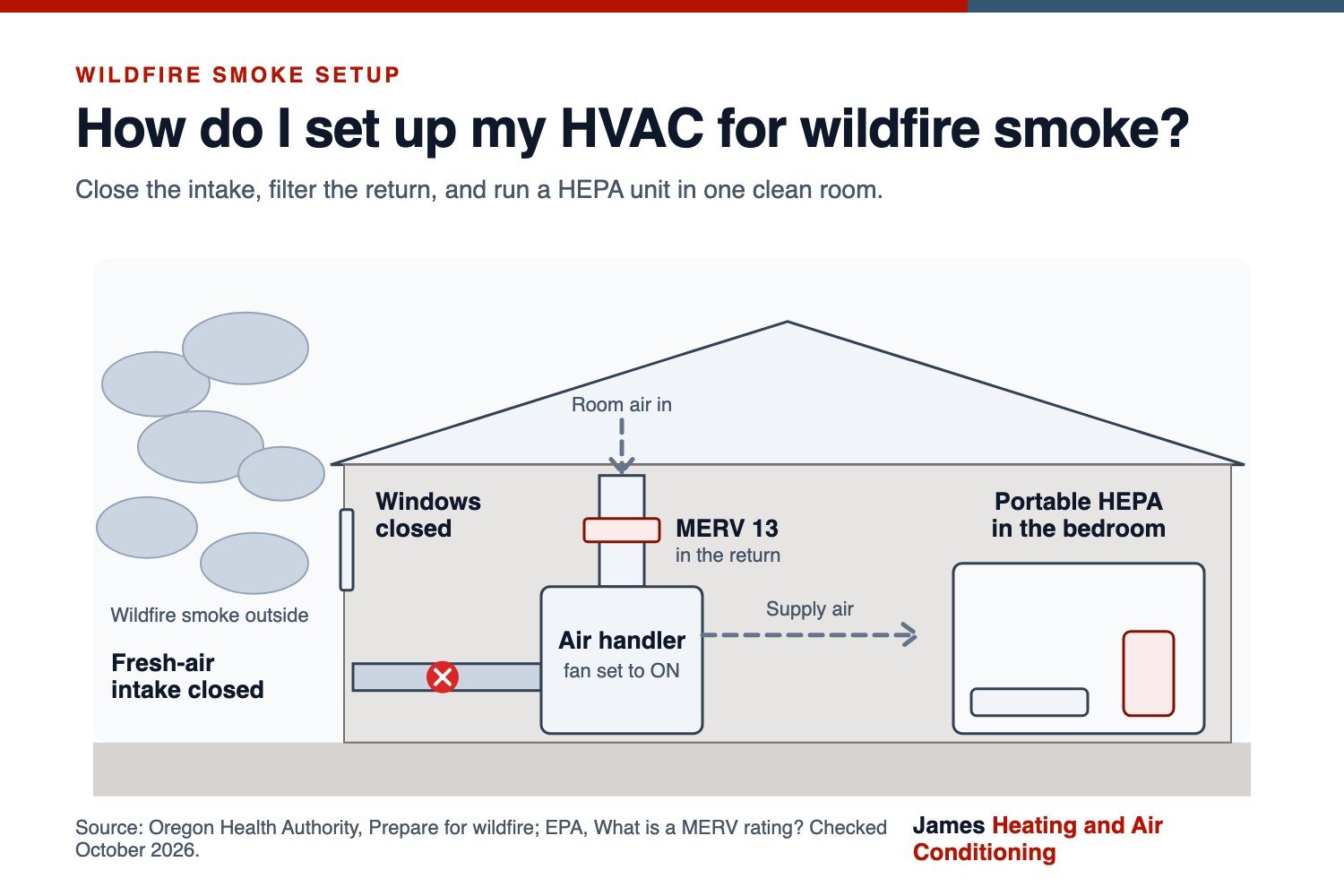
Oregon DEQ posts the Air Quality Index from more than 37 monitors on its air pollution advisories page, and the free OregonAir app carries the same data. Advisories come mainly in summer. Before the season, we check that your fresh-air intake closes fully. Then buy two MERV 13 filters that fit your slot, ask us to check that your blower can take them, and pick one HEPA air cleaner sized for the bedroom.
We test static pressure with the MERV 13 in place, so the blower still moves enough air on day three of a smoke event. During an advisory, work through this list, which follows the Oregon Health Authority’s wildfire guidance:
- Check the AQI before you open anything.
- Keep windows and doors closed unless it is extremely hot.
- Run the AC with the fresh-air intake closed and the filter clean. DEQ says to set heating or cooling to recirculate.
- Run the fan for the whole event. EPA notes that longer run times filter more air, and the fan switch on ON, not AUTO, is how you get them.
- Use the best filter your system can handle. MERV 13 to 16 can remove 90 percent or more of the particles, per the Oregon Smoke blog.
- Put a HEPA unit sized for the room in one clean room.
- Skip candles, fireplaces and gas stoves, and do not vacuum, since all of these add particles.
If it is too hot to stay inside with the windows shut and you have no AC, OHA says to seek shelter elsewhere. Infants, young children, older adults, pregnant people and anyone with heart or lung disease face the greatest risk. After the smoke clears, replace the filter. It is loaded with ash and will restrict airflow if you leave it in place.
Do whole-home air cleaners and UV lights work?
They help with some pollutants and not others, and none replaces a good filter. EPA’s air cleaner guide warns against any device that intentionally produces ozone, a lung irritant, and notes that air cleaners are generally not designed to remove gases.
We install the Air Scrubber by ActivePure, a whole-home unit that connects to your ductwork, and we inspect the ductwork before we install any unit that connects to it. It is one option on the list, not a substitute for a good filter, ventilation or humidity control. Read the manufacturer’s ozone information for any unit before you buy it, ours included. The Air Scrubber page has the details.
How much do indoor air quality upgrades cost?
National cost guides put a media filter system at $400 to $700 installed and an ERV at $1,500 to $2,000. These are national guides, not James prices. After a visit we quote a firm written price for your house, and we check your filter slot and your return first so the quote fits what the blower can move.
| Upgrade | Typical cost | Source |
|---|---|---|
| Extended media (pleated) filter system, installed | $400 to $700 | HomeAdvisor via Bob Vila, 2023 |
| Whole-house electronic air cleaner | $600 to $2,000 | HomeAdvisor via Bob Vila, 2023 |
| Whole-house UV unit | $800 to $3,000 | HomeAdvisor via Bob Vila, 2023 |
| ERV, installed | $1,500 to $2,000 | Inch Calculator, 2023 |
| Whole-house dehumidifier | $1,300 to $2,800, plus about $500 to $700 labor | Angi and HomeAdvisor via Bob Vila, 2023 |
Treat the ERV figure as the low end. Ducted retrofits in older homes can cost more, and cost guides disagree widely. We test your existing ductwork before we quote a ducted retrofit. The dehumidifier source labels its range as unit only, which is why labor is shown separately.
Should I get my air ducts cleaned?
Only when you have a reason. EPA says duct cleaning is worth doing for visible mold, vermin or heavy debris, and the research has not shown that it improves health.
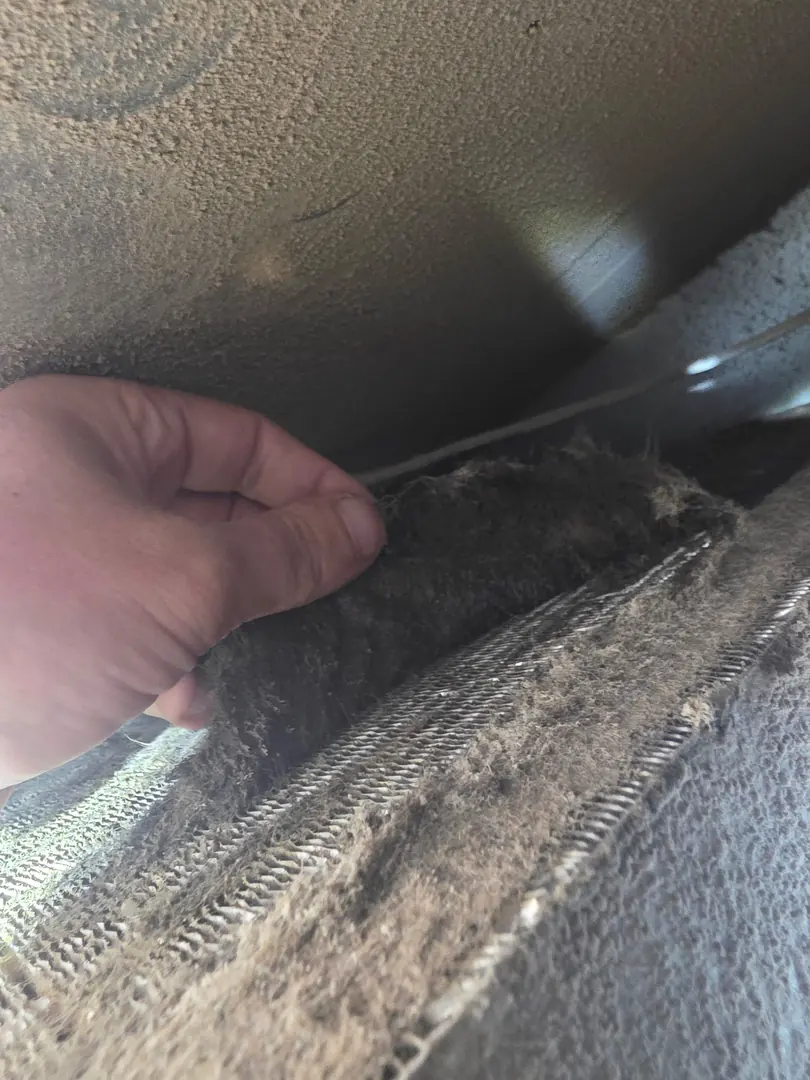
We inspect your ducts before we clean them. If we find one of those problems, our duct cleaning service clears it. Our write-up on whether duct cleaning really helps explains what the research shows.
FAQ
What is the fastest way to improve indoor air quality?
Replace a dirty filter and run a portable HEPA air cleaner in the room you use most. Both work the day you set them up. Ventilation and humidity control take a service visit but fix problems a filter cannot, and we service both.
What MERV filter is best for wildfire smoke?
MERV 13 is the practical target. EPA recommends at least MERV 13, or the highest rating your system can accommodate. The Oregon Smoke blog says MERV 13 to 16 can remove 90 percent or more of the particles. We test your blower against a MERV 13 before you buy one.
Can my HVAC system use a MERV 13 filter?
Often yes, but not always in the filter slot you have now. A thin MERV 13 can restrict airflow, so a deeper filter or a media cabinet is the usual fix. Our technicians check static pressure to confirm, and we replace the slot with a deeper one when the return allows.
Should I run my AC during wildfire smoke?
Yes, with the fresh-air intake closed and a clean filter, per the Oregon Health Authority. Set it to recirculate so it cools the air already inside instead of pulling smoke in.
What is a good indoor humidity level?
EPA recommends 30 to 50 percent relative humidity and never above 60 percent. A cheap hygrometer tells you where you stand, and we check it with ours on every air quality visit.
Does duct cleaning help indoor air quality?
Only in specific cases. EPA recommends it for visible mold, vermin or heavy debris, not as routine maintenance. We clean ducts only when an inspection finds one of those problems.
Talk to a technician about your air
Not sure what your system can handle? We check the filter slot, test static pressure, and install only what your blower can move. James Heating and Air Conditioning has served Oregon since 1983 (CCB #47396). We answer emergency calls around the clock at both numbers.
- Eugene, Springfield and Lane County: (541) 461-2101. See Eugene and Springfield HVAC.
- Salem, Keizer and Marion County: (503) 581-9982. See Salem HVAC.