






Heat pump vs furnace in Oregon comes down to what heats your house now. If you have electric baseboard or an electric furnace, a heat pump is almost always the better swap. If you have gas, your electric rate decides it. We run the numbers with you: (541) 461-2101 for Eugene and Springfield, (503) 581-9982 for Salem and Keizer.
What is the difference between a heat pump and a gas furnace?
A gas furnace makes heat by burning natural gas. A heat pump moves heat that already exists in the outdoor air into your house.
In a furnace, the burners fire into the heat exchanger, the blower pushes your house air across the hot metal, and the flue carries the exhaust outside. Energy Trust of Oregon describes a heat pump as a system that “moves existing heat rather than generating it” and says it uses significantly less electricity than a furnace.
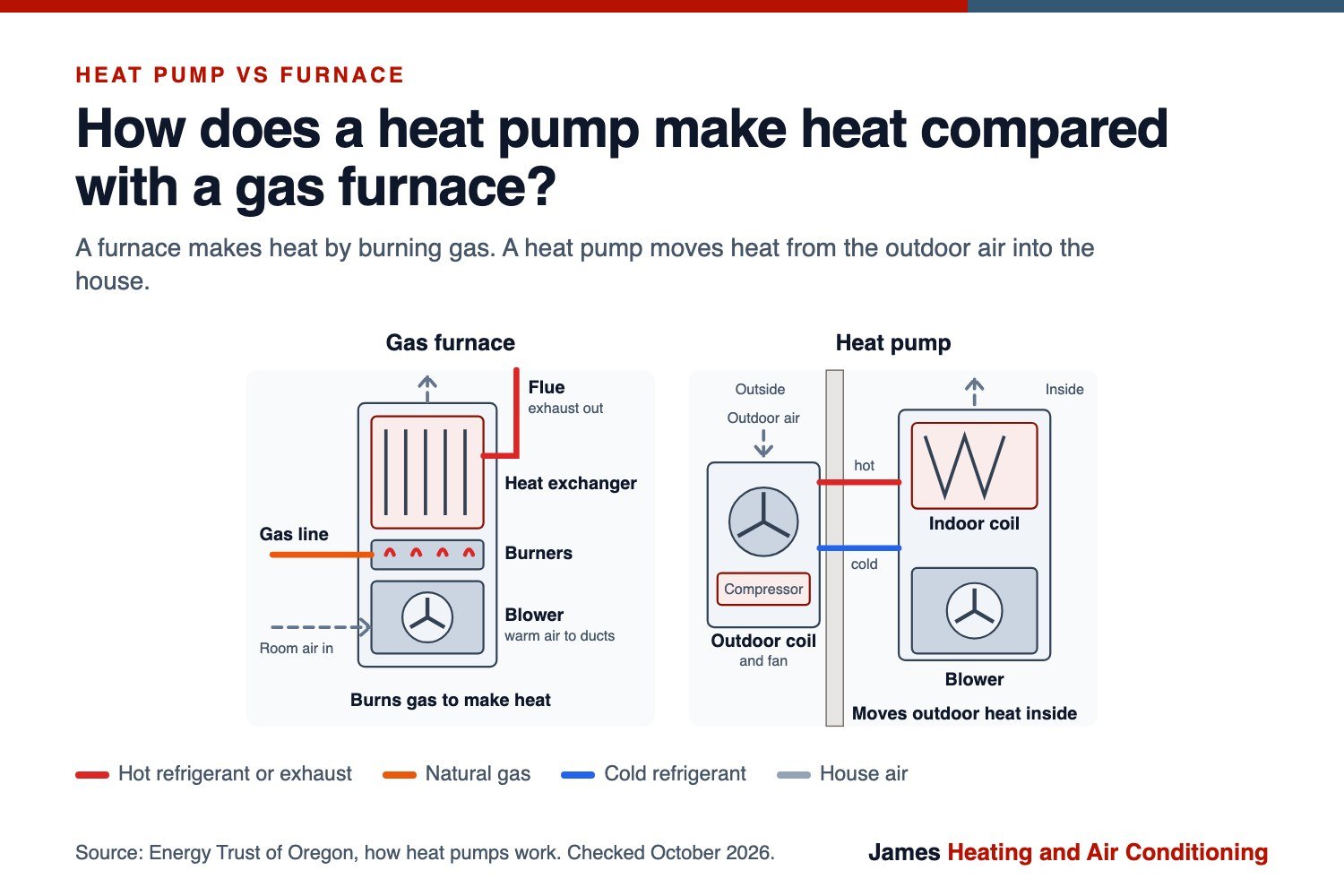
The heat pump’s outdoor coil collects heat from the air, even cold winter air. The compressor concentrates that heat, and refrigerant carries it through the line set to the indoor coil. Your blower then pushes warm air into the ducts, the same ducts a furnace uses. Nothing about your registers changes. Our technicians check refrigerant charge and airflow at startup, because a heat pump’s efficiency depends on both. We install the indoor coil and the outdoor unit as a matched pair.
One more difference changes your shopping list. A heat pump also cools, because its refrigerant loop reverses in summer. One unit replaces your furnace and your AC. We install Ruud and Rheem heat pumps and gas furnaces, and we service both after the install, so we have no stake in which one you pick. On a replacement visit we check your fuel, your utility bill and your ducts before we talk equipment.
Is a heat pump cheaper to run than a gas furnace?
At EWEB, SUB and Salem Electric rates a heat pump usually costs less to run than a 95% gas furnace. At the Oregon average rate, gas can win.
We run every fuel through one yardstick, 100,000 Btu of heat delivered into your house. That’s one therm. The U.S. Energy Information Administration puts 3,412 Btu in a kilowatt-hour and 100,000 Btu in a therm, so 100,000 Btu of electric-resistance heat takes 29.31 kWh.
Gas comes first. NW Natural’s Oregon residential tariff, effective October 31, 2025, charges $1.4122 per therm plus a $10 monthly customer charge. AFUE is the share of the fuel that becomes heat. At 80% AFUE you pay $1.4122 / 0.80 = $1.77 per 100,000 Btu delivered, and at 95% you pay $1.4122 / 0.95 = $1.49. NW Natural’s gas price page says its fall filings raise the average bill about $6.30 a month at 54 therms, roughly 12 cents a therm. We check the current filing before we put a gas number in front of you. With that increase a 95% furnace runs near $1.61, so read the gas figures below as slightly low.
Electric comes next. A heat pump’s efficiency is its COP, the units of heat out per unit of electricity in. The Department of Energy’s heat pump purchasing page lists 7.8 HSPF2 for an ENERGY STAR model and 11 for the best available. Dividing by 3.412 gives a seasonal COP of 2.29 and 3.22. Those are season-long test averages, not cold-night numbers.
| Heat per 100,000 Btu | EWEB 10.82¢ | SUB 6.62¢ | Salem Electric 7.95¢ | Oregon average 15.92¢ |
|---|---|---|---|---|
| Electric resistance (COP 1) | $3.17 | $1.94 | $2.33 | $4.67 |
| Heat pump, COP 2.29 | $1.38 | $0.85 | $1.02 | $2.04 |
| Heat pump, COP 3.22 | $0.98 | $0.60 | $0.72 | $1.45 |
| Gas furnace for comparison | 80% AFUE $1.77 | 95% AFUE $1.49 |
The rates come from EWEB (3.99 delivery plus 6.83 energy), SUB (first 1,500 kWh, October through April), Salem Electric and the EIA Oregon average (preliminary, latest month). Salem Electric serves Salem and Keizer as a not-for-profit co-op. We run the table without fixed monthly charges, because they don’t change with the equipment you pick. We pull your rate from your utility’s published schedule, not from a statewide average. If PGE or Pacific Power sends your bill, put your own price per kWh into the formula below.
The break-even is the COP at which both cost the same. Work it out as 29.31 x your price per kWh / your gas cost per 100,000 Btu. Against a 95% furnace at $1.49, it’s COP 2.13 at EWEB, 1.31 at SUB, 1.57 at Salem Electric and 3.14 at the Oregon average. Against an 80% furnace at $1.77 it’s 1.80, 1.10, 1.32 and 2.64. At EWEB’s rate even an ENERGY STAR-minimum heat pump beats a 95% furnace on a typical day. At 15.92 cents it only wins if the unit holds a high COP. We run this break-even on every gas-home quote, using your rate and not an average.
Can a heat pump keep a Willamette Valley house warm in winter?
Yes, in most Valley homes. Eugene’s January normals are a 48.1°F high and a 34.7°F low, which sits in the range a heat pump handles well.
The National Weather Service’s Eugene climate book lists a January mean of 41.4°F. That’s a marine winter, not a Midwest one. Cold snaps still arrive, and the same table has a coldest January mean of 28.1°F in 1949. Most hours, though, fall in mild air.
The Department of Energy says cold climates call for specially designed heat pumps. It adds that the electric resistance elements built into many units are inefficient and should be used as little as possible. So we check which rooms run coldest on your worst nights before we recommend a model. We size and quote a cold-climate unit where your house calls for one. That matters most up in the Cascade foothills. The Department’s article on heat pumps calls modern air-source units a legitimate option for colder regions.
Which should you pick for the heat your house has today?
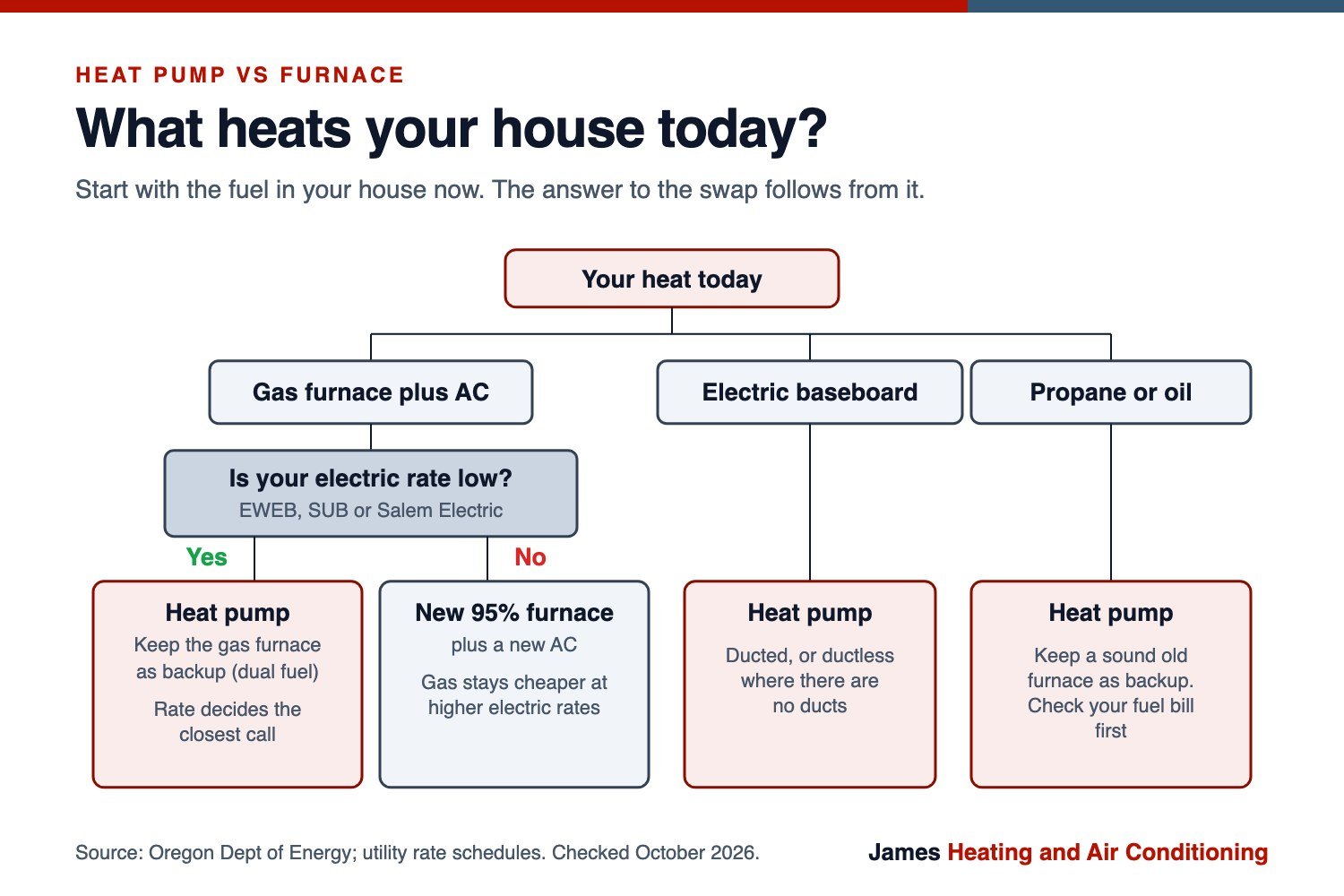
Pick by the fuel already in your house. Electric homes get a heat pump, gas homes get a rate check, and propane or oil homes get a bill check.
The Oregon Department of Energy’s Lane County profile lists electricity as the main heat source in 75% of the county’s 158,621 households, natural gas in 18%, wood in 5%, propane in 1% and fuel oil in 0%. In Eugene and Springfield the typical swap is electric to electric. We check the fuel and the utility bill first, then we work toward equipment.
| Your house today | Usual best replacement | What could change that |
|---|---|---|
| Electric baseboard or electric furnace | Heat pump (ducted, or ductless where there are no ducts) | Very low electric rates narrow the gap, but don’t reverse it |
| Gas furnace plus AC | Heat pump with the furnace kept (dual fuel), or a new 95% furnace plus AC | Your electric rate; see the break-even above |
| Propane or oil furnace | Heat pump, with the old furnace kept as backup if it’s sound | Delivered fuel price against your kWh rate |
| Wood as the main heat | Heat pump for the rest of the house | Wood stays a supplement, not a plan for every night |
Electric baseboard or electric furnace homes
A heat pump wins here, because it delivers the same warmth for about half the electricity. The Department of Energy says modern air-source heat pumps can reduce electricity use 50% compared with furnaces and baseboard heaters. In a baseboard home that’s the whole case.
We check whether your house has ducts, and we check your electrical panel for room on a new circuit. If the ducts are there, we quote a ducted system. If it doesn’t, we quote ductless heat pump systems room by room.
Gas furnace plus AC homes
You have three real options. You can buy a new furnace plus a new AC, a heat pump with your gas furnace kept as backup, or a heat pump alone. We quote the first two side by side so you see the difference on paper. The rate table tilts toward the heat pump at EWEB, SUB and Salem Electric prices, and toward gas at higher rates.
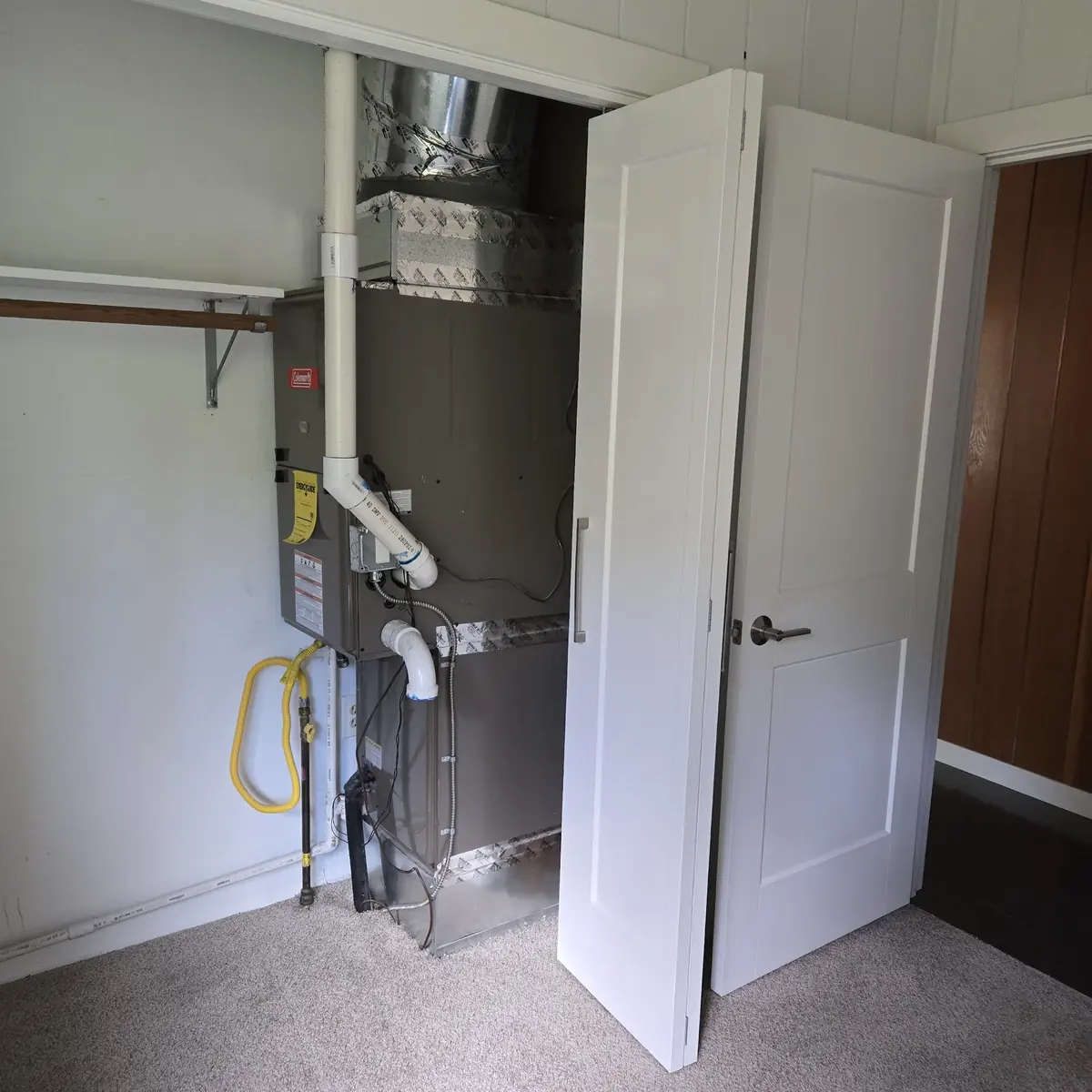
When your AC needs replacing and the furnace is still sound, we install a heat pump in the AC’s place and leave the furnace alone. That’s the cheapest way to try the pair. If the furnace is also near the end, we inspect the gas line, the vent and the flue before we call it sound, and our post on how long a furnace lasts covers the signs. A new furnace brings a gas line, a vent and a heat exchanger for another 15 years. A heat pump brings none of those.
Propane or oil homes
You’re in a small group. The Lane County profile puts propane at 1% of homes and oil at 0%. EIA lists 91,452 Btu per gallon of propane and 138,500 per gallon of heating oil. At 95% AFUE, 100,000 Btu takes 1.15 gallons of propane (100,000 / (91,452 x 0.95)). An oil furnace at an assumed 85% takes 0.85 gallons (100,000 / (138,500 x 0.85)).
Multiply by the delivered price on your last fuel invoice and compare it with the heat pump rows in the table. We run that math with your invoice in hand, and we check the old furnace’s age and heat exchanger before we call it a backup. At Valley electric rates most delivered-fuel homes come out ahead with a heat pump, and keeping the old furnace as backup costs nothing extra.
What is dual fuel, and is it worth the extra cost?
Dual fuel, also called a hybrid system, pairs a heat pump with a gas furnace so the cheaper source runs. It pays off in a gas home with a sound furnace.
Oregon’s Building Codes Division describes it in its technical summary. The heat pump does the first stage of heating, then the furnace takes over at a set point.
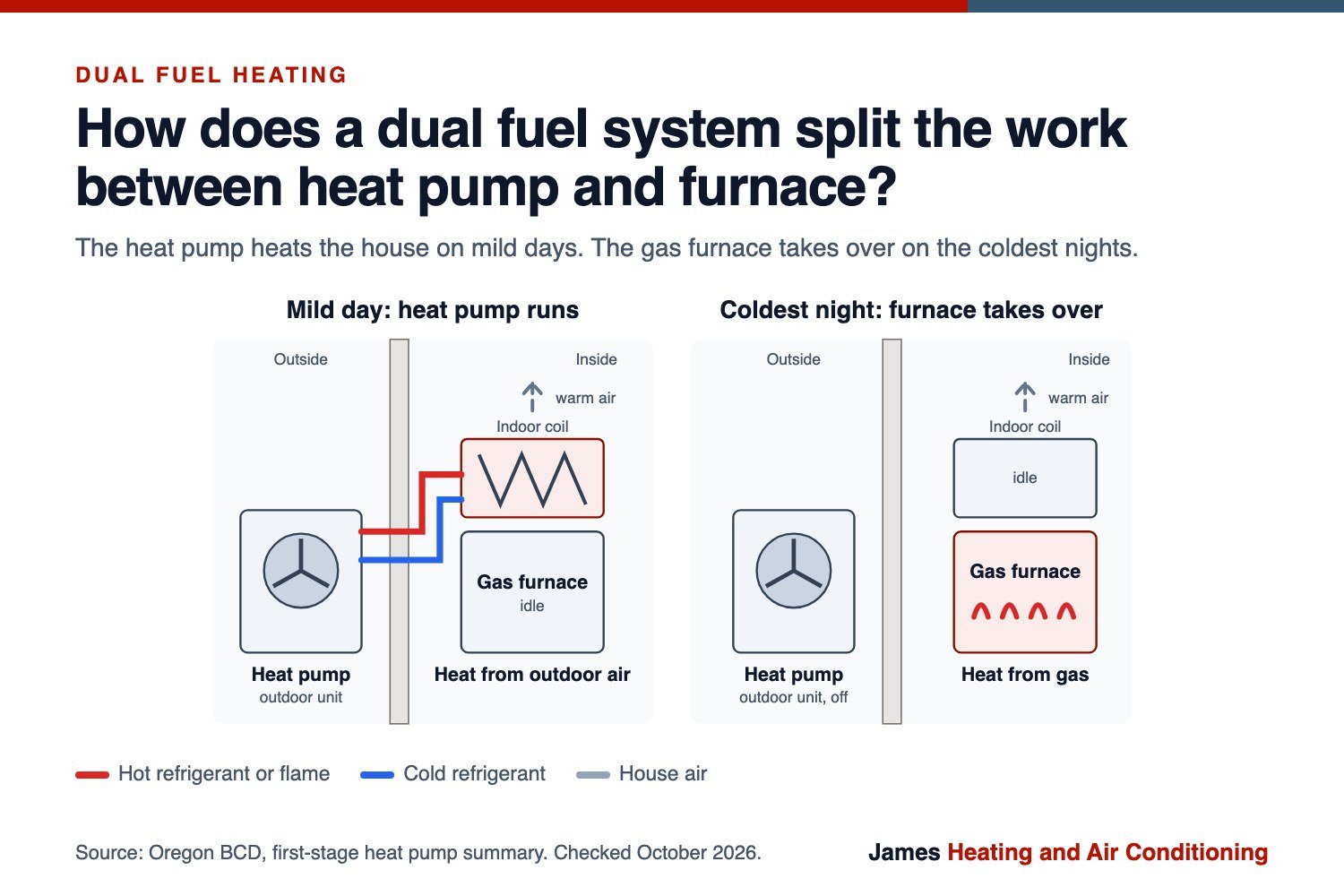
The set point is the break-even from the rate table. When outdoor air gets cold enough that the heat pump’s COP falls below break-even, the furnace costs less per Btu. We run that break-even from your kWh price and your therm price, then we test the control to confirm the handoff works. That’s why we won’t quote one temperature for every house, and you should doubt any single number you see online. We service both halves of a dual fuel system on the same visit.
Dual fuel earns its cost in two cases. The first is a house with gas and a good furnace, where the heat pump takes the mild-weather hours. The second is anyone who wants gas heat on the coldest nights without electric strip backup. Energy Trust of Oregon says strip backup can cost two to three times more to run than the heat pump, and dual fuel replaces that backup with a furnace that’s cheaper per Btu.
It costs more up front. You also keep two systems alive, and two sets of parts wear out. Skip it in an all-electric house, since there’s no gas line to use.
What does each option cost to install?
Installed cost runs about $5,000 to $15,000 for a central heat pump, $3,800 to $10,000 for a gas furnace and $6,000 to $18,000 for dual fuel.
Those are national guide ranges for an existing-duct home, not James Heating and Air Conditioning prices. We quote a written price after we see your house.
| Option | Installed range | Source |
|---|---|---|
| Central heat pump | $5,000 to $15,000, average $8,350 | Fixr |
| Ductless heat pump | $2,000 to $8,000 | Fixr |
| Gas furnace | $3,800 to $10,000 | Bob Vila (older guide) |
| Dual fuel, existing ducts | $6,000 to $18,000 | Filterbuy |
The ranges overlap a lot, and the furnace and dual fuel figures are the thinnest. Filterbuy adds $2,400 to $6,600 if the house needs new ductwork, so we inspect your ducts before we quote, and when they leak we seal them before we size the new system. Our own cost posts break down what a heat pump costs and what a new furnace costs in more detail.
Does Oregon’s heat pump code or a rebate change your choice?
No. If you’re replacing equipment in an existing house, nothing in Oregon’s proposed code forces your pick.
The Building Codes Division’s proposed 2026 residential code, section N1105.8, would require a heat pump where split-system AC goes into a new dwelling. Its summary says the section applies to new dwellings only, doesn’t apply to replacing an existing cooling system and doesn’t dictate the heating fuel.
Rebates are separate. Utilities set their own, and Energy Trust requires that its extended-capacity heat pump have no gas backup system, so we check the program rules before we quote dual fuel. Our rebate guide covers the utility-by-utility breakdown. The federal 25C credit expired December 31, 2025. We size the system with a load calculation, not a tonnage guess.
Frequently asked questions
Is a heat pump worth it in Oregon?
Usually yes, if you heat with electric resistance or have a gas furnace and an electric rate near EWEB’s. A heat pump cuts electricity use about 50% against baseboard and electric furnaces, per the Department of Energy. At the state average rate, gas can still win on a cold day, so we run your rates before we say yes.
Do I need a gas furnace backup with a heat pump in the Willamette Valley?
Not always. Many homes use electric backup strips instead, which Energy Trust says can cost two to three times more to run than the heat pump. Our aux and emergency heat guide explains the difference. A gas furnace as backup costs less per Btu on the coldest nights, so we install dual fuel where a gas furnace is already in the house.
Does Oregon require a heat pump when I replace my AC?
No. The Building Codes Division summary says the proposed N1105.8 section is for new dwellings only and doesn’t apply to replacing an existing cooling system.
Can a heat pump replace my furnace completely?
Yes, in most Valley homes. January normals in Eugene are a 34.7°F low and a 41.4°F mean. Ask for a cold-climate model if your house sees harder nights, since the Department of Energy says cold climates need specially designed units. We size and install one where the house calls for it.
Does a heat pump replace my AC too?
Yes. The refrigerant loop reverses in summer, so one heat pump heats in winter and cools in summer, and we install it in place of both old units.
Can I keep my old furnace and add a heat pump?
Often, if the furnace is in good shape. We inspect the furnace, the coil fit and the thermostat before we price a dual fuel setup.
Call James Heating and Air Conditioning
We serve Eugene, Springfield, Salem and Keizer homes under CCB #47396, and we have since 1983. We install heat pumps, gas furnaces and dual fuel systems, and we check your fuel, your utility bill and your ducts, then we quote the numbers on paper. Our HVAC system installation page shows how a replacement runs.
- Eugene, Springfield and Lane County: (541) 461-2101.
- Salem, Keizer and Marion County: (503) 581-9982.