






Aux heat is the electric backup your thermostat switches on by itself when the heat pump falls behind. Emergency heat is a setting you choose that shuts the heat pump out and runs only the electric strips. Our technicians check the outdoor unit first on every call, and we want you on emergency heat only when it has failed.
Heat pump down right now? Our Eugene office covers Springfield and Lane County at (541) 461-2101, and our Salem office covers Keizer and Marion County at (503) 581-9982. We answer both lines at any hour, weekends included.
What is the difference between aux heat and emergency heat on a heat pump?
Aux heat runs the electric strips alongside the heat pump, and emergency heat runs the strips alone with the outdoor unit shut out.
Most ducted heat pumps carry electric resistance strips inside the air handler, the same idea as a toaster element with a blower behind it. Our technicians inspect that cabinet on every winter no-heat call, so the layout below is what we see when we pull the panel at your house.
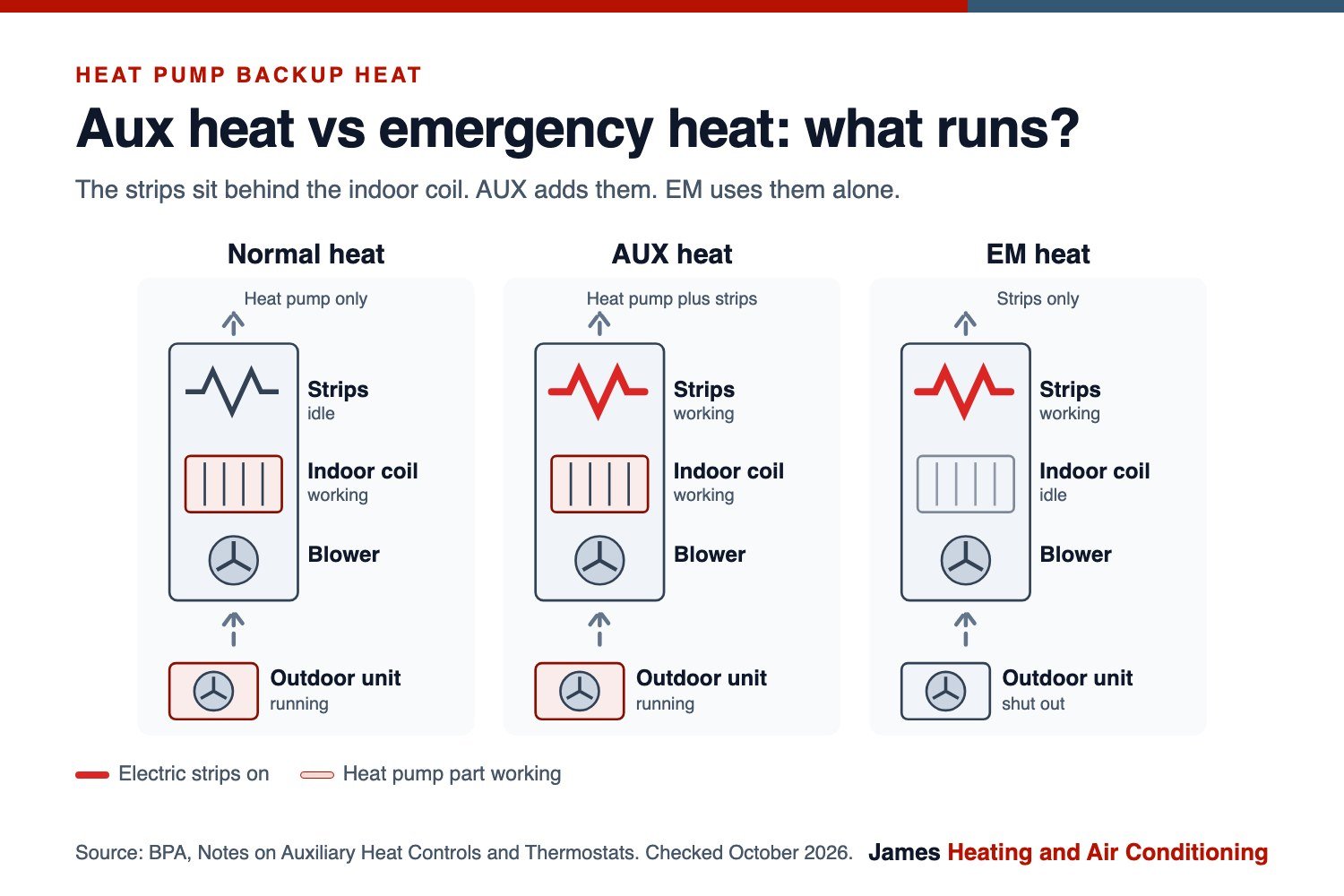
The strips sit downstream of the indoor coil. In normal heat only the coil works. In AUX the strips join the coil. In EM the thermostat sends the call to the strips alone, and the outdoor unit does nothing.
| AUX (auxiliary) heat | EM (emergency) heat | |
|---|---|---|
| Who turns it on | The thermostat, automatically | You, by changing the system mode |
| Heat pump running? | Yes, strips work alongside it | No, strips do all the work |
| When it’s right | Recovery, defrost, the coldest hours | Outdoor unit failed or won’t run |
| Cost | Higher than heat pump alone | Highest, because you’ve turned off the cheap heat |
The Bonneville Power Administration’s notes on auxiliary heat controls give installers two points. The emergency heat circuit has to energize the strips, and the aux and emergency circuits should be controlled separately. On service calls our technicians check both. If your heat pump is paired with a gas furnace as backup instead of strips, we check your equipment label and wiring to see what EM does on your setup. The label is the same and the behavior can differ.
What do AUX and EM mean on my thermostat, and who turns them on?
AUX lights on its own while the system is in Heat. EM shows only after you select Emergency Heat as the system mode.
The thermostat decides AUX, and you decide EM. We test both modes at startup. Labels vary by thermostat, so yours may say “Aux Heat,” “Auxiliary,” “EM” or “Emergency Heat,” but the logic is the same.
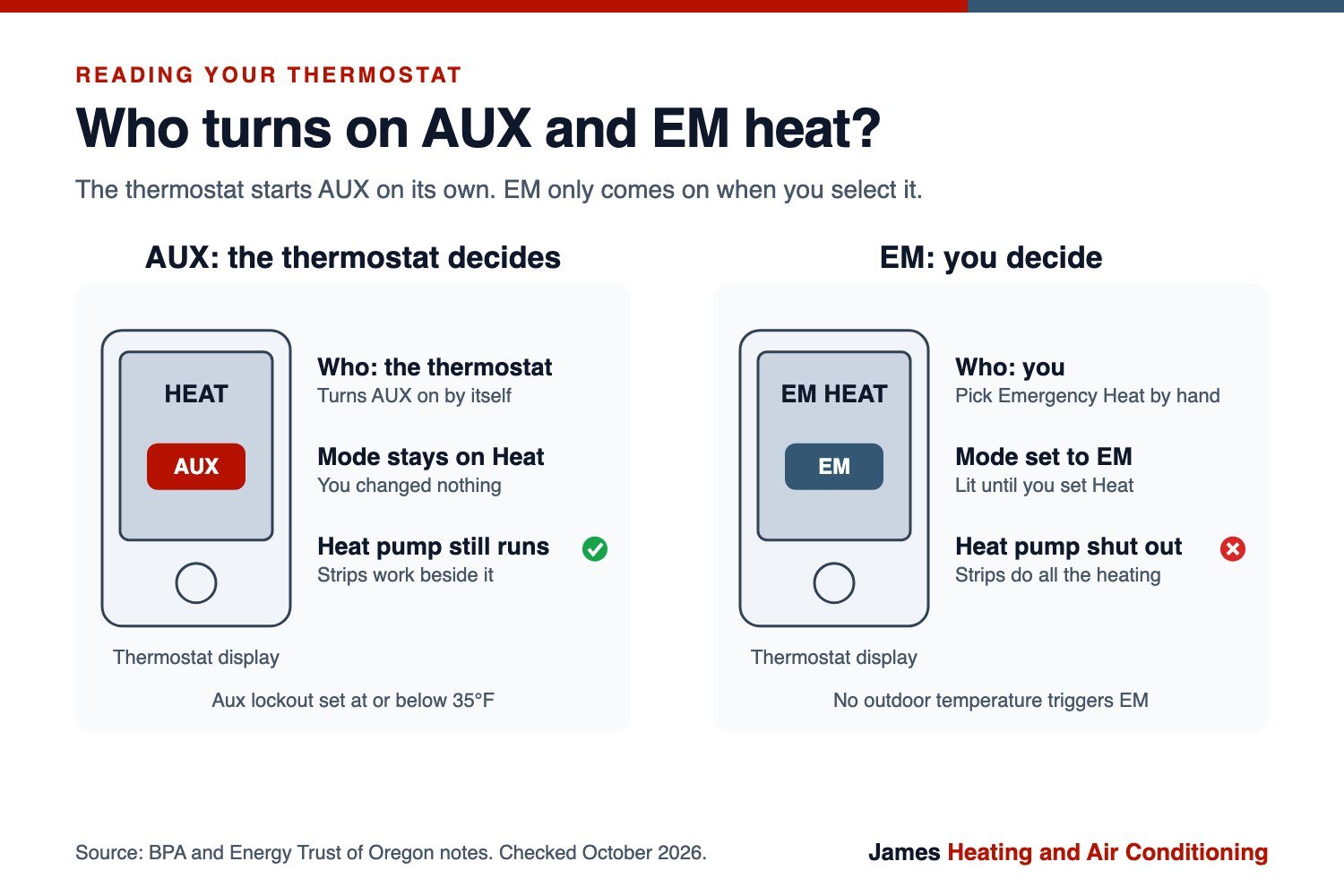
If EM is lit and you never chose it, someone changed the mode, so set it back to Heat and watch whether the system keeps heating. AUX on a cold morning? You did nothing wrong. Our technicians check the aux lockout setting at startup and on service visits, and we check the outdoor temperature sensor it depends on. Energy Trust of Oregon requires the lockout at or below 35°F in its 2025 specifications, which blocks the strips above that outdoor temperature.
We cover a blank thermostat screen in a separate post, because it is a different problem from a wrong mode.
When should I use emergency heat on my heat pump, and at what temperature?
Use emergency heat only when the outdoor unit has stopped working. No outdoor temperature triggers it, because you select it by hand.
Common reasons are an outdoor fan that won’t spin, a unit that won’t start, a coil iced solid, or a breaker that keeps tripping. The strips can keep a house livable while you wait, and we dispatch a technician to the outdoor unit first. The 35°F figure above belongs to AUX lockout, not to EM.
If the outdoor unit is fine, leave the thermostat on Heat. Pressing EM to “boost” a cold house shuts off the efficient part of the system and runs the strips for as long as you leave it there.
If you do need it, work through these steps.
- Set the thermostat to Emergency Heat. Confirm warm air is coming from the registers within a few minutes.
- Call the office for your area. Our Eugene office covers Springfield and Lane County at (541) 461-2101, and our Salem office covers Salem, Keizer and Marion County at (503) 581-9982.
- Close off unused rooms’ doors and keep registers open. Don’t run space heaters on extension cords to “help.”
- If the strips don’t warm the air either, shut the system off and tell the dispatcher. The strips and the blower share the air handler, so we check there too on a no-heat call.
- Switch back to Heat once we repair the outdoor unit, so EM doesn’t stay on for the rest of the winter.
We answer both numbers 24 hours a day, so a search for emergency heat pump repair in Salem ends at (503) 581-9982. Want the warning signs first? Heat pump repair in Salem lists what to watch for before a unit quits.
Why is my emergency heat not working or blowing cold air?
If EM brings no warm air, the strips aren’t energizing, so shut the system off and call us.
Emergency heat depends on a chain of parts, from the thermostat’s EM call through the air handler’s breaker, the safety limit switch and the relay or sequencer to the strip elements themselves. On these calls we check the air handler breaker first, then we test voltage at the strip kit and the amp draw when the strips should be on. We also test the thermostat’s EM wiring, and we check the supply-air temperature at the registers to confirm the strips are heating. A dirty filter can trip the limit switch, so our technicians inspect the filter and airflow before they replace a part. We replace a strip element or relay only after we confirm it failed. No guessing.
Cold air from the registers can also mean the blower runs while the strips are off. You can check the filter yourself, but leave the panel doors closed, because strip kits draw serious current.
Is it bad to use emergency heat on a heat pump?
Short stretches won’t hurt the equipment. Your bill is another story. Emergency heat costs far more than normal heat pump heating.
EM turns off the heat pump and runs the strips alone. A long run also leans on your filter, ducts and wiring, so call us rather than live on EM for weeks. We inspect all three on an EM call and service whatever shows strain. A resistance strip turns one unit of electricity into one unit of heat. A heat pump moves heat instead of making it. ENERGY STAR certifies air-source heat pumps on this basis and says they can deliver up to three times more heat energy than the electrical energy they use. ENERGY STAR tests certified units down to 5°F, and the number drops as the outdoor air gets colder, so treat three as a best case.
How much does emergency heat cost to run per hour?
On an example 10 kW strip kit, one hour of emergency heat costs about $1.08 at EWEB’s rate and $1.59 at the Oregon average. Our technicians check the air handler nameplate for your real kilowatts.
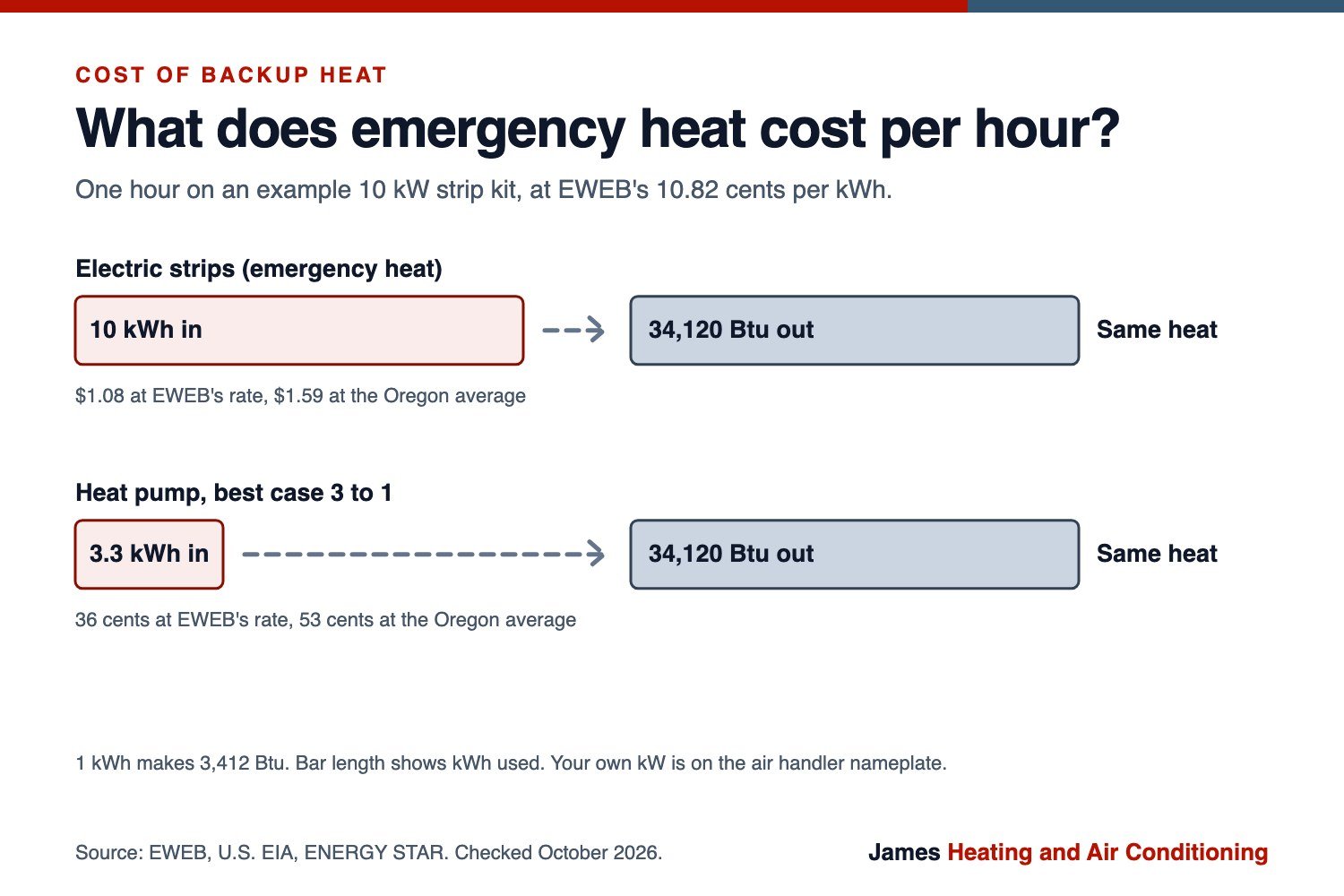
This is the arithmetic behind those numbers.
- One kilowatt-hour makes 3,412 Btu of heat (U.S. EIA). The strips draw 10 kW, so an hour makes 34,120 Btu and uses 10 kWh.
- EWEB offers one flat residential price on its 2026 price list, with no tiers, at 3.99 cents for delivery plus 6.83 cents for energy. That is 10.82 cents per kWh, or $1.08 an hour.
- The Oregon residential average is 15.92 cents per kWh (EIA, August 2026), so the same hour is $1.59.
- A heat pump at the best-case 3-to-1 makes those same 34,120 Btu from about 3.3 kWh. That is 36 cents at EWEB’s rate and 53 cents at the state average.
The hours add up fast. Strips running 4 hours a day for 30 days use 1,200 kWh, which is about $130 at EWEB’s rate and about $191 at the state average. A night of 8 straight hours is $8.66 to $12.74. We run the same math for Salem homes on the rate from your own bill, whether your utility is Portland General Electric or Salem Electric.
Is aux heat normal, and when does it come on?
Yes. Aux heat is a tool, not a fault. Three situations call for it.
- Recovery from a setback. Raise the thermostat several degrees and the heat pump can’t close the gap fast enough, so the thermostat adds the strips.
- Defrost. The unit briefly reverses to melt frost off the outdoor coil while the strips keep the air from blowing cool. We cover what normal frost looks like in our defrost and ice guide.
- A cold snap past the balance point. Below some outdoor temperature the house loses heat faster than the heat pump alone can replace it.
The Willamette Valley doesn’t hand you many of those hours. The National Weather Service’s Eugene climate normals (1991 to 2020) put the overnight low at or below 32°F on 11 nights in January, 12 in December and 10 in February. A low at or below 20°F is about one night in each of those months. When we size a system, we plan around those mild, damp winters and not the rare 20°F night. A properly sized system with tight ducts shouldn’t lean on strips much, and BPA says backup hours in a system like that are “expected to be relatively few.”
Why is my heat pump on aux heat when it’s 40 degrees outside?
Usually it’s one of two things. The thermostat is recovering from a setback, or its lockout isn’t set. If neither explains it, something in the system is making the strips cover for the heat pump.
If you haven’t touched the dial and AUX still comes on at 40°F, we diagnose it as a symptom, not a setting. A thermostat with no lockout, or one set well above 35°F, calls strips when the heat pump could handle the load. Watch for these signs.
- AUX lit when it’s 40 to 50°F outside.
- AUX on for hours with no setback recovery involved.
- The electric bill jumps in a mild stretch.
- Warm, not hot, air at the registers while AUX is lit.
- The outdoor unit running with frost that never clears, or not running at all.
- The breaker for the air handler trips when the strips start.
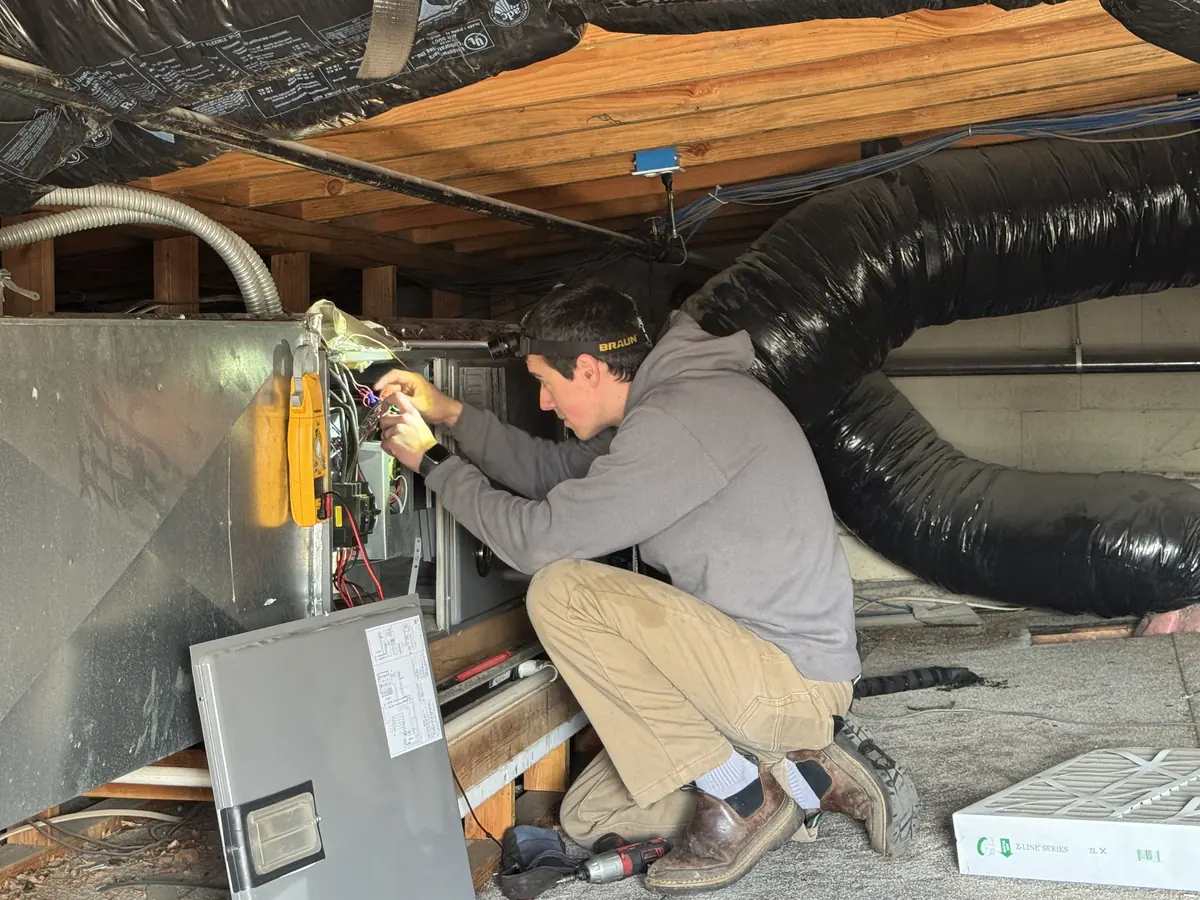
A heat pump that’s undersized, low on refrigerant, or iced up leaves the strips to cover for it. Leaky or restricted ducts waste what the heat pump makes, and we seal and repair them when they are the cause. On a visit we run through the same checks in order.
- We check the lockout setting and the outdoor sensor.
- Our technicians test the strip kit’s amp draw.
- We check the temperature split across the air handler.
- Our technicians check the outdoor unit’s refrigerant pressures.
- We test the outdoor fan and the defrost control.
- We inspect airflow, the filter and the ducts.
Whichever check fails tells us why AUX is running. You can do two checks yourself. Replace a dirty filter, and look at the outdoor unit for a fan that isn’t turning or ice that stays through the afternoon. Our licensed technicians handle anything past that, and the panel doors stay closed.
Do thermostat setbacks make a heat pump use aux heat?
Big ones do. A deep overnight setback forces the strips on for the morning recovery.
The U.S. Department of Energy’s home upgrades page says programmable thermostats “have generally not been recommended for heat pump systems.” It adds that some thermostats now sold for heat pumps make setback cost effective, and that turning back 7 to 10°F for 8 hours a day can save as much as 10 percent a year. That 10 percent is the general figure for any system. It assumes the setback doesn’t wake the strips.
BPA’s installer notes say adaptive recovery works if the homeowner doesn’t use deep setback and doesn’t fiddle with the thermostat all day.
Our starting point for most homes is a couple of degrees at night, not eight, on a thermostat with smart or gradual recovery rather than a plain timer. We check the thermostat’s recovery setting whenever we service a heat pump. If the house is empty for a day or two, drop it more, then bring it back up in steps. Raise the dial 5 degrees at 6 a.m. and you’ve bought a morning of strip heat.
Frequently asked questions about emergency heat and aux heat
Is aux heat running constantly normal?
No. Aux heat for short stretches during recovery, defrost or a hard freeze is normal. If it runs for hours on mild days, suspect a lockout set too high, a heat pump that can’t keep up, or an airflow problem. We check those three in that order to find which.
What does EM stand for on a thermostat?
EM stands for emergency heat. Selecting it turns the heat pump off and runs only the electric strips, so choose it only when the outdoor unit is down.
Can emergency heat warm my house faster?
It can feel faster in a cold house, but it costs about three times as much at best-case heat pump efficiency. We check the outdoor unit first, and if it’s fine, leave the setting on Heat.
Do all heat pumps have emergency heat?
Not every system works the same way. The setting needs a backup source such as strips or a furnace behind it, and what EM does on dual-fuel or ductless equipment varies. We check your equipment label and wiring and tell you what it does on yours.
Who do I call for emergency heat pump repair in Salem?
Call (503) 581-9982 for Salem, Keizer and Marion County. Our Salem office answers around the clock, and Eugene, Springfield and Lane County customers call (541) 461-2101.
Call James Heating and Air Conditioning
James Heating and Air Conditioning serves Oregon homes under CCB #47396 and has since 1983, and we keep dispatch open around the clock. If AUX is lit more than it should be, or the outdoor unit has quit, start with HVAC diagnostics and repair or heating repair. We inspect the controls and the strip kit during a preventative maintenance visit before winter, while the weather is still easy. If you’re deciding whether a repair is worth it, the heat pump cost breakdown lays out national ranges.
- Our Eugene office covers Springfield and Lane County homes at (541) 461-2101.
- Our Salem office covers Salem, Keizer, Marion County and Polk County homes at (503) 581-9982.