






An HVAC tune-up is a visit where a licensed technician cleans, tests and measures the parts that wear out first. Most systems need one visit a year, and a heat pump needs two. Call us in Eugene at (541) 461-2101 or in Salem at (503) 581-9982. We answer around the clock.
ENERGY STAR advises one check per system each year, cooling in spring and heating in fall. We hold our visits to the published lists below, and you can hold any company to them. To book, see preventative maintenance with James Heating & Air Conditioning.
What does an HVAC tune-up include?
An HVAC tune-up includes cleaning the coils, measuring electrical load and airflow, checking refrigerant, clearing the drain and testing the controls, with gas checks added for a furnace.
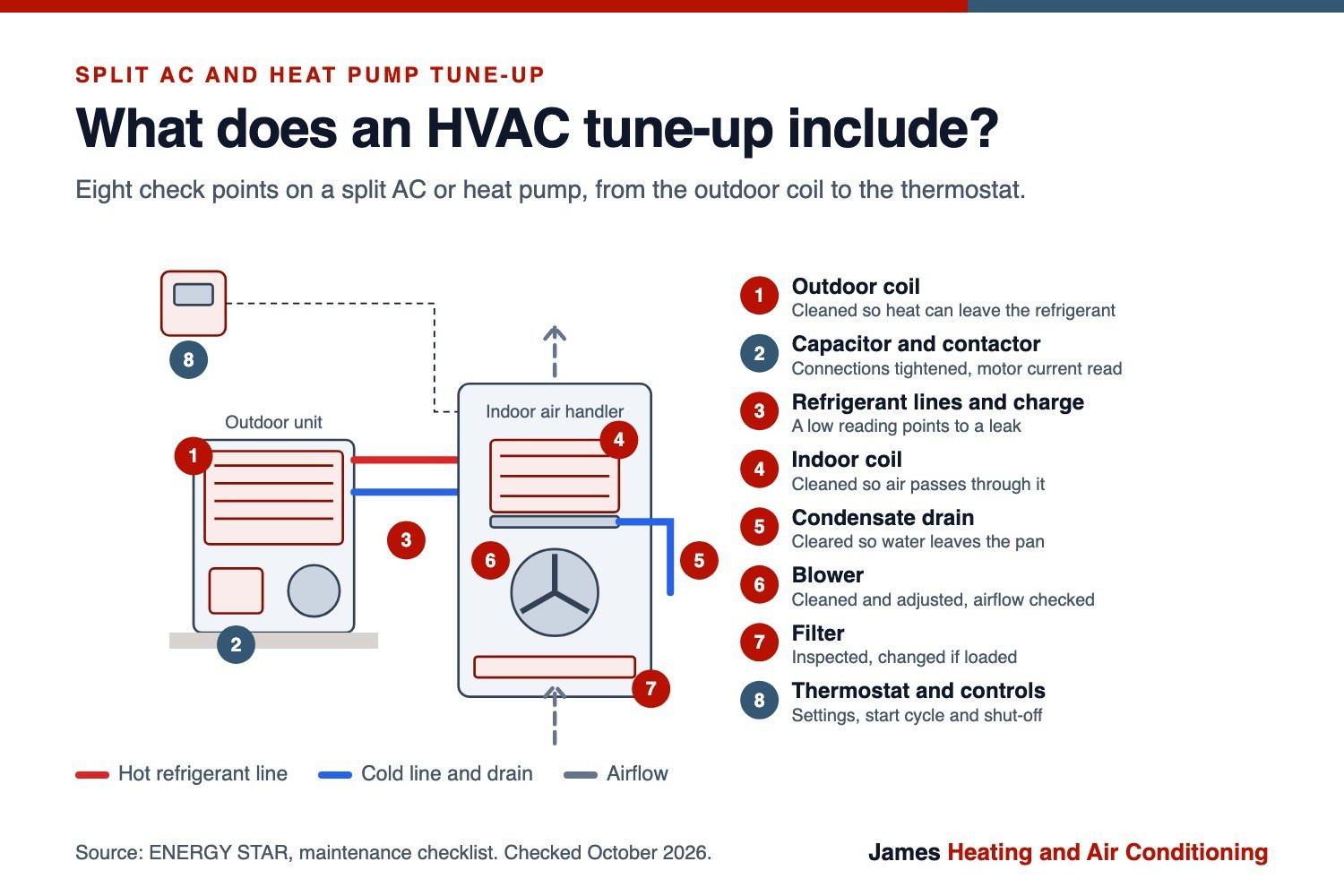
On a cooling or heat pump visit, our technicians clean the coils. We check the refrigerant level and test the thermostat and the start cycle. We inspect the electrical connections and read motor voltage and current. We check the condensate drain and clear it if it runs slow. ENERGY STAR covers these tasks in its maintenance checklist, and the Department of Energy covers the central heat pump version. ANSI/ACCA 4 QM, the residential maintenance standard that ANSI reaffirmed in 2024, sets minimum inspection tasks so you can compare one company’s visit with another’s. Its full task list sits behind a copyright click-through, so each row below names ENERGY STAR or DOE as the source.
| Check | AC | Gas furnace | Heat pump | Why it matters |
|---|---|---|---|---|
| Thermostat settings and operation | Yes | Yes | Yes | Keeps the home comfortable when you’re in and saves energy when you’re out |
| Electrical connections tightened, motor voltage and current measured | Yes | Yes | Yes | Loose connections can make a system unsafe and shorten part life |
| Moving parts lubricated (only where the maker calls for it) | Yes | Yes | Yes | Dry parts add friction and raise electricity use |
| Condensate drain checked | Yes | Condensing models | Yes (cooling mode) | A clogged drain can cause water damage and affect indoor humidity |
| Controls and start cycle | Yes | Yes | Yes | Confirms the system starts, runs and shuts off properly |
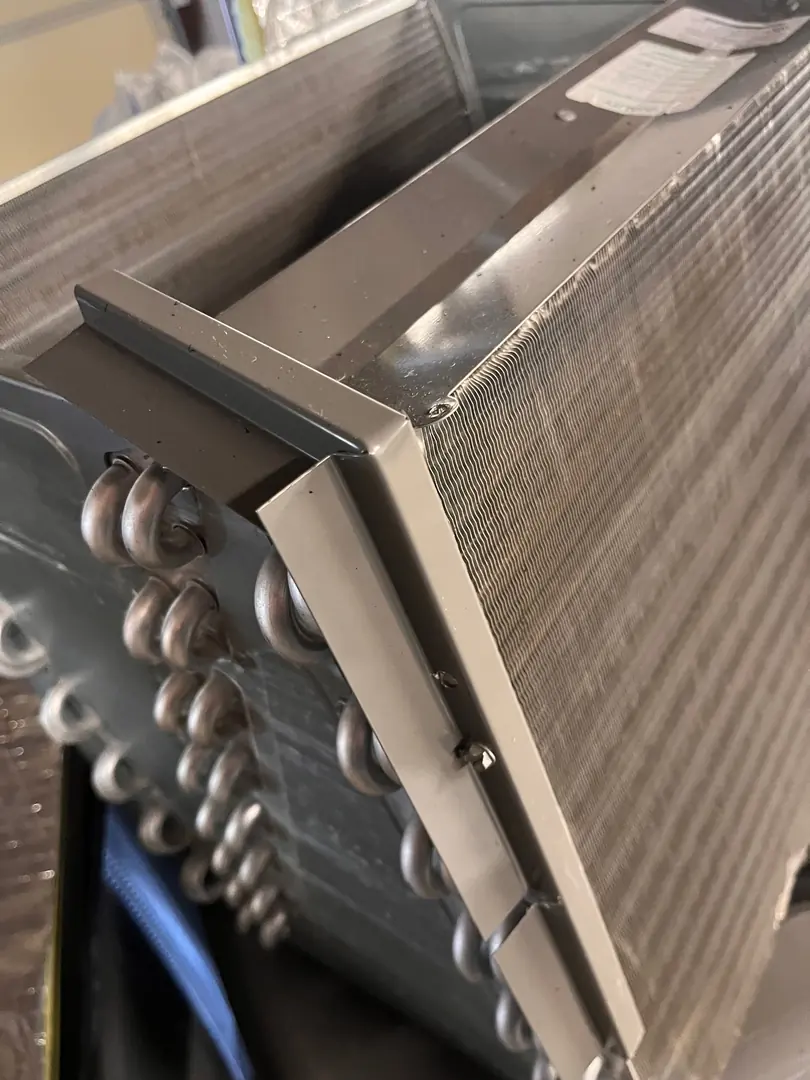
| Evaporator and condenser coils cleaned | Yes | No | Yes | Dirty coils make the system run longer and shorten equipment life |
| Refrigerant level checked | Yes | No | Yes | A wrong charge, high or low, cuts efficiency and equipment life |
| Blower cleaned and adjusted, airflow checked | Yes | Yes | Yes | ENERGY STAR says airflow problems can cut efficiency by up to 15 percent |
| Filter inspected | Yes | Yes | Yes | A dirty filter raises energy costs and can lead to early failure |
| Gas connections and gas pressure | No | Yes | No | Faulty connections are a fire hazard |
| Burner combustion | No | Yes | No | A dirty burner makes operation less safe and less efficient |
| Heat exchanger inspected | No | Yes | No | A cracked heat exchanger makes operation unsafe |
DOE’s central heat pump checklist adds ductwork and the drain pan to the heat pump column. It also says newer fan motors are often sealed, so a technician oils one only if the maker’s instructions say to, which is why the lubrication row carries a condition. A dual-fuel system, a heat pump paired with a gas furnace, gets both columns, and we service both halves.
What should I have in hand after the visit?
You should have a written record of the readings taken, the parts cleaned and anything flagged for repair with a price attached. We recommend you ask for one when you book and file it with the equipment manual. We quote repairs in writing after the visit. Dated service records are the paperwork you want if you ever make a warranty claim, and your model’s warranty sheet states what it requires.
What does a gas furnace tune-up check that an AC tune-up does not?
A gas furnace tune-up adds three checks an AC never needs, gas connections and pressure, burner combustion and the heat exchanger.
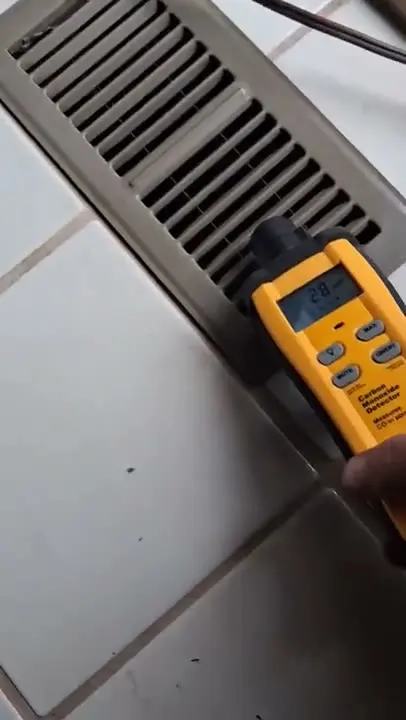
The Consumer Product Safety Commission goes further and urges a yearly professional inspection of every fuel-burning heating system. A cracked heat exchanger or a dirty burner gives you no warning you can see or smell, so the inspection has to find it. Our technicians check the gas connections and pressure at the valve. We inspect the burners and the heat exchanger. We test the safety switches, and a safety switch should never be bypassed to get heat back.
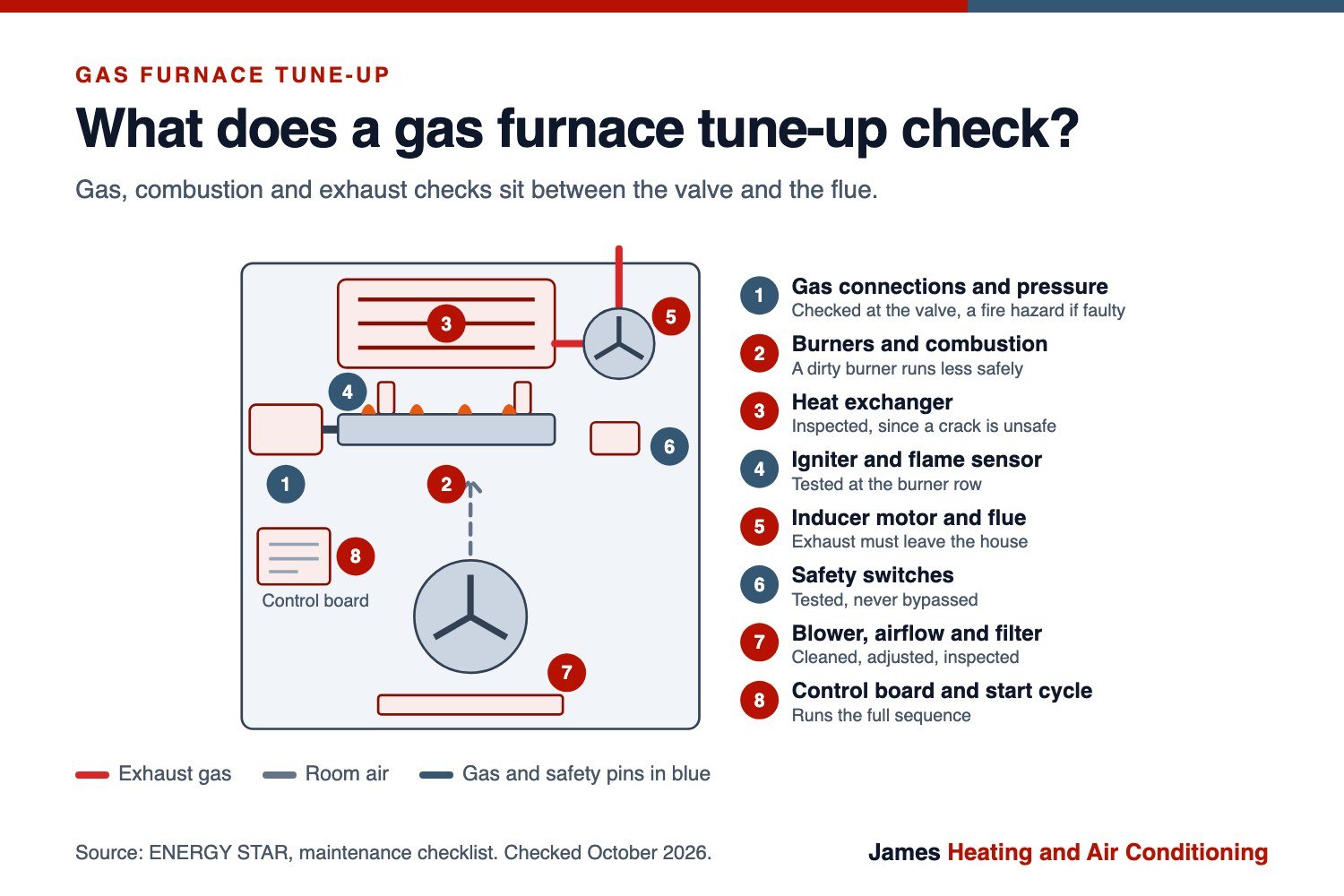
The rest of a furnace visit matches an AC visit. We check the thermostat and the electrical connections. We test the controls and the airflow and inspect the filter. On a condensing furnace we clean the condensate drain too. Which of those jobs can you take on yourself?
What can I check myself, and what needs a licensed technician?
You can check the filter and the area around the outdoor unit yourself, and a licensed technician handles refrigerant, electrical and gas work.
ENERGY STAR covers filter care and says to inspect, clean or change filters monthly, and how often to change your air filter depends on the filter type and your household. Outdoors, keep plants and debris back from the unit and never cover a heat pump, because it runs year-round. Indoors, keep storage out of the furnace closet. Your equipment needs air around it.
Refrigerant is different. The EPA requires Section 608 certification for anyone who handles it, and a low reading means a leak, because refrigerant isn’t consumed. Our technicians hold that certification when they handle refrigerant. We handle your electrical and gas work too. James Heating & Air Conditioning works under Oregon CCB #47396. Once you know who does what, when should the visit happen?
How often should I schedule an HVAC tune-up?
Schedule one HVAC tune-up a year for an AC or a gas furnace, and two for a heat pump.
ENERGY STAR covers the calendar in two halves, cooling in spring and heating in fall, because contractors get busy once summer and winter arrive. A heat pump does both jobs with the same outdoor unit and coils, so we service it in both seasons and recommend a visit in each. We run the cooling check in spring and the heating check in fall. A home with a gas furnace and a separate AC has two systems and two seasons, so you need one visit for each, and a dual-fuel home works the same way.
Why does the calendar matter that much? Worn parts fail when the system works hardest.
Why is HVAC maintenance important?
HVAC maintenance matters because it protects efficiency, safety and uptime, and clean coils, correct airflow and a safe burner all come from regular visits.
Airflow and coil condition drive efficiency. ENERGY STAR covers airflow too, and says problems can reduce efficiency by up to 15 percent, and that dirty coils keep the system running longer while shortening its life. Refrigerant charge works the same way, since too much or too little costs efficiency and equipment life. Our technicians check the airflow and the charge on every cooling visit.
Safety is the stronger reason on a gas furnace, where the heat exchanger and the burners decide whether exhaust stays in the flue. We inspect both on every gas furnace visit. Breakdowns are the reason you feel it. A worn contactor or weak capacitor is a small part when a tune-up catches it, and a no-cool call when it fails in July. We replace those parts on a repair visit, and maintenance lowers the odds of needing one. It doesn’t remove them, because parts can still fail between visits. So does the visit pay for itself?
Is an HVAC tune-up worth it?
An HVAC tune-up is worth it for gas furnaces, heat pumps and older equipment, and worth less on a young AC with a clean filter habit.
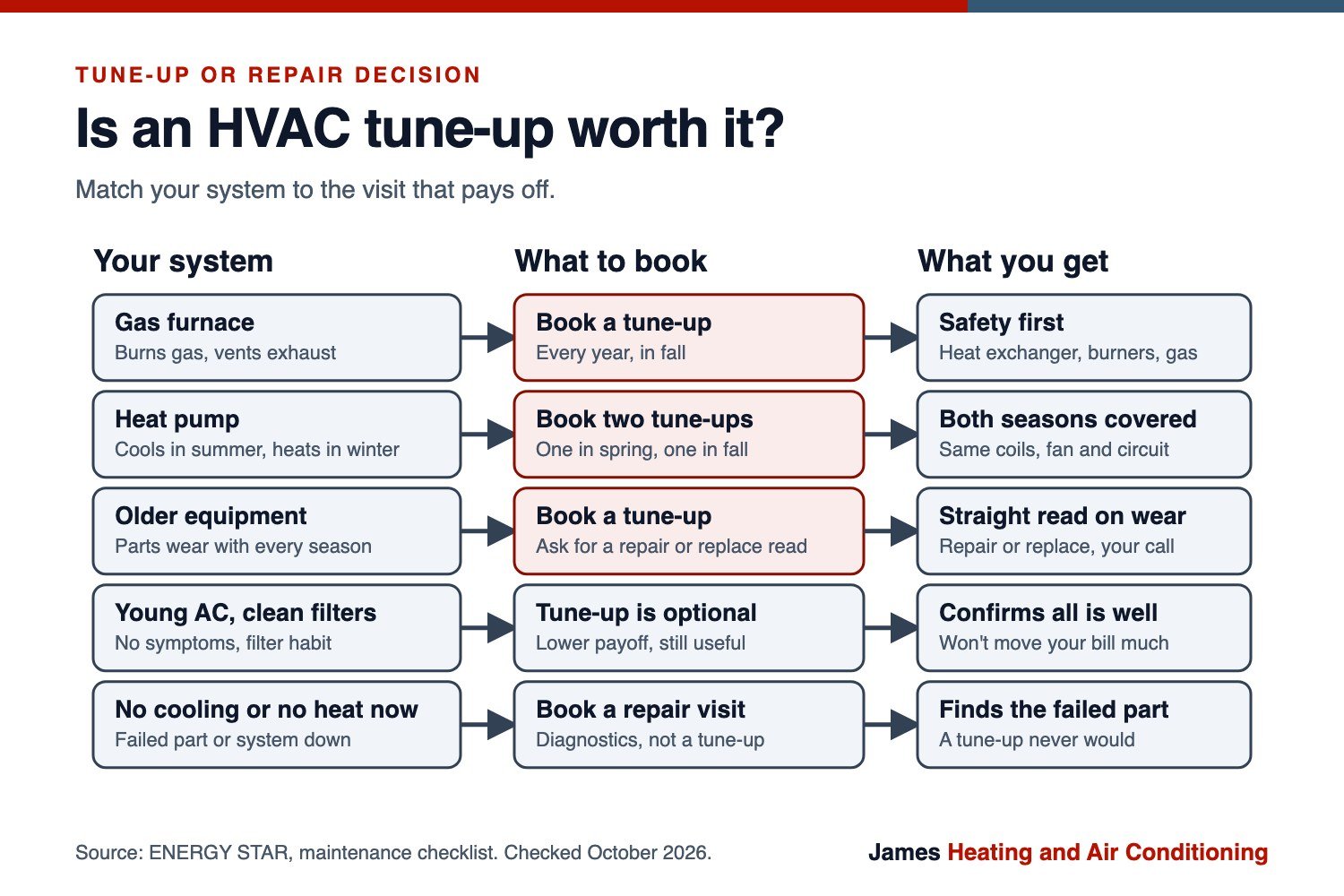
On a gas furnace the visit is a safety inspection first and an efficiency check second. On a heat pump it matters because the same outdoor unit works through summer and winter, so you have no off season to wait out. On older equipment we inspect what is wearing and give you a straight read on whether repair or replacement makes more sense. We run that comparison with you when the numbers are close.
The payoff is smaller on a young AC with no symptoms. We inspect a young AC the same way and tell you plainly when nothing is wrong. The visit mostly confirms that, which has value, but it will not move your bill much. No tune-up saves energy beyond what the equipment was built to deliver. It only restores what neglect took away. What will you pay for it?
How much does an HVAC tune-up cost?
An HVAC tune-up costs about $150 to $350 for most homeowners, with a national average of $275, according to Fixr’s 2026 cost guide.
| System | National guide range |
|---|---|
| Central AC tune-up | $70 to $200 |
| Furnace tune-up | $70 to $300 |
| Heat pump tune-up | $75 to $150 |
| Yearly service plan | $150 to $500 |
Plans usually discount repairs rather than cover them. These are national figures from one publisher, not a James quote. Oregon labor rates, your equipment and the scope of the visit move the number, and Fixr bills duct cleaning, duct sealing and major parts separately. Compare quotes by scope, because the same $150 can buy a filter swap and a quick look or a measured service with coils cleaned. We quote after the visit, in writing, so call us for a quote on your system.
What is the difference between a tune-up and a repair?
A tune-up finds wear before it fails, and a repair visit replaces a part that has already failed.
Mixing them up is how you end up disappointed by a tune-up that was never going to fix a dead compressor. We clean a dirty coil at a tune-up, and we replace a worn contactor at a repair visit.
| Situation | At a tune-up | At a repair visit |
|---|---|---|
| Dirty coil or slow condensate drain | Cleaned and cleared | Not needed |
| Worn contactor or weak capacitor | Measured and flagged | Part replaced |
| Low refrigerant reading | Level checked; a low reading points to a leak | Leak located and repaired, charge restored |
| Failed compressor or blower motor | Not a tune-up job | Diagnosed and quoted for repair or replacement |
| No cooling or no heat right now | Not a tune-up job | Diagnostic visit |
We diagnose a no-cool or no-heat call as a repair visit, never as a tune-up. If your system is already misbehaving, book HVAC diagnostics and repair instead of waiting for a tune-up slot. How do you know the visit you paid for was a real one?
How can I tell a tune-up was rushed?
A rushed tune-up skips measurements, so look for readings, a full run cycle and written findings.
- The system never ran through a full cycle while the technician was there.
- Nobody measured anything, with no motor voltage or current and no refrigerant reading.
- The outdoor coil was not cleaned or at least looked at, and the drain was never mentioned.
- You got no written findings.
- A replacement pitch arrived before any measurement did.
Any one of those means the visit skipped something the published lists treat as standard. We run the system through a full cycle before we leave, and our technicians check the outdoor coil and the drain on every visit. Where do we do that work?
Who does HVAC tune-ups in Eugene and Salem?
James Heating & Air Conditioning does tune-ups across Eugene, Salem and the towns around them, and every technician works from the same checklist.
We serve Lane County and Marion County homes. What changes is the weather your equipment lives through. Summers in the Willamette Valley are dry, and the heating season stretches from fall deep into spring, so furnaces and heat pumps put in a long stretch of run time. Fall service matters as much as spring here.
Our Eugene office covers Eugene, Springfield, Junction City, Veneta, Cottage Grove, Florence and the towns around them. In the Eugene and Lane County area, call (541) 461-2101, or see HVAC service in Eugene and Springfield. Our team answers that line around the clock.
Our Salem office covers Salem, Keizer, Albany, Lebanon, Corvallis, Silverton and nearby towns. In the Salem area, call (503) 581-9982, or see HVAC service in Salem. Our team answers that line around the clock too.
Frequently asked questions
Do heat pumps need maintenance twice a year?
Yes, we service a heat pump twice a year. It cools in summer and heats in winter, so both seasons put wear on the same coils, fan and refrigerant circuit.
How long does an HVAC tune-up take?
It depends on the system and on what the technician finds, so ask the company for its expected window when you book. Be wary of any visit that ends before the system has run through a full cycle.
Will a tune-up lower my energy bill?
Only if something was dragging the system down. ENERGY STAR ties airflow problems to efficiency losses of up to 15 percent, so a clogged filter or blower can show up on your bill. A healthy system won’t use less energy than its rating after a tune-up.
Is a tune-up the same as duct cleaning?
No. Duct cleaning is a separate service, and the EPA covers it in guidance saying it should be done only as needed, meaning visible mold, vermin or excessive dust and debris. We offer duct cleaning separately when one of those applies.
Does a tune-up include adding refrigerant?
Our technicians check the level and adjust it if needed, as ENERGY STAR describes. A system that needs refrigerant has a leak, so ask whether a leak search and the refrigerant itself are priced separately from the base visit.
Can maintenance prevent every breakdown?
No. A tune-up catches wear that can be measured, such as a weakening capacitor or a slow drain. It can’t predict a part that fails between visits.
Call James Heating & Air Conditioning
James Heating & Air Conditioning has served Eugene since 1983 and works under Oregon CCB #47396. We answer around the clock. Call Eugene at (541) 461-2101 or Salem at (503) 581-9982, or start from preventative maintenance and ask us for the written checklist for your equipment.